
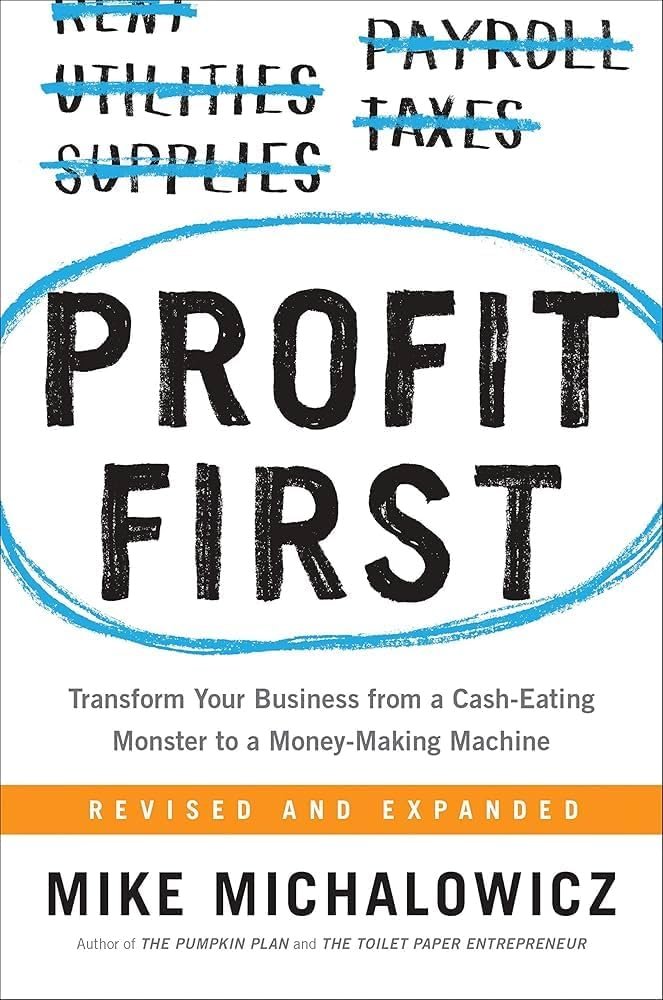
Discover Profit First principles — the small-plate cash system that forces profitability. Practical allocations, steps, and real examples to make profit habitual
Why Profit First matters
If you’re an entrepreneur, you’ve probably experienced the cycle: sales spike, expenses swell, and at month-end profit is nowhere to be seen. Mike Michalowicz’s Profit First argues that this pattern isn’t accidental — it’s the default. The fix is counterintuitive but elegant: take profit first, then live on what’s left. The handwritten summary you gave me maps this concept into a practical, bank-account driven system that forces discipline and prevents profit from being an afterthought.
The simple idea: change the math
Traditional formula:
Sales − Expenses = Profit
Profit First turns it into:
Sales − Profit = Expenses
The mental shift is enormous. When you allocate profit first, you force the business to operate within smaller, realistic means — you effectively put your own company on a “small plate” so it consumes less. Your notes capture this visually: large plate → small plate analogy
Core Principles
Your summary lists four core Profit First principles :
-
Use a small plate — shrink the amount available to spend so you naturally limit waste.
-
Serve sequentially — allocate funds in a strict order (profit first, then other accounts).
-
Remove temptation — use multiple bank accounts to lock funds away.
-
Enforce a rhythm — set a regular cadence for allocating and transferring funds (daily/weekly/monthly and quarterly).
These are practical behavioral hacks disguised as accounting. They make the human tendency to overspend irrelevant.
The account system — 5 foundational bank accounts
Michalowicz recommends five core accounts :
-
Income Account — all deposits go here first (daily/bi-weekly).
-
Profit Account — the portion reserved as owner profit/savings.
-
Owner’s Pay (or Payroll) Account — pay the owner(s) from here.
-
Tax Account — money saved for tax obligations.
-
Operating Expense (OPEX) Account — what’s left to run the business.
Your notes also show the flow diagram where revenue flows into the Income account and gets allocated across these accounts according to target percentages.
Step-by-Step Implementation
Step 1 — Set up accounts
Open the five bank accounts at different banks if possible (helps remove temptation and makes transfers slightly more “costly”/deliberate).
Step 2 — Determine target allocation percentages
Start small. The notes recommend starting with a modest profit percentage (e.g., 1–2%) and higher OPEX allocations initially. The document includes a target allocation table across revenue bands . Typical target ranges (for later stages) might be:
-
Profit 5–10%
-
Owner’s pay 20–50% (depends on stage)
-
Tax 15%
-
OPEX 30–65%
Percentages shift as revenue grows.
Step 3 — Implement an allocation rhythm
From daily to bi-weekly to monthly: route every income deposit into the Income Account. On pre-set days (e.g., 10th and 25th of each month or weekly), transfer the target percentages into each account.
Step 4 — Gradually increase profit allocation
Every quarter (or month), inch profit allocation up by 1%. This incremental approach compounds into meaningful profitability without shock.
Step 5 — Quarterly profit distribution
Every quarter, distribute a portion of the Profit Account to owner(s) as a reward (your notes suggested 50% distribution vs 50% retained as business buffer). This builds the habit of profitability being a reward rather than a wish.
Step 6 — Reconcile, analyze, and tweak
Analyze allocations each fiscal quarter to move percentages toward the target allocation matrix . Use the data to cut waste and make reality-based budgeting decisions.
Why this works — behavioral & financial rationale
-
Behavioral lock: Separating profit and tax funds into distinct accounts takes temptation out of the equation. When funds are gone (or in a separate account), you can’t pretend they exist.
-
Forced efficiency: Operating on a smaller OPEX allocation forces you to cut nonessential costs and become creative. Your notes repeatedly mention “cut expenses” and “use a small plate” as a behavior change.
-
Profit is prioritized: Quarterly distributions make profit a real, tangible reward — not an accounting entry.
Two real-world example
1. Neighborhood bakery (example adapted from typical Profit First success stories)
A bakery in San Diego struggled — decent sales but late invoices and no owner pay. Implementing Profit First, the owner set up five accounts, started allocating 2% of every sale to profit and 15% to tax, moved owner pay to 20%, and operated the bakery on the remaining 63%. The result: within 6 months the owner stopped taking irregular “emergency draws,” found one supplier contract to renegotiate (cutting cost 8%), and by quarter two distributed a small profit and then increased profit allocation to 4%. The enforced discipline led to clear, comparable monthly budgets and consistent owner pay.
2. Digital marketing freelancer (agency)
A two-person agency moved from unpredictable owner draws to a Profit First cadence. They separated income as it arrived, set aside a tax buffer of 15%, and gave themselves predictable monthly owner pay. Pressure to chase every new tool subsided because the OPEX pool was finite — forcing them to choose the highest ROI tools. Three quarters later they reported consistent monthly salaries, a growing profit buffer, and the ability to invest intentionally in one growth channel instead of dozens of scattered experiments.
Both examples show the psychological relief of predictability and the financial improvement from deliberate constraints.
Quick wins: What to do in the next 30 days
-
Open five accounts (if you don’t already have them). Keep Profit and Tax accounts at separate banks if possible.
-
Decide initial targets — start with Profit 1–2%, Tax 10–15%, Owner Pay whatever covers personal expenses, OPEX the rest.
-
Set calendar reminders for allocation days (e.g., 1st and 15th).
-
Route all income to the Income account from day one.
-
Do not touch the Profit account — treat it as sacred. At quarter-end, distribute a portion to owners (celebrate!).
10 Key Takeaways
-
Profit is a habit, not an event. Start small and scale allocations.
-
Change the math: Sales − Profit = Expenses. Force profitability every time revenue comes in.
-
Use multiple accounts to remove temptation and create clarity (Income, Profit, Owner’s Pay, Tax, OPEX).
-
Start with tiny profit percentages (1–2%) if you must — the key is action.
-
Enforce a rhythm — regular scheduled allocations make it real.
Profit first book summary
-
Use Parkinson’s Law to your advantage: less available cash drives leaner operations.
-
Quarterly profit distribution builds morale and proves the system works
-
Aim for long-term target allocations and use a stepwise approach to reach them
-
Profit First simplifies decision making — with finite OPEX, spending choices must justify themselves. (multiple pages)
-
Discipline beats motivation — systems outlast enthusiasm.
Mistakes to avoid
-
Skipping the small start and demanding instant target percentages (this often leads to failure).
-
Keeping all accounts at one institution — easy internal transfers make the temptation real.
-
Using profit for “just-this-one” emergencies — the point is to keep it sacred.
-
Not measuring and adjusting — allocations should evolve with revenue.
Sample allocation plan (practical template)
Revenue band: $0–$250k
-
Profit: 5%
-
Owner’s Pay: 50% → (for solo operator this includes owner salary; adjust when hiring)
-
Tax: 15%
-
OPEX: 30%
Revenue band: $250k–$1M (target)
-
Profit: 10%
-
Owner’s Pay: 30%
-
Tax: 15%
-
OPEX: 45%
Start at conservative profit (1–2%), then raise profit and owner’s pay gradually while OPEX percentage shrinks by discipline and efficiency.
How to handle objections — the psychological ones
-
“I need cash to grow — I can’t set aside profit.” The system helps you grow on the right foundation; pressured growth that ignores profitability often collapses.
-
“If I set aside profit, I’ll starve the business.” Start with 1% and watch how it forces better decisions. You may find more profitable focus areas emerge.
The ultimate benefit: freedom & choices
Profit First is not about penny-pinching; it’s about giving yourself choices. When you have a profit buffer and predictable taxes, you can negotiate better, invest wisely, hire confidently, or even take a vacation without panic. The notes emphasize this psychological weight-lifting — money outside the operating account is “out of mind,” reducing stress and enabling better leadership
Final checklist to start today
-
Open 5 accounts (Income, Profit, Owner Pay, Tax, OPEX)
-
Deposit all future receipts into Income
-
Choose starting allocations (Profit 1–2%, Tax 10–15%)
-
Schedule allocation days (weekly/bi-weekly/monthly)
-
Start transferring according to plan — be religious about it
-
At quarter end, distribute profit and review allocations
Call to action
If you’re tired of “numbers that lie” and want a system that makes profit inevitable, take this simple first step: open the five accounts today and route tomorrow’s income to the Income account. Implement the 1% profit habit and watch the discipline change the business. Want help mapping allocations for your revenue level? Tell me your monthly revenue range and I’ll sketch a starter allocation plan.
10-point takeaways (concise):
Profit is intentional. Start small. Use 5 accounts. Allocate on schedule. Increase profit slowly. Pay owner predictably. Save for taxes. Operate with OPEX limits. Distribute quarterly. Iterate quarterly.