
Learn Radical Candor — Kim Scott’s framework for honest, caring feedback — with practical steps, real examples, and a 7-step coach’s playbook for managers.
Why Radical Candor matters (Overview)
Managers and team leads are often stuck between two lousy choices: avoid hard truths to protect feelings, or be blunt and wreck relationships. Kim Scott’s Radical Candor offers a third way: give direct, clear feedback delivered from a place of sincere care. It’s not just a technique — it’s the foundation for coaching people to do their best work and for teams to move fast without burning out.
I built much of this post around a careful, handwritten summary uploaded by a reader (notes captured across multiple pages of practical highlights and the GSD — “Get Stuff Done” — wheel). Those notes helped me surface the most useful, actionable parts of the book for managers today.
The core idea: Care personally + Challenge directly
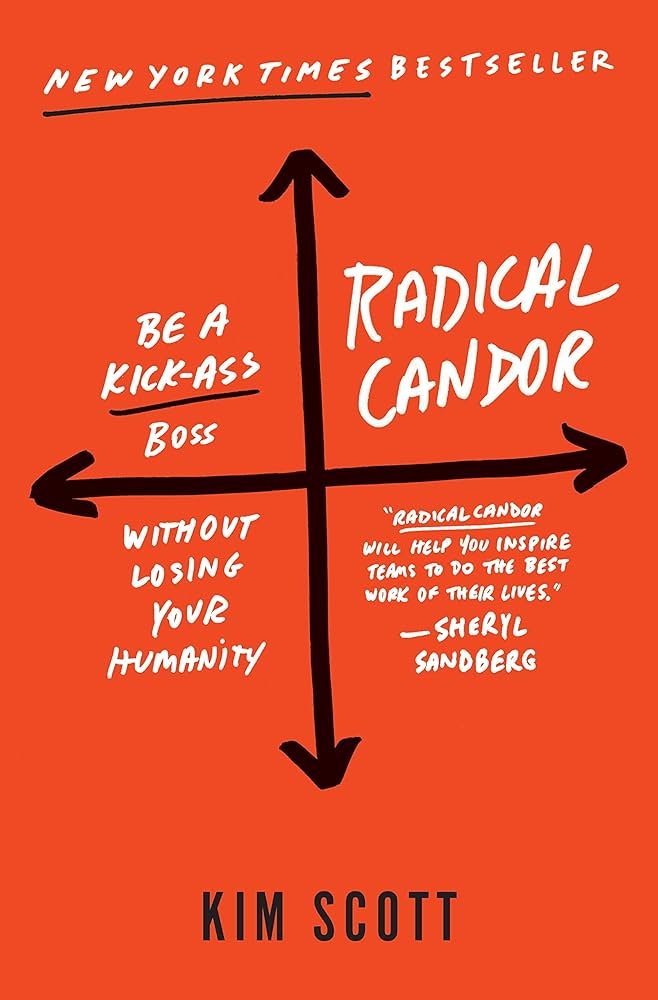
At the heart of Radical Candor are two axes:
-
Care Personally — show you’re a human who values the person beyond output.
-
Challenge Directly — be honest, specific, and timely about performance.
When you combine both, you get Radical Candor (the upper-right quadrant). Other quadrants show leadership traps:
-
Ruinous Empathy (care without challenge): avoids hard feedback; short-term kindness, long-term harm.
-
Obnoxious Aggression (challenge without care): blunt feedback that damages trust.
-
Manipulative Insincerity (neither care nor challenge): political, damaging behavior.
These distinctions appear repeatedly in the notes and are the foundation for everything that follows.
Three practical dialogs every manager needs
Kim Scott emphasizes three conversations that create clarity and alignment — the notes label them as Life Story, Dreams, and Growth Play. These are not one-time chats: they’re frameworks you repeat and refine.
-
Life Story — understand who your team members are, what shaped them, and what motivates them. This helps you tailor coaching and build trust.
-
Dreams — what are they trying to achieve in 1–3 years? Big-picture aspirations let you align opportunities to career goals.
-
Growth Play — concrete next steps: what skills to build, small bets to take, and how you’ll measure progress. This is the tactical plan that converts dreams into growth.
The Get-Stuff-Done (GSD) process
One of the best practical tools in the notes is the GSD wheel — a repeatable process managers can run in meetings and one-on-ones to convert conversation into results.
GSD steps (condensed):
-
Listen — ensure everyone is heard.
-
Clarify — make ambiguous assumptions explicit.
-
Debate — get differing views on the table.
-
Decide — a clear owner and timeline.
-
Persuade — align the team behind the decision.
-
Execute — get to work.
-
Iterate — review and improve.
Notes emphasize the power of listening to create psychological safety, and the necessity of clarity so teams don’t waste time.
How to give (and receive) feedback: Practical tactics
Radical Candor is a practice — here’s a step-by-step guide you can use next time you need to give feedback.
A. Prep (before the conversation)
-
Identify the specific behavior (not personality).
-
Decide the desired change.
-
Consider what the person cares about (their “dreams” or motivators).
B. Delivering the feedback (in-person preferred)
-
Start with care. A short, sincere line: “I care about you and want you to succeed.”
-
Be specific. “In yesterday’s demo, you skipped the customer-impact slide.”
-
Explain impact. “Customers left confused; we lost momentum.”
-
Ask for their perspective. Invite dialogue: “What happened from your view?”
-
Agree next steps. “Let’s rehearse the demo together next time.”
C. Follow up
-
Schedule a short check-in.
-
Praise improvements publicly; correct privately if needed.
Your notes stress being precise and doing this often — not saving feedback for dramatic annual reviews. The “be precise” and “do it in person” capture this beautifully.
Dealing with different employee types
Kim Scott (and the notes) highlight three common types and how Radical Candor looks for each:
-
Superstars — high performers who want stretch assignments. Give clarity and guard their time; help them prioritize.
-
Rock stars — steady, dependable workers. Keep them engaged with concrete goals and appreciation.
-
Falling stars — people losing momentum. Use Radical Candor to diagnose whether they need coaching, role change, or exit.
A manager’s job isn’t to treat everyone the same, but to treat everyone fairly and honestly. The notes emphasize tailoring feedback to the person’s needs and motivators.
Two real-world examples
Example 1 — Priya, product lead at a fintech startup
Priya had a team that missed delivery dates and spiraled into finger-pointing. She adopted Radical Candor:
-
Held Life Story one-on-ones to learn that many developers were juggling parental responsibilities.
-
Introduced weekly GSD check-ins to clarify blockers.
-
When an engineer repeatedly missed test coverage, Priya gave specific feedback in private: “When tests fail in production, customers suffer — let’s pair on test design.” She also recognized improvements publicly.
Result: fewer emergencies, better morale, and a 30% drop in post-release bugs over three months.
Example 2 — Carlos, marketing manager at a mid-size agency
Carlos previously praised everyone to avoid awkward conversations. After reading Radical Candor he:
-
Started giving brief, private coaching on early drafts.
-
Ran monthly “dream” conversations; discovered his junior loved analytics and wanted to move into data-driven roles.
-
Guided a structured Growth Play; within six months she led performance reporting and lifted campaign ROI.
Both stories show how candid, caring conversation accelerates results.
Common traps & how to avoid them
-
Saved-up feedback: Don’t hoard. Frequent micro-feedback works better than big surprises.
-
Public criticism: Always correct privately unless you’re celebrating wins.
-
Ambiguous praise: Be specific. “Great job” is less useful than “Your framing made the client understand ROI.”
-
Lack of follow-up: Feedback without follow-up is empty. Book quick check-ins.
The handwritten notes emphasize patience, listening, and iterative follow-up as central to success
A manager’s checklist (Step-by-step guide)
-
Schedule recurring one-on-ones (30–45 minutes).
-
Start each with a Life Story question (what’s taking energy this week?).
-
Run the GSD process for team decisions.
-
Give both praise and criticism with the Radical Candor formula.
-
Document Growth Plays and review progress every 30–60 days.
-
Practice listening: pause, paraphrase, ask one follow-up.
-
Hold a quarterly formal performance review tied to the smaller frequent checkpoints.
10 key takeaways
-
Radical Candor = Care Personally + Challenge Directly.
-
Be specific and timely; avoid vague annual-only feedback.
-
Use the Life Story / Dreams / Growth Play trio to align careers and work.
-
Run the GSD wheel to turn conversation into decisions.
-
Tailor feedback to the employee type (superstar, rockstar, falling star).
-
Praise in public, critique in private — but be honest in both.
-
Listening is a leadership superpower; practice it intention.
-
Be humble and explicit about intentions when giving crit
-
Follow up: coaching without follow-through wastes time.
-
Radical Candor builds trust that makes teams resilient, fast, and humane.
Final thoughts: Start small, practice daily
Radical Candor is not a one-time workshop — it’s a muscle. Start with two habits this week: (1) run one Life Story conversation and (2) pick one piece of specific feedback to give (and one to ask for). Track the result. Repeat.
If you practice caring personally and challenging directly often enough, you’ll create a culture where hard truths are tools, not weapons — and where people grow faster than they ever thought possible.
Call to Action
Inspired by what you read? Radical Candor can change how your team works and lives. Try the GSD process in your next team meeting, schedule a Life Story one-on-one this week, and pick one small piece of feedback to deliver with care. For more transformational reads in our Book to Life series, explore other titles and start your journey today.
Disclaimer: This post distills and applies ideas from Radical Candor by Kim Scott. The examples and narrative are illustrative; the summary above also references a detailed handwritten summary uploaded by a reader for practical cues and emphasis.