
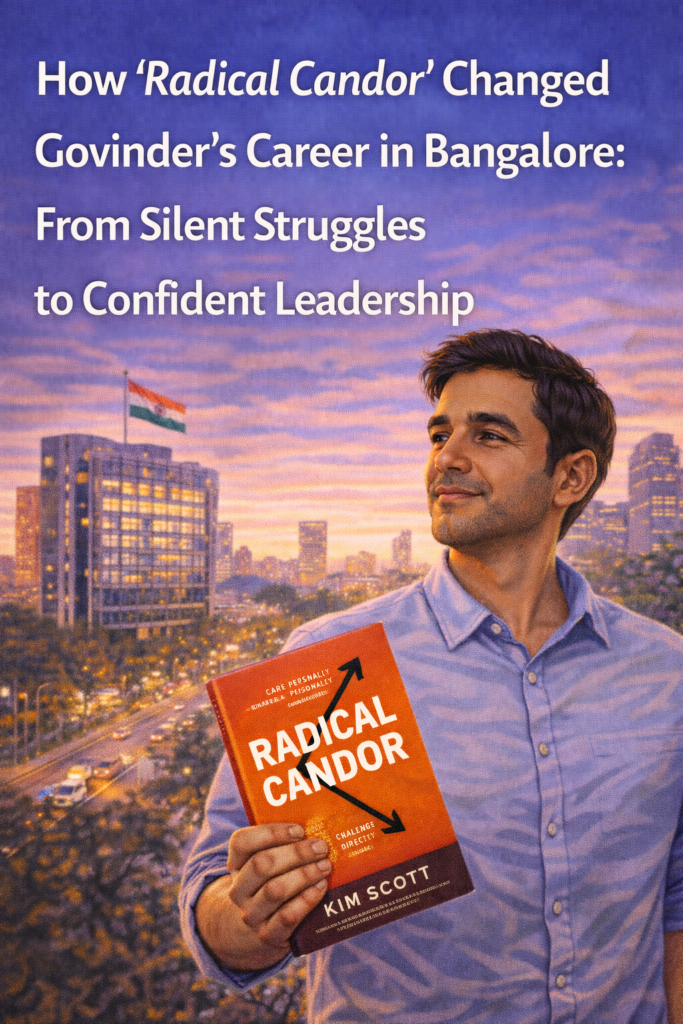
Care Personally. Challenge Directly. How Radical Candor Turned Govinder into a Confident Leader in Bangalore
Life Before Radical Candor
Govinder stared at his laptop screen in a quiet café in Indiranagar, Bangalore. Slack notifications blinked. A half-written performance review sat open. He knew exactly what needed to be said—but his fingers refused to type it.
At 32, Govinder was a mid-level engineering manager in a fast-growing SaaS startup. On paper, life looked perfect: good salary, respected role, exciting company. Inside, however, he was exhausted.
His team missed deadlines. Senior leadership felt he wasn’t “assertive enough.” Junior developers felt confused by vague feedback like “Good effort, let’s try better next time.”
Govinder avoided confrontation. He wanted to be liked. He feared that honest feedback would hurt people, damage relationships, or make him look harsh.
Ironically, his silence was doing exactly what he feared—hurting people and damaging results.
Late nights became routine. Promotions passed him by. One brutal line from his manager echoed in his mind:
“Govinder, you’re technically brilliant—but you don’t challenge your team.”
That sentence stung more than any criticism he had ever avoided giving.
Turning Point: Discovering Radical Candor
The turning point came unexpectedly.
During a leadership workshop hosted by his company, a visiting coach recommended a book: Radical Candor by Kim Scott. The subtitle caught Govinder’s attention:
Be a Kick-Ass Boss Without Losing Your Humanity.
On a Sunday morning, he began reading. Within the first few chapters, he felt exposed.
Kim Scott described four leadership quadrants:
-
Ruinous Empathy
-
Obnoxious Aggression
-
Manipulative Insincerity
-
Radical Candor
Govinder instantly recognized himself in Ruinous Empathy—caring deeply, but failing to challenge directly.
One line hit him hard:
“Silence is not kindness.”
That night, Govinder made a decision. He wouldn’t just read the book. He would live it.
Implementation Phase: Applying Radical Candor Step by Step
Concept 1: Care Personally, Challenge Directly
Govinder realized his mistake wasn’t caring too much—it was caring without courage.
He started small.
Instead of generic praise, he gave specific appreciation:
-
❌ “Good job”
-
✅ “Your database optimization reduced load time by 40%. That directly improved customer experience.”
And when issues arose, he addressed them early:
“I value your contribution, but missing code reviews affects the whole team. Let’s fix this together.”
The tone changed. People leaned in instead of shutting down.
Concept 2: Asking for Feedback Before Giving It
Radical Candor emphasizes soliciting criticism.
Govinder tried something uncomfortable. In his next team meeting, he said:
“I’m working on becoming a better manager. What’s one thing I should do differently?”
The room was silent—then honest.
-
“We don’t always know what success looks like.”
-
“Feedback comes too late.”
-
“We want more clarity.”
Instead of defending himself, Govinder listened.
That moment built trust faster than months of politeness ever had.
Concept 3: Guidance, Not Judgment
Kim Scott explains that feedback should be:
-
Timely
-
Specific
-
Behavior-focused
Govinder stopped labeling people and started addressing actions.
Instead of:
“You’re careless with deadlines”
He said:
“When deadlines slip, QA gets compressed and stress increases. How can we prevent this next sprint?”
The shift from blame to problem-solving changed everything.
Concept 4: One-on-Ones That Actually Matter
Govinder redesigned his one-on-ones using Radical Candor principles:
-
Listening more than talking
-
Understanding personal goals
-
Connecting work to growth
He asked:
-
“What do you want to learn this year?”
-
“What frustrates you most right now?”
-
“How can I support you better?”
For the first time, his team felt seen, not managed.
Concept 5: The Get Stuff Done (GSD) Wheel
Using Kim Scott’s GSD framework, Govinder structured team meetings to:
-
Listen
-
Clarify
-
Debate
-
Decide
-
Execute
-
Learn
Meetings became shorter. Decisions became clearer. Accountability improved.
The Breakthrough: When Everything Changed
The real breakthrough came during a critical client escalation.
A senior developer had shipped buggy code—again. Previously, Govinder would have fixed it himself and stayed silent.
This time, he called a private meeting.
Calm. Respectful. Direct.
“I care about your growth here. But repeated bugs are hurting trust with clients. What’s getting in your way?”
The developer admitted he was overwhelmed and afraid to ask for help.
They restructured responsibilities. Bugs dropped. Confidence rose.
Weeks later, the same developer delivered the cleanest release of the quarter.
Soon after, senior leadership noticed the shift.
Govinder was promoted to Head of Engineering within six months.
Not because he became tougher—but because he became clearer.
Life After Change: A New Version of Govinder
Today, Govinder’s life looks very different.
-
His team performs better and feels safer.
-
Feedback flows openly—up, down, and sideways.
-
Workdays are calmer, not chaotic.
-
Promotions and opportunities come naturally.
Most importantly, Govinder no longer carries the emotional burden of unspoken truth.
Radical Candor didn’t just change how he managed—it changed how he lived.
Reflection: Govinder’s Lessons for You
Govinder often shares these lessons with young professionals in Bangalore:
-
Being nice is not the same as being kind
-
Avoiding discomfort creates bigger problems
-
Honest feedback builds trust, not fear
-
Leadership is a relationship, not a title
-
Care without courage is cruelty in disguise
Call to Action
Inspired by Govinder’s journey?
This is just one story in our Book to Life series.
Pick up Radical Candor by Kim Scott, apply one principle this week, and notice the shift in your conversations, confidence, and career.
Care personally. Challenge directly. Start your own transformation today.