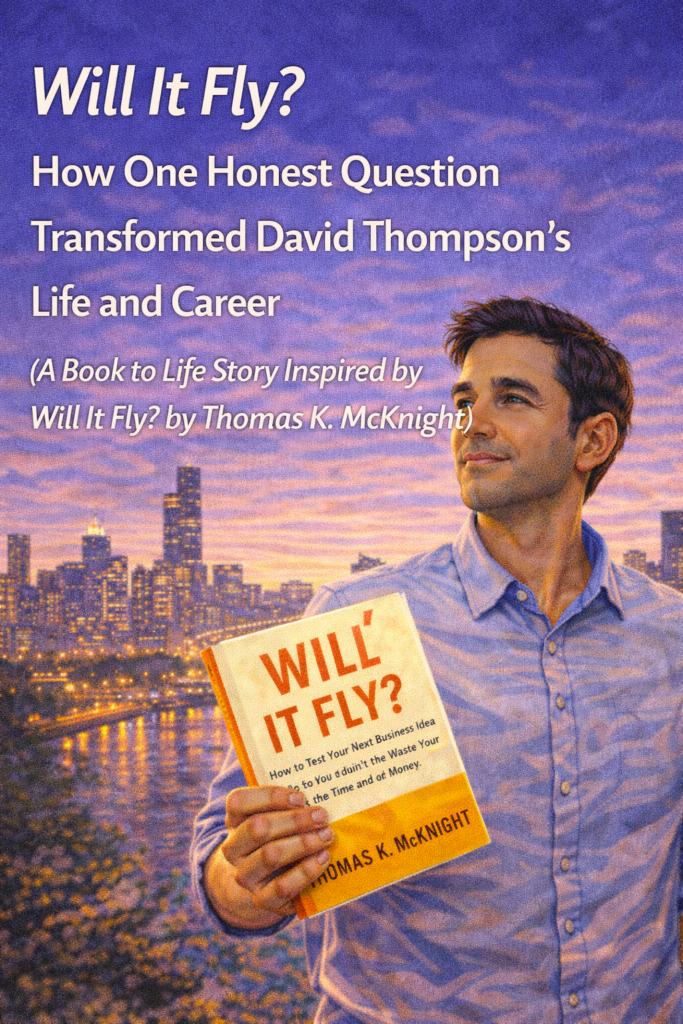
(A Book to Life Story Inspired by Will It Fly? by Thomas K. McKnight)
One Question That Changed Everything
At 2:17 a.m., David Thompson sat alone at his kitchen table in Chicago, staring at his laptop screen.
A half-written business plan.
Three unopened coffee mugs.
A browser filled with tabs titled “Startup Ideas 2025,” “How to Escape the 9–5,” and “How to Become Financially Free.”
David was exhausted—not from working too hard, but from thinking too much.
He had ideas. Plenty of them.
But one fear kept looping in his mind:
“What if I quit my job… and this idea doesn’t work?”
That single question had already stolen two years of his life.
What David didn’t know yet was that another question—simpler, sharper, and more honest—was about to change everything:
Will it fly?
Before the Book: A Life Full of Ideas but No Clarity
David was 34, working as a mid-level operations manager at a logistics firm in downtown Chicago. On paper, he was doing well—steady income, promotions, respect.
Inside, he felt trapped.
Every morning on the Blue Line train, he imagined a different life:
-
Working on something meaningful
-
Building a business of his own
-
Having control over his time
-
Achieving financial freedom without burnout
He tried multiple side hustles:
-
An online productivity blog (abandoned after 6 months)
-
A dropshipping store (lost money)
-
A coaching idea he never launched
The pattern was always the same:
-
Excitement
-
Overthinking
-
Fear
-
Inaction
David didn’t fail because he lacked ability.
He failed because he never validated anything.
The Turning Point: Discovering Will It Fly?
One Saturday afternoon, while browsing Amazon for business books, David stumbled across a title that felt like it was speaking directly to him:
Will It Fly?
The subtitle hit even harder:
How to Test Your Next Business Idea So You Don’t Waste Your Time and Money.
No hype. No false promises. Just honesty.
That night, David ordered the book.
By Sunday evening, he was halfway through—and uncomfortable in the best possible way.
The book wasn’t asking him to dream bigger.
It was asking him to think clearer.
Implementation Phase: Applying the Core Principles of Will It Fly?
Concept 1: The Mission Test – Designing a Business Around Life
The first major concept shook David to his core.
Before markets, before money, before ideas—the book asked:
“What kind of life do you actually want?”
David had never answered that clearly.
So he did the exercise from the book:
-
Ideal work hours: 5–6 hours/day
-
Income goal: ₹2–3 crore equivalent per year within 5 years
-
Freedom to work remotely
-
Low stress, high autonomy
Suddenly, many of his past ideas failed the test.
They could make money—but would cost his health, time, or peace.
This was his first breakthrough:
A business that doesn’t support your life is not success.
Concept 2: The History Test – Has This Problem Existed Before?
David’s new idea was simple:
Helping mid-career professionals transition into remote, skill-based consulting roles.
Instead of building immediately, he tested the idea:
-
Are people already paying for this?
-
Are there books, courses, coaches in this space?
-
Are forums filled with similar questions?
The answer was a strong yes.
Competition, the book taught him, was proof of demand, not a threat.
Concept 3: The P.L.A.N. Framework – Understanding Real Problems
David applied the P.L.A.N. framework from Will It Fly?:
-
P – Problems:
“I hate my job but don’t know what to switch to.” -
L – Language:
He used exact phrases from Reddit, LinkedIn comments, and forums. -
A – Anecdotes:
Stories of people stuck in safe but unfulfilling careers. -
N – Needs:
Clarity, confidence, and a realistic transition path.
This changed everything.
He stopped talking about features and started talking about feelings and outcomes.
Concept 4: Validation Before Creation – Don’t Build, Test
Instead of building a website or course, David followed the book’s most powerful advice:
Validate before you create.
He did three things:
-
Messaged 20 professionals on LinkedIn
-
Asked simple questions
-
Offered free clarity calls
The response shocked him.
People were eager.
They opened up.
Some even asked, “Can I pay you for this?”
That’s when David realized:
The market was already asking for the solution.
Concept 5: The Pre-Sell Test – Confidence, Not Greed
David created a simple Google Doc outlining a 6-week transition framework and offered it as a paid beta program.
No website.
No branding.
No perfection.
Within 10 days:
-
7 people signed up
-
3 paid upfront
-
2 referred friends
David had his answer.
It flew.
The Breakthrough: From Fear to First Real Win
The real crossover moment came three months later.
David earned more from his validated side business in one month than he made at his job.
But more importantly:
-
He felt calm
-
He felt clear
-
He felt in control
For the first time, he wasn’t guessing.
He wasn’t hoping.
He was building with certainty.
Six months later, he resigned—without panic.
Life After Change: A Business Built on Clarity, Not Chaos
Today, David runs a consulting and mentoring business helping professionals redesign their careers.
His life looks very different:
-
Works remotely from Chicago or while traveling
-
Controls his schedule
-
Consistent income
-
Low stress, high impact
And the biggest shift?
He never builds anything without asking: Will it fly?
Reflection: David’s Advice to Anyone with an Idea
“If I could go back and talk to my younger self,” David says,
“I’d tell him this:
Don’t fall in love with your idea.
Fall in love with testing the truth.
Fear comes from uncertainty.
Clarity comes from validation.”
Lessons from Will It Fly? Applied in Real Life
-
Design life first, business second
-
Validation beats motivation
-
Competition proves demand
-
Talk to people before building
-
Language matters more than features
-
Pre-selling saves time and money
-
Failure early is success
-
Simplicity scales faster
-
Clarity reduces fear
-
One honest question can change your life
Final Call to Action
Inspired by David’s journey?
This is just one story in our Book to Life series inspired by Will It Fly? by Thomas K. McKnight.
📘 Read the book.
🧠 Ask better questions.
🚀 Test before you leap.
Your idea doesn’t need motivation.
It needs validation
Disclaimer
This story is hypothetical and created only to demonstrate how the concepts from the book Will It Fly? by Thomas K. McKnight can be applied in real life through a story format.