
How Doing the Simple Things Right Can Create Extraordinary Results in Life, Work, and Leadership
Why The Checklist Manifesto Matters More Than Ever
In a world overflowing with information, expertise, and technology, we still make avoidable mistakes.
Planes crash.
Surgeries go wrong.
Projects fail.
Businesses bleed money.
Not because people are incompetent—but because complexity overwhelms even the best experts.
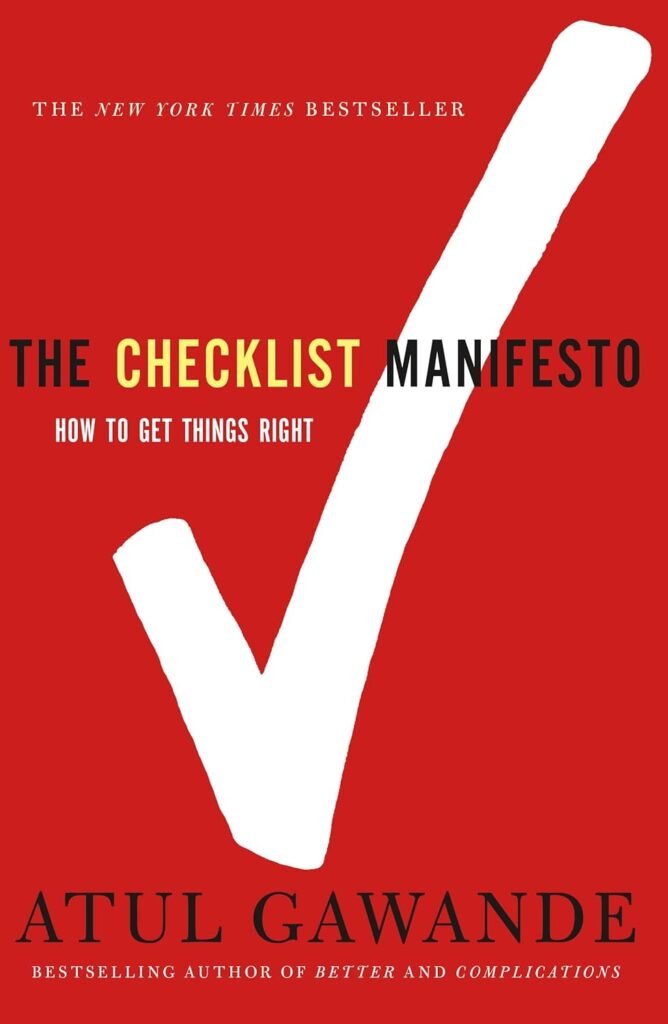
That is the powerful insight behind The Checklist Manifesto by Dr. Atul Gawande, a renowned surgeon, public health researcher, and writer. Through gripping real-life stories from hospitals, aviation, construction, and business, Gawande proves one counterintuitive truth:
Most failures don’t happen due to ignorance—but due to omission.
This book is not about dumbing down work.
It’s about protecting excellence from human error.
Whether you are:
-
an entrepreneur or startup founder,
-
a manager or leader,
-
a doctor, engineer, or consultant, or
-
someone simply trying to get more done with fewer mistakes—
this book changes how you work forever.
how checklists act as a discipline against human fallibility, especially in complex environments
The Core Problem: Why Smart People Make Stupid Mistakes
Atul Gawande explains that mistakes fall into two broad categories:
1. Errors of Ignorance
When we don’t know what to do.
2. Errors of Ineptitude
When we know what to do—but fail to do it.
Modern professionals mostly suffer from the second type.
Your notes explain this beautifully:
“Despite training, experience, and intelligence, we forget small but critical steps.
In hospitals, for example:
-
Doctors forget to wash hands
-
Teams fail to confirm patient identity
-
Simple steps are skipped under pressure
The result?
Half of medical errors are preventable.
And the same pattern repeats in:
-
startups,
-
marketing campaigns,
-
financial planning,
-
hiring,
-
project execution.
Key Insight #1: Complexity Is the New Enemy
Earlier, most work was simple:
-
Follow rules
-
Apply formulas
-
Repeat steps
Today, most work is complex:
-
Many moving parts
-
Unpredictable outcomes
-
High dependency on teamwork
Gawande explains three types of problems :
| Problem Type | Example | Solution |
|---|---|---|
| Simple | Baking a cake | Recipe |
| Complicated | Sending a rocket to space | Expertise |
| Complex | Raising a child / Running a business | Judgment + Adaptability |
Checklists shine not in simple tasks, but in complex systems, where even experts can fail.
Key Insight #2: The Power of the Checklist
A checklist is not:
❌ a to-do list
❌ micromanagement
❌ lack of trust
A checklist is:
✅ a memory aid
✅ a discipline tool
✅ a safeguard against stress and distraction
As your notes highlight:
“Checklists help people perform better, even experts.”
Real-Life Example #1: How a Simple Checklist Saved Thousands of Lives
The Surgical Checklist Story
Gawande helped design a 19-item surgical checklist used before, during, and after surgery.
It took:
-
60 seconds
-
No new technology
-
No expensive equipment
Results across 8 hospitals worldwide:
-
Complications reduced by 36%
-
Deaths reduced by 47%
Why it worked:
-
Encouraged team communication
-
Forced pause at critical moments
-
Made responsibility shared, not assumed
Key Insight #3: Checklists Work Only When Designed Correctly
Not all checklists are effective.
From your notes and the book, effective checklists must follow 4 rules:
1. Clear Pause Points
Checklist must be used at moments of highest risk.
2. Short & Focused
-
5–9 items max
-
Under 60 seconds
3. Simple Language
-
Plain words
-
No jargon
4. Action-Oriented
Each item should demand a clear action.
Your notes emphasize:
“Checklist should be simple, practical, and field-tested.”
Real-Life Example #2: Aviation—The Gold Standard of Safety
Aviation is one of the safest industries in the world.
Why?
Pilots—despite thousands of flying hours—never skip checklists.
Before every takeoff:
-
Confirm flaps
-
Verify fuel
-
Cross-check instruments
-
Communicate with co-pilot
Your notes reference airline accidents caused by skipping one small step, reinforcing the idea that confidence is dangerous without discipline
Key Insight #4: Checklists Improve Team Communication
One underrated benefit of checklists is psychological safety.
When everyone follows a checklist:
-
Junior staff can speak up
-
Authority barriers reduce
-
Teams collaborate better
This principle applies directly to:
-
business meetings,
-
startup teams,
-
family businesses,
-
hospitals,
-
factories.
Checklists replace hierarchy with clarity.
Key Insight #5: Checklists Don’t Replace Thinking—They Enable It
Gawande makes a crucial distinction:
Checklists are not substitutes for judgment.
They are tools that free mental space for judgment.
Instead of worrying about basics, your brain focuses on:
-
creativity,
-
strategy,
-
decision-making.
Action Plan: How You Can Apply Checklist Thinking Today
Here’s how readers can implement this philosophy immediately.
Step 1: Identify High-Risk Repetitive Tasks
Examples:
-
Client onboarding
-
Investment decisions
-
Content publishing
-
Product launches
-
Hiring employees
Step 2: Write a First Draft Checklist
Ask:
-
What do I usually forget?
-
What causes the most errors?
Step 3: Keep It Short
-
Max 7 items
-
Only critical steps
Step 4: Test It in Real Life
-
Use it daily
-
Refine based on feedback
Step 5: Make It a Habit
Consistency beats intelligence.
Lessons Learned from The Checklist Manifesto
-
Expertise alone is not enough
-
Complexity demands discipline
-
Small steps prevent big failures
-
Checklists reduce stress and errors
-
Team communication improves performance
-
Failure is often procedural, not personal
-
Simple systems outperform complex rules
-
Humility is the foundation of mastery
-
Consistency creates excellence
-
Discipline is freedom
Step-by-Step Guide: Build Your First Checklist
Example: Business Decision Checklist
-
Is the goal clearly defined?
-
Have I verified assumptions?
-
Have I consulted someone smarter?
-
What’s the worst-case scenario?
-
Is timing right?
-
Do I have resources?
-
Final confirmation before execution
Who Should Read This Book?
-
Entrepreneurs
-
Doctors & healthcare professionals
-
Managers & leaders
-
Engineers
-
Investors
-
Students
-
Anyone serious about excellence
Call to Action
If you want fewer mistakes, calmer execution, and consistent success—
start with a checklist today.
Read The Checklist Manifesto by Atul Gawande and begin building systems that protect your best work—even on your worst days.
Final Thought
“We don’t rise to the level of our talent.
We fall to the level of our systems.”
And checklists are one of the most powerful systems ever created