Book Summary | Personal Finance | Investing | Financial Freedom | Wealth Building | Personal Development
The market will move. Your emotions will move. Your financial plan should not have to move with them.
Imagine opening your investment account on a Monday morning and seeing that your portfolio has suddenly fallen.
Your first thought is not about your long-term financial goal.
It is:
“Should I sell?”
You check the news.
The headlines are frightening.
You call a friend.
Everyone has a different prediction.
One person says a crash is coming. Another says the market is about to recover. Social media is full of opinions.
Within minutes, years of disciplined investing can be put at risk by one emotional decision.
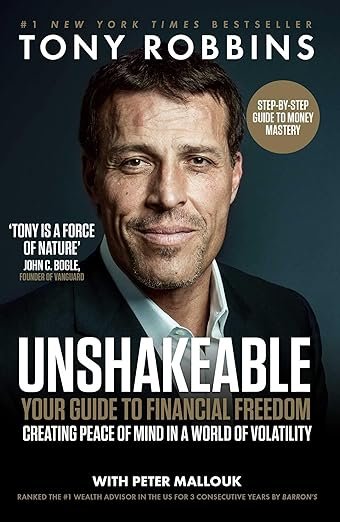
This is the problem at the heart of Unshakeable: Your Financial Freedom Playbook by Tony Robbins and Peter Mallouk.
The book isn’t simply about choosing investments. It is about developing a financial strategy—and the psychological discipline required to follow it when markets become frightening. The official publisher describes the book as a practical guide to financial freedom covering market volatility, hidden fees, retirement planning, diversification and the “Core Four” principles used by successful investors.
And perhaps its most important message is this:
You cannot control the market, but you can control how you prepare for it and how you respond to it.
Note: You wrote the title as “Ushakable” and “Toney Robins.” The correct title is Unshakeable, and the book is by Tony Robbins and Peter Mallouk. I could not locate an uploaded Unshakeable notes file among the files currently available in this conversation, so this article is based on the book’s official publisher/author material and supporting sources rather than claiming to reproduce your missing notes.
What Is Unshakeable by Tony Robbins About?
Unshakeable is a personal finance and investing book focused on helping ordinary investors build a strategy for financial freedom while remaining calm during market uncertainty.
Robbins and Mallouk organize the ideas around three broad areas:
- Understanding the financial rulebook
- Using the Unshakeable playbook
- Developing an unshakeable mindset
The book’s official publisher specifically highlights the “Core Four” principles and the importance of understanding fees, diversification, market corrections, retirement planning and investor psychology.
The book is especially useful for people who:
- worry about stock-market crashes
- don’t know how to construct a long-term portfolio
- pay too much in investment fees
- constantly react to financial news
- are approaching retirement
- want financial independence
- struggle with emotional investing
- want a simple framework for long-term wealth creation
Why This Book Matters: The Biggest Problem May Be the Investor
Suppose you invest for 20 years.
Your investments experience:
- bull markets
- bear markets
- recessions
- political uncertainty
- inflation
- economic expansions
- market corrections
You cannot control any of these things.
But you can control:
your savings, your asset allocation, your diversification, your costs and your behavior.
That distinction is incredibly important.
Many investors don’t lose money because they don’t know anything about investing.
They lose money because they react emotionally at the worst possible time.
The book therefore treats psychology as a central part of investment success. The official publisher specifically discusses emotional mistakes and the need to “silence the enemy within.”
Lesson 1: Understand That Market Corrections Are Normal
One of the first ideas in Unshakeable is that market declines aren’t extraordinary events.
They are part of investing.
The publisher describes market corrections as a recurring feature of markets rather than something investors should be shocked by.
This changes your mindset.
Instead of thinking:
“The market is falling. Something has gone terribly wrong.”
You begin thinking:
“Market declines are part of the environment I invested in.”
That doesn’t mean every decline should be ignored.
It means your investment plan should be designed with the expectation that difficult periods will happen.
Lesson 2: Winter Is Coming—But You Don’t Know When
The book uses the metaphor of winter to describe market downturns.
You know winter will arrive.
You simply don’t know exactly when.
The same principle applies to market corrections and bear markets.
You shouldn’t build a financial plan that works only when markets rise.
You need a strategy capable of surviving difficult periods.
This is why asset allocation becomes so important.
Your portfolio should reflect:
- your goals
- your time horizon
- your financial situation
- your risk tolerance
- your need for liquidity
The goal isn’t to eliminate uncertainty.
It is to prepare for it.
Lesson 3: Don’t Overpay for Investment Performance
One of the strongest themes in Unshakeable is investment fees.
The official book description specifically emphasizes uncovering hidden fees and avoiding situations where investors pay excessive costs for underperformance.
Think about it this way.
If your investments generate returns, you want as much of that return as reasonably possible to remain yours.
Investment costs can include:
- management fees
- advisory fees
- transaction costs
- fund expenses
- commissions
- other hidden charges
A small percentage may look harmless.
But investing is a long-term game.
Over many years, costs can compound too.
That means investors should not simply ask:
“What return can I earn?”
They should also ask:
“What am I paying to earn it?”
Lesson 4: Be Careful Who You Trust With Your Money
Financial advice can be valuable.
But investors need to understand how their advisers and financial products are structured.
The official publisher says Unshakeable discusses how to identify advisers who are not conflicted and how to avoid self-serving financial advice.
This doesn’t mean every financial adviser is bad.
Quite the opposite.
A good adviser can help investors:
- develop a financial plan
- understand risk
- manage taxes
- construct portfolios
- avoid emotional mistakes
- plan for retirement
But investors should understand:
How is the adviser compensated?
What conflicts may exist?
What exactly are you paying for?
Financial literacy gives you the ability to ask better questions.
The Core Four: The Heart of Unshakeable
The book’s most important investment framework is the Core Four.
Tony Robbins describes these as principles shared by many successful investors.
They are:
- Don’t lose
- Seek asymmetric risk/reward
- Maximize tax efficiency
- Diversify
The official Tony Robbins site describes these four principles as protecting principal, seeking asymmetric risk and reward, maximizing tax efficiency and diversifying effectively.
Let’s explore each one.
Core Principle 1: Don’t Lose Money
This sounds obvious.
But the mathematics behind losses makes the lesson powerful.
Imagine you invest $100.
Your investment falls 50%.
You now have $50.
To return from $50 to $100, you need a 100% gain.
That’s why avoiding severe losses matters.
The book’s philosophy isn’t that investors can eliminate all losses.
They can’t.
Instead, the goal is to structure a portfolio that manages downside risk.
Tony Robbins’ framework describes separating investments into a Security Bucket and a Risk Bucket. The Security Bucket is intended for assets providing greater stability, while the Risk Bucket contains investments with greater growth potential and volatility.
The practical lesson:
Don’t take risks with money you cannot afford to lose.
Core Principle 2: Look for Asymmetric Risk and Reward
This is one of the more interesting ideas in the book.
The goal is to seek situations where the potential upside is meaningfully greater than the downside you are accepting.
But investors need to understand that there is no investment strategy that guarantees profits.
The principle is about risk/reward structure, not certainty.
For example, an investor may ask:
- What can I gain?
- What can I lose?
- How likely are those outcomes?
- Can I survive the downside?
- Does the potential reward justify the risk?
This is a much better framework than simply asking:
“Will this investment go up?”
Core Principle 3: Maximize Tax Efficiency
Taxes can quietly reduce investment wealth.
Two investments may produce similar gross returns but leave the investor with different after-tax outcomes.
The book therefore encourages investors to think about tax efficiency when constructing their financial plan. Tony Robbins’ official material identifies tax efficiency as one of the Core Four principles.
This includes understanding:
- taxable income
- capital gains
- dividends
- retirement accounts
- tax-advantaged investments
- withdrawal rules
The exact tax strategy depends on the country and individual circumstances.
For Indian investors, for example, U.S.-specific structures discussed in the book should not simply be copied. The principle should be adapted to India’s tax and investment environment.
The bigger lesson is universal:
Don’t look only at the return before tax. Look at what you actually keep.
Core Principle 4: Diversify, Diversify, Diversify
Diversification is perhaps one of the most widely known investment concepts, but Unshakeable takes it further.
Tony Robbins’ official material describes diversification across:
- different asset classes
- holdings within asset classes
- global markets
- different time periods
Imagine putting all your wealth into one company.
If that company succeeds, you may benefit enormously.
But if it fails, your financial future can be severely damaged.
Diversification reduces dependence on any single investment.
It doesn’t guarantee profits.
It doesn’t eliminate losses.
But it can help reduce concentration risk.
Lesson 5: Asset Allocation May Matter More Than Finding the “Perfect” Investment
Many beginners spend enormous amounts of time searching for the perfect stock.
But the bigger question may be:
How much should I have in different types of investments?
The book emphasizes asset allocation as a central part of portfolio construction. The publisher specifically discusses determining how much money belongs in different asset classes such as stocks, bonds, real estate, gold and cash.
The appropriate allocation is personal.
A 25-year-old with a long investment horizon may have a very different allocation from someone approaching retirement.
There is no universal portfolio.
Lesson 6: Don’t Try to Predict Every Market Move
Imagine you could accurately predict:
- recessions
- market bottoms
- market tops
- interest rates
- political events
You could potentially make extraordinary investment decisions.
But nobody consistently knows the future.
That’s why Unshakeable focuses more on preparation than prediction.
The book discusses how investors can profit from the opportunities created by market crashes and corrections rather than being paralyzed by fear.
The mindset becomes:
I don’t know what tomorrow’s market will do. But I know what my long-term plan is.
Lesson 7: Market Crashes Can Create Opportunity
This is one of the most counterintuitive ideas in the book.
When markets fall, most people think:
“I need to get out.”
A disciplined long-term investor may instead think:
“Are quality assets becoming available at lower prices?”
That doesn’t mean blindly buying every falling investment.
It means understanding that fear can create opportunities.
The publisher describes the book as teaching investors how to “slay the bear” by building diversified portfolios and using market turmoil as an opportunity rather than allowing fear to destroy their financial plans.
Lesson 8: Your Brain Can Become Your Biggest Financial Enemy
This may be the most important lesson of all.
You can build a diversified portfolio.
You can minimize fees.
You can understand asset allocation.
And still fail because of your own behavior.
The book discusses psychological mistakes investors commonly make.
These include:
- confirmation bias
- overconfidence
- following the crowd
- reacting to recent events
- fear during market declines
- chasing spectacular returns
A supporting summary of the book identifies six major behavioral traps: confirmation bias, mistaking events for trends, overconfidence, chasing home runs, investing too close to home and becoming fearful during downturns.
Real-Life Example 1: John Bogle and the Power of Simple, Low-Cost Investing
One real-world investor whose philosophy strongly aligns with the ideas discussed in Unshakeable is John Bogle.
Bogle championed low-cost index investing and broad diversification.
The book itself references Bogle among the investment thinkers whose approaches support indexing as a sensible strategy for ordinary investors.
The lesson isn’t that investors should blindly copy Bogle.
The lesson is:
Simple, diversified and low-cost investing can be a powerful alternative to constantly trying to identify winners.
For an ordinary investor, this can reduce unnecessary complexity and make long-term discipline easier.
Real-Life Example 2: Warren Buffett’s Long-Term Philosophy
Warren Buffett also represents several ideas that overlap with Unshakeable.
Buffett is known for emphasizing:
- long-term thinking
- avoiding unnecessary speculation
- understanding businesses
- controlling emotions
- accepting that markets fluctuate
The book also draws on the wisdom of investors such as Buffett, Ray Dalio and David Swensen when discussing portfolio construction and risk.
One of the lessons ordinary investors can take from Buffett is that patience can be an investment advantage.
You don’t need to win every month.
You need to avoid catastrophic mistakes and allow good decisions enough time to work.
A Story: When Rahul Almost Sold Everything
Consider Rahul.
He had spent ten years investing.
His portfolio had grown steadily.
Then the market suddenly fell.
Rahul opened his investment account.
His portfolio was down significantly.
His heart sank.
He immediately thought:
“I should sell before things get worse.”
But then he remembered what he had learned.
He asked himself:
Had his financial goals changed?
No.
Had his investment horizon changed?
No.
Had the underlying reason for diversification disappeared?
No.
Was he reacting to his plan—or to fear?
Fear.
Rahul decided not to make a major decision while emotionally overwhelmed.
He reviewed his asset allocation.
He checked whether his emergency fund was adequate.
He reassessed his goals.
And then he stayed disciplined.
The market eventually recovered.
But the bigger recovery happened inside Rahul.
He had learned that being unshakeable doesn’t mean never feeling fear.
It means not allowing fear to control your financial decisions.
The Unshakeable Action Plan
Now let’s turn the book’s concepts into practical steps.
Step 1: Define Your Financial Freedom Number
Ask:
How much money would I need to support the life I actually want?
Think about:
- living expenses
- retirement
- family goals
- healthcare
- travel
- housing
- emergency reserves
Step 2: Build Your Financial Foundation
Before taking unnecessary investment risks, establish a sensible financial foundation.
Consider:
- emergency savings
- insurance
- manageable debt
- regular savings
- appropriate retirement planning
Step 3: Review Your Investment Fees
Make a list of every fee you pay.
Don’t assume a small percentage is meaningless.
Understand what you’re paying.
Step 4: Determine Your Risk Capacity
Ask:
“How much loss could I realistically tolerate without abandoning my strategy?”
Your emotional tolerance matters too.
Step 5: Create an Asset Allocation
Decide how your investments should be distributed based on your goals and circumstances.
Step 6: Diversify
Diversify across appropriate:
- asset classes
- securities
- sectors
- geographies
- time horizons
Tony Robbins’ material specifically describes these multiple layers of diversification.
Step 7: Improve Tax Efficiency
Understand how your investments are taxed.
Where appropriate, use tax-efficient structures available in your country.
Step 8: Prepare for Market Corrections
Don’t wait for a crash to decide what you will do during a crash.
Create your plan beforehand.
Step 9: Identify Your Behavioral Weaknesses
Ask yourself:
Do I panic when markets fall?
Do I chase recent winners?
Do I follow financial influencers too quickly?
Do I trade because I’m bored?
Knowing your weaknesses is a financial advantage.
Step 10: Stay Focused on the Long Term
Your financial plan should be measured in years and decades—not in daily headlines.
10 Powerful Takeaways From Unshakeable by Tony Robbins
1. Market corrections are normal.
Don’t build a financial plan that assumes markets will always rise.
2. You cannot predict the future.
Prepare for uncertainty rather than pretending you can eliminate it.
3. Protect your downside.
Large losses require disproportionately large gains to recover.
4. Don’t overpay for investment management.
Fees can quietly reduce long-term wealth.
5. Use the Core Four.
Protect against losses, seek asymmetric risk/reward, improve tax efficiency and diversify.
6. Diversification matters.
Don’t make one asset, company or market responsible for your financial future.
7. Asset allocation matters.
How you divide your portfolio is a fundamental investment decision.
8. Market crashes can create opportunities.
Fear can produce attractive prices, provided you have the financial capacity and discipline to act.
9. Your emotions can sabotage your portfolio.
Fear, greed, overconfidence and herd behavior can lead to poor decisions.
10. Financial freedom is about more than money.
The ultimate goal is the freedom, security and peace of mind that money can help support.
These themes are consistent with the book’s official publisher description and Tony Robbins’ presentation of the Core Four framework.
The Deeper Lesson: Financial Freedom Is Also Emotional Freedom
Perhaps this is where Unshakeable becomes more than an investing book.
Imagine having a large portfolio but constantly worrying about it.
You check prices every morning.
You watch financial news throughout the day.
Every correction scares you.
Every bull market makes you greedy.
Are you financially free?
Maybe not.
Real financial freedom isn’t simply:
“I have enough money.”
It is also:
“I understand my financial plan well enough that I don’t have to live in constant fear.”
The official publisher describes the book as being about achieving not only financial freedom but also peace of mind in a world of uncertainty and economic volatility.
That is a powerful distinction.
The Book’s Biggest Message: Don’t Let Fear Make Your Financial Decisions
The market will fall.
The market will rise.
Experts will disagree.
Headlines will change.
Interest rates will change.
Economic conditions will change.
Technology will change.
Political events will change.
But your financial principles can remain stable.
You can continue to:
Save.
Invest.
Diversify.
Control costs.
Manage taxes.
Protect your downside.
Review your plan.
Control your emotions.
Stay focused on the long term.
That is what becoming unshakeable really means.
Final Thoughts: Build a Financial Life That Can Survive the Storm
When Chris, Rahul or any ordinary investor looks at the market during a difficult year, they don’t need certainty.
They need preparation.
They need a financial plan that doesn’t depend on everything going perfectly.
They need to understand that market volatility is part of investing.
They need to know their risk.
They need diversification.
They need cost awareness.
They need tax awareness.
And above all, they need emotional discipline.
Unshakeable by Tony Robbins and Peter Mallouk is ultimately a reminder that financial success isn’t only about what happens in the market. It’s also about what happens inside your mind when the market becomes frightening.
The official publisher presents the book as a practical financial playbook built around the Core Four and a mindset designed to help investors navigate uncertainty.
So the next time the market falls, don’t immediately ask:
“What should I do?”
First ask:
“What does my financial plan say I should do?”
That small pause could be one of the most valuable habits you develop as an investor.
Because the goal isn’t to create a portfolio that never falls.
The goal is to create a financial life strong enough that you don’t fall apart when the market does.
Book to Life: Turn the Lessons Into Action
A book can give you knowledge.
But knowledge alone doesn’t create financial freedom.
Action does.
Choose one lesson from Unshakeable today:
- Review your investment fees.
- Check your diversification.
- Revisit your asset allocation.
- Identify your emotional investing triggers.
- Create a written long-term investment plan.
- Learn more about tax efficiency.
- Build an emergency reserve.
- Decide in advance how you will respond to a market correction.
Don’t try to change everything overnight.
One better financial decision repeated consistently can become a powerful habit.
And that is the real purpose of the Book to Life series:
Read the idea. Understand the lesson. Apply it to real life. Build the habit. Transform the future.