Book Summary, Key Lessons, Entrepreneurial Insights, Personal Development & Success Strategies
There are many stories about successful entrepreneurs. Some begin with money. Some begin with powerful connections. Some begin with a brilliant business idea.
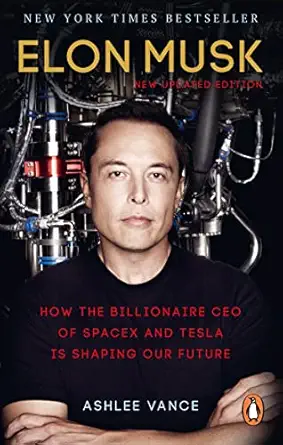
But the story of Elon Musk, as captured in Elon Musk by Ashlee Vance, begins somewhere more complicated: with an unusually intense curiosity, a fascination with technology, an appetite for difficult problems, and a willingness to keep moving even when the odds looked terrible.
This book trace Musk’s journey from childhood curiosity and early experiments to Zip2, PayPal, SpaceX, and Tesla. They repeatedly highlight one theme: Musk was willing to pursue goals that appeared almost impossible, while accepting enormous personal and professional pressure along the way.
This is not simply a story about becoming rich.
It is a story about thinking differently, building companies, taking calculated risks, learning from failure, and pursuing a mission larger than yourself.
And that is what makes this book particularly valuable for entrepreneurs, startup founders, business professionals, students, and anyone interested in self-growth and development, personal development, success strategies, entrepreneurship, startup business, sales and marketing, and social media brand building.
Why the Story of Elon Musk Matters
Imagine being told that you were trying to do something impossible.
Imagine starting a company when you had limited resources.
Imagine watching a rocket fail after years of work.
Imagine investing heavily in an electric-car company when many people doubted whether electric vehicles could become mainstream.
Now imagine continuing anyway.
That is the central emotional thread running through the journey described in the book.
The handwritten notes begin by describing Musk as a billionaire CEO associated with companies such as SpaceX and Tesla, while also emphasizing his desire to build things related to solar power, electric cars and space exploration. The notes portray his ambition as extending beyond simply making money.
The deeper lesson is important:
A meaningful goal can become more powerful than a comfortable life.
Musk’s journey shows what can happen when an entrepreneur repeatedly asks:
“What problem is worth solving?”
rather than merely asking:
“What business can make me money?”
Elon Musk’s Early Years: Curiosity Before Business
Long before Tesla and SpaceX, there was a young Elon Musk who was fascinated by computers, technology and ideas.
The notes describe Musk as someone who was highly curious from an early age. One striking example is that he reportedly sold a game at around age 12.
That detail matters because entrepreneurship often begins before someone calls themselves an entrepreneur.
It begins with curiosity.
A child sees a problem and wants to understand it.
A teenager wants to build something.
A young adult starts asking whether an existing system can be improved.
Musk’s early interest in programming became an early indication of this pattern.
Lesson for personal development
You don’t necessarily need to discover your “perfect career” immediately.
Instead, pay attention to what naturally captures your attention.
Ask yourself:
- What problems do I enjoy solving?
- What subjects can I study for hours without being forced?
- What technology or industry interests me?
- What do I repeatedly try to understand?
- What would I build if I had permission to experiment?
Curiosity can become a career advantage when it is combined with action.
From Student to Entrepreneur: The First Big Leap
Describe Musk’s move toward the United States and his college years, including his studies and growing ambition. They also describe his determination and interest in technology and entrepreneurship.
Eventually, the young entrepreneur faced an important decision:
Should he follow a conventional path—or try to build something?
He chose to build.
That decision led toward his first major entrepreneurial venture, Zip2.
The lesson here isn’t that everyone should immediately leave a traditional career.
The real lesson is:
At some point, knowledge must become action.
You can read 100 books about entrepreneurship.
You can watch thousands of videos about startups.
You can study sales, marketing, investing and leadership.
But eventually you must create something.
Zip2: Learning How to Build a Business
Zip2 became an important chapter in Musk’s entrepreneurial development.
Describe the company, the development of its internet-related business, and eventually the acquisition of Zip2 by Compaq for a substantial amount.
This was a critical lesson.
Musk wasn’t starting with SpaceX.
He wasn’t starting with Tesla.
He was learning.
He was learning how customers behave.
He was learning how technology becomes a product.
He was learning how companies are built.
And most importantly, he was learning how to turn an idea into something valuable enough that another company would want to acquire it.
Practical entrepreneurial lesson
If you’re building a startup business today, don’t obsess over becoming a billion-dollar company immediately.
Focus on:
Problem → Product → Customer → Revenue → Improvement
That sequence is much more useful than simply saying:
“I want to build a huge company.”
X.com and PayPal: The Power of Moving Into New Industries
After Zip2, Musk moved into online financial services.
The development of X.com and the eventual merger with Confinity, followed by the emergence of PayPal. They also describe the scale of the transaction that ultimately created enormous financial resources for Musk.
This stage of the journey teaches another important principle:
Don’t Become Trapped by Your First Success
One of the biggest mistakes entrepreneurs make is becoming emotionally attached to their first business.
They think:
“This is what I am.”
Musk demonstrated something different.
He could move from:
Internet software → online payments → space technology → electric vehicles
The industries were radically different.
But the underlying skill was similar:
Find a difficult problem. Learn rapidly. Build. Improve. Repeat.
That is an extremely valuable success strategy.
The Turning Point: SpaceX
Then came one of the boldest moves in the story.
Space.
For most people, space exploration feels like something belonging to governments and enormous aerospace organizations.
For Musk, it became a problem worth attempting.
Musk deciding to enter the space industry and wanting to send something toward Mars. They also describe his realization that rockets were extraordinarily expensive and his decision to pursue a lower-cost approach.
This reveals one of the most important entrepreneurial principles in the entire story:
Challenge the Assumption
Instead of accepting:
“Rockets are expensive.”
Musk’s thinking moved toward:
“Why are rockets so expensive, and can the cost be reduced?”
That difference is enormous.
Many entrepreneurs optimize existing systems.
Exceptional entrepreneurs sometimes question the system itself.
Failure Is Not the Opposite of Success
SpaceX did not become successful immediately.
Early rocket failures and the intense pressure surrounding the company. The notes emphasize that the first launches failed before later success was achieved.
Imagine spending years building something.
Imagine putting enormous effort and money into it.
Then watching it fail.
Most people would stop.
But Musk continued.
Eventually, SpaceX achieved a successful launch, creating a major turning point for the company. The notes describe NASA subsequently becoming interested and SpaceX moving toward important contracts.
The lesson is not “never fail.”
The lesson is:
Failure becomes useful when you learn from it and continue improving.
A failed attempt can provide information.
A failed marketing campaign can reveal what customers don’t want.
A failed product can reveal a design problem.
A failed startup can teach you about pricing, customers, hiring or cash flow.
The question isn’t:
“Did I fail?”
The better question is:
“What did this failure teach me?”
Tesla: Turning a Difficult Idea Into a Major Mission
Another major chapter of the book is Tesla.
Musk’s involvement with Tesla, the goal of developing electric vehicles and the company’s evolution toward producing cars at scale.
The interesting part is that Musk wasn’t simply trying to create another automobile company.
The larger idea was about transforming transportation.
Tesla with electric vehicles, efficiency and the broader future of energy.
This illustrates a powerful principle for entrepreneurs:
Build Around a Mission, Not Just a Product
A product can become outdated.
A mission can continue evolving.
For example:
Product: Electric car.
Mission: Accelerate the transition toward sustainable transportation.
The second idea gives a company a much bigger reason to exist.
Five Major Lessons From Elon Musk’s Journey
1. Think Bigger Than Your Current Circumstances
One of the strongest lessons from the book is the importance of ambitious thinking.
Musk’s willingness to pursue huge goals involving space, electric vehicles and technological development.
But thinking big does not mean making unrealistic plans.
It means asking:
“What would be possible if the existing limitations could be challenged?”
Practical tip
Take your biggest professional goal and ask:
“What would this look like if I thought ten times bigger?”
Then work backward.
2. Learn the Fundamentals
Musk’s journey repeatedly demonstrates the importance of understanding how things actually work.
Whether the subject was rockets, electric vehicles or software, the approach involved learning deeply.
This is particularly valuable in today’s world.
Entrepreneurs should not rely entirely on other people’s opinions.
Learn:
- Your industry
- Your customer
- Your technology
- Your costs
- Your competition
- Your distribution
- Your economics
Practical tip
Before starting a business, spend 30 days becoming a student of the industry.
Read.
Interview customers.
Study competitors.
Understand costs.
Then act.
3. Don’t Accept “That’s How It Has Always Been Done”
This may be one of the most powerful lessons.
The space industry had established assumptions about cost.
The automobile industry had established assumptions about electric vehicles.
Musk repeatedly challenged assumptions
Efforts to reduce rocket costs and improve electric vehicles.
Ask these questions in your own business:
- Why is this process so expensive?
- Why does this take so long?
- Why does the customer have to do this?
- Why does everyone use this business model?
- Can technology make it simpler?
- Can I remove a middleman?
- Can I dramatically improve the customer experience?
This is where innovation begins.
4. Persistence Must Be Combined With Adaptation
Persistence alone isn’t enough.
If you repeat the same mistake endlessly, that’s not persistence.
It’s stubbornness.
The Musk story shows persistence combined with adaptation.
SpaceX experienced failures, learned, changed and continued. The notes describe the progression from unsuccessful launches toward successful launches and eventually NASA-related opportunities.
The formula is:
Attempt → Failure → Learning → Improvement → Attempt Again
This formula works in entrepreneurship, career development and personal growth.
5. Build for the Long Term
The book’s story is not a story of overnight success.
It is a story spanning decades.
From childhood curiosity to software companies, online payments, rockets and electric vehicles, each stage built experience and resources for the next.
Show this progression clearly across the later pages, including SpaceX, Tesla and the development of increasingly ambitious projects.
Personal development lesson
Don’t judge your life by one year.
Judge it by the direction of your journey.
One year of learning may become five years of expertise.
Five years of expertise may become a business.
A business may create financial independence.
And financial independence may give you the freedom to pursue a larger mission.
Two Real-World Examples From the Journey
Example 1: SpaceX — From Repeated Failure to Breakthrough
SpaceX is perhaps the clearest example of applying persistence and first-principles thinking.
Musk entered an industry dominated by established players and extremely high costs. Early launches failed. Yet the company continued developing its technology until it achieved successful launches and attracted NASA’s attention.
Lesson: Don’t confuse an early failure with a final verdict.
Example 2: Tesla — From Electric-Car Idea to Mass-Market Ambition
Tesla represents another application of the same mindset.
The company’s work around electric cars and the development of increasingly capable vehicles. Later notes discuss production ambitions, manufacturing and the company’s growth.
Lesson: A difficult industry can become an opportunity when technology, persistence and a strong mission come together.
What Entrepreneurs Can Learn From Elon Musk
For entrepreneurs and startup founders, the book offers several practical ideas.
1. Start With a Problem
Don’t start with:
“What should I sell?”
Start with:
“What problem can I solve?”
2. Build Knowledge Before Making Major Decisions
Study the industry.
3. Think About the Economics
Revenue is not enough.
Understand:
Revenue – Costs = Profit
And understand how the business can scale.
4. Create a Strong Product
Marketing cannot permanently rescue a weak product.
Build something people genuinely value.
5. Use Technology as Leverage
Technology can reduce costs, increase productivity and create entirely new business models.
6. Think Long Term
Don’t build only for this year’s results.
Build something that can become stronger over five, ten or twenty years.
What the Story Teaches About Personal Development
Although the book focuses heavily on entrepreneurship and technology, its lessons extend into everyday life.
You don’t have to build a rocket to apply these ideas.
You can apply them to your career.
Suppose you want to become financially independent.
Instead of saying:
“I need more money.”
Ask:
“What valuable skills can I develop?”
Then:
Skill → Income → Saving → Investing → Ownership → Financial Freedom
Or perhaps you want to build a personal brand.
The same principle applies:
Knowledge → Content → Audience → Trust → Product/Service → Business
The journey begins with learning and action.
A Step-by-Step Elon Musk-Inspired Action Plan
Step 1: Choose a Meaningful Goal
Write down one ambitious goal.
Not ten.
One.
Step 2: Understand the Problem
Research the problem deeply.
Step 3: Learn the Fundamentals
Become knowledgeable enough to challenge assumptions.
Step 4: Start Small
Don’t wait for perfect conditions.
Create a first version.
Step 5: Test Reality
Let customers, users or the market give you feedback.
Step 6: Accept Failure
Treat mistakes as information.
Step 7: Improve Quickly
Make changes based on evidence.
Step 8: Build Systems
Don’t depend entirely on your personal effort.
Create processes, technology and teams.
Step 9: Think Long Term
Give the project enough time to compound.
Step 10: Keep the Mission Bigger Than the Money
Money can be an outcome.
A strong mission can become the engine.
10 Key Takeaways From Elon Musk by Ashlee Vance
- Curiosity can become a competitive advantage.
- Think beyond conventional limitations.
- Learn the fundamentals of your industry.
- Question assumptions instead of automatically accepting them.
- Take calculated risks.
- Failure can become valuable information.
- Persistence matters when combined with learning.
- Build products around meaningful problems.
- Technology can create extraordinary leverage.
- Long-term vision can turn difficult goals into achievable missions.
The Biggest Lesson: Your Current Reality Is Not Your Final Reality
Perhaps the most inspiring aspect of this story is the distance between the beginning and the destination.
The person interested in computers as a child eventually became involved in companies working on online payments, rockets and electric vehicles.
The journey wasn’t straight.
There were setbacks.
There were disagreements.
There were failures.
There were enormous financial and personal risks.
But the direction remained ambitious.
SpaceX’s successful progress, Tesla’s development and the scale of Musk’s achievements over time.
And that provides a powerful message for anyone reading this book:
You don’t need to know exactly how you will reach the destination before you begin.
You need a direction.
You need the willingness to learn.
You need the courage to start.
And you need the persistence to continue improving.
Final Reflection: What If You Thought Bigger?
Imagine looking at your current life five years from now.
What could change?
Maybe you could build a successful business.
Maybe you could become financially independent.
Maybe you could develop a valuable skill.
Maybe you could create a personal brand.
Maybe you could transform your career.
Maybe you could build something that solves a problem for thousands—or millions—of people.
The lesson from Elon Musk isn’t that everyone should become Elon Musk.
It is not even that everyone should take enormous risks.
The deeper lesson is this:
Your life can become much larger when you stop treating today’s limitations as permanent.
Think carefully.
Learn deeply.
Start practically.
Fail intelligently.
Improve continuously.
And keep moving toward something meaningful.
Disclaimer
Disclaimer: This blog is a summary and interpretation of Elon Musk by Ashlee Vance, based on the uploaded handwritten notes and the book’s subject matter. The purpose is educational and inspirational. The views and interpretations expressed here are intended to help readers understand and apply entrepreneurial and personal-development lessons in real life. This article is not a substitute for reading the original book.
Inspired by Elon Musk’s Journey?
This is another story in the Book to Life series—where the goal is not simply to read a book, but to take its ideas and put them into action.
Don’t just ask, “What did Elon Musk do?”
Ask yourself:
“What can I learn from his journey—and what will I build with that lesson?”
Read the original book, choose one lesson from this summary, and apply it to your own life this week.
Because the biggest transformation doesn’t happen when you finish a book. It happens when a book changes what you do next.