
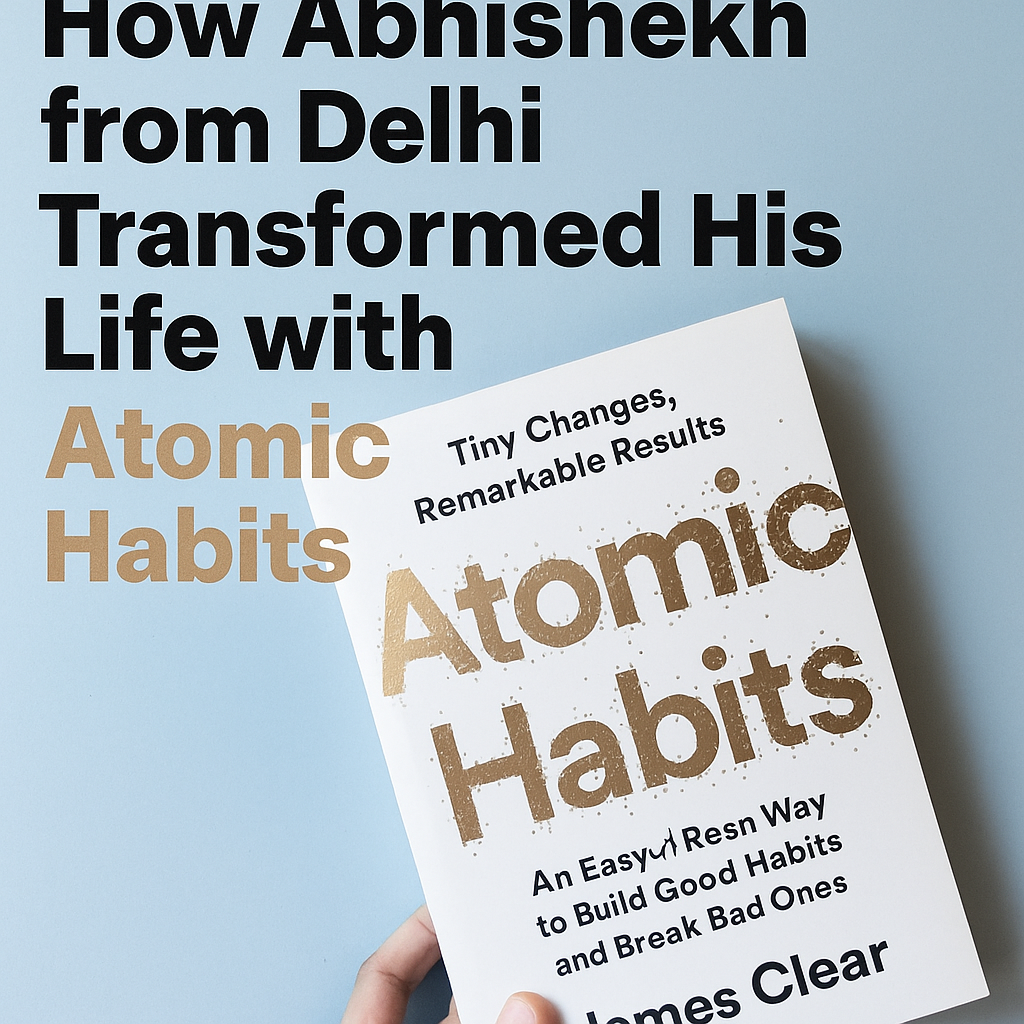
Life Before Change
It was a muggy July evening in Delhi. Abhishekh sat at his cluttered desk, staring at his bank statement. His salary as a mid-level marketing executive barely covered rent, groceries, and loan EMIs. Every month ended the same way — broke, frustrated, and feeling stuck in a cycle he couldn’t escape.
He had big dreams: buying his own home, starting a small business, maybe even traveling the world. But those dreams seemed as far away as the stars over the Delhi sky.
Like many of us, Abhishekh kept setting goals. “This year I’ll save ₹5 lakhs.” “I’ll start my side business next month.” But deadlines came and went, and nothing changed. The gym membership card in his wallet was gathering dust. His motivation? Always short-lived.
Deep inside, Abhishekh wasn’t lazy — he was exhausted by failure. And slowly, he began to wonder: Maybe success isn’t for people like me.
Turning Point: Discovering Atomic Habits
One afternoon, while scrolling YouTube during his lunch break, Abhishekh stumbled upon an interview with James Clear, the author of Atomic Habits. A single line struck him like lightning:
“You do not rise to the level of your goals. You fall to the level of your systems.”
That night, he ordered the book. A week later, sitting in his small rented flat with a cup of chai, he opened Atomic Habits.
By the third chapter, his perspective shifted. Maybe the problem wasn’t his goals. Maybe it was the system he lacked. That was the night Abhishekh decided: I will rebuild my life, one small habit at a time.
Implementation Phase: Applying Atomic Habits Step by Step
1. Identity First: Who Do I Want to Become?
James Clear explains that real change starts not with goals, but with identity. Instead of asking, “What do I want to achieve?”, you ask, “Who do I want to become?”
Abhishekh wrote in his journal:
-
I want to become someone who is financially free.
-
I want to become a disciplined entrepreneur.
-
I want to become a healthy, energetic person.
With each small habit, he wasn’t chasing a goal — he was casting a vote for his new identity.
2. The 1% Rule: Small Wins Every Day
Instead of trying to save ₹20,000 in a month, Abhishekh started with ₹200 daily. It seemed laughably small, but James Clear’s words echoed:
“Habits are the compound interest of self-improvement.”
Over weeks, ₹200 turned into ₹500. Within a year, his emergency fund was full.
He applied the same 1% rule to health:
-
10 pushups a day → 20 → 50.
-
15-minute walks → 30-minute jogs.
-
Junk food twice a week instead of daily.
Small improvements, but over months, his energy skyrocketed.
3. The Habit Loop: Cue → Craving → Response → Reward
James Clear explains that habits work in a loop.
-
Cue: Seeing his wallet → Craving: security → Response: transferring ₹200 to savings → Reward: sense of control.
-
Cue: Morning alarm → Craving: freshness → Response: stretching → Reward: energized mood.
By understanding triggers, Abhishekh stopped relying on motivation. Habits ran on autopilot.
4. The 4 Laws of Behavior Change
(a) Make it Obvious
Abhishekh kept a piggy bank on his desk and a post-it: “I am an investor.”
(b) Make it Attractive
He gamified saving with a chart. Every week, he colored a new block. Watching it fill was addictive.
(c) Make it Easy
He automated SIPs in mutual funds so saving happened without effort.
(d) Make it Satisfying
Each month, he rewarded himself with a small treat — guilt-free coffee at his favorite café — after hitting savings goals.
5. Systems Over Goals
Abhishekh stopped chasing outcomes like “earn ₹1 crore”. Instead, he focused on systems:
-
Consistently improve his freelance skills by 1% daily.
-
Network with one new contact every week.
-
Review finances every Sunday.
Slowly, his side hustle grew. Clients started noticing his reliability.
The Breakthrough: Crossing the Valley of Disappointment
At first, progress was invisible. After six months, savings were modest, his body showed small changes, and business inquiries were sporadic. Friends teased him: “All this effort for just ₹500 in savings?”
This was James Clear’s Valley of Disappointment — the dangerous phase where results don’t yet match the effort.
But Abhishekh persisted. He trusted the system.
Then, the breakthrough came.
One year in, he received a freelance contract worth ₹3 lakhs — the biggest in his career. His consistent habit of networking and skill-building finally paid off.
Soon after, his fitness improvements became visible. He had lost 10 kilos, his face looked fresher, and his energy at work soared. His manager noticed, leading to a promotion.
The compounding effect had kicked in.
Life After Change: A New Abhishekh Emerges
Two years later, Abhishekh’s life looked nothing like before.
-
His emergency fund was strong.
-
His side business in digital marketing brought in consistent income.
-
His health improved dramatically; daily exercise was non-negotiable.
-
Most importantly, he no longer felt stuck. He felt free.
Financial freedom wasn’t a distant dream anymore — it was a living reality.
Reflection: What Abhishekh Learned
Looking back, Abhishekh realized:
-
Goals motivate you, but systems transform you.
-
Success isn’t about radical overnight change, but tiny 1% improvements compounded over years.
-
Identity drives behavior. Once he saw himself as an investor, entrepreneur, and healthy person, his actions aligned.
-
Habits are powerful because they run automatically, freeing willpower for bigger challenges.
His advice for others?
“Don’t wait for motivation. Start small, start now. One tiny habit can change the entire direction of your life.”
Call to Action
Inspired by Abhishekh’s journey? This is just one story in our Book to Life series. Pick up Atomic Habits by James Clear today and take the first step toward your own transformation.
👉 Visit MYCASHFLOW – www.mycashflowhub.com or call 885051169 to start building your path to financial freedom.
Disclaimer
This story is hypothetical, written only to demonstrate how the concepts of the book can be applied in real life in story form.