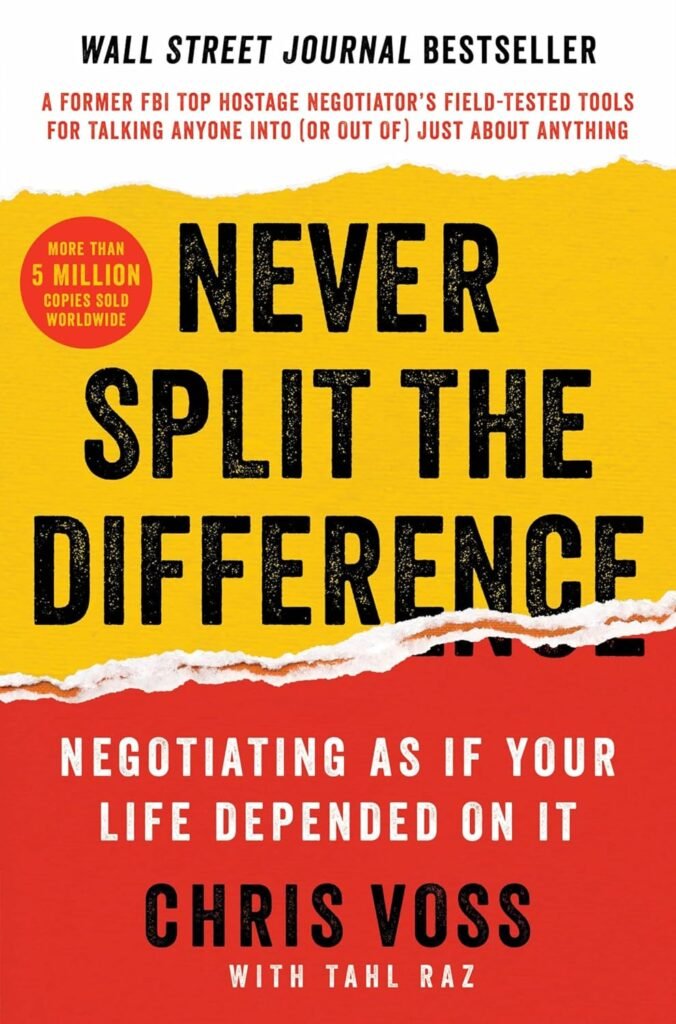
Book Summary & Lessons from Never Split the Difference by Chris Voss and Tahl Raz
Why Never Split the Difference Matters More Than Ever
What if I told you that every conversation you have is a negotiation?
From salary discussions, client pricing, business deals, vendor contracts, rent, sales calls, partnerships, and even family decisions — negotiation isn’t something we do occasionally. It’s something we do every single day.
That’s what makes Never Split the Difference by Chris Voss, former FBI hostage negotiator, and Tahl Raz, bestselling author, such a powerful and practical book.
This is not a book about boardroom theory or textbook negotiation models.
This is about real human behavior, emotions, fear, ego, trust, and decision-making — learned in situations where lives literally depended on the outcome.
Chris Voss spent decades negotiating with terrorists, kidnappers, and criminals. His biggest insight?
Humans are emotional first and logical second.
If you try to win negotiations using only logic, data, and facts, you will lose — in business, career, and life.
This book teaches you how to:
-
Use tactical empathy
-
Build instant rapport
-
Control conversations without appearing controlling
-
Influence outcomes ethically
-
Avoid bad compromises
-
And create win-win results without splitting the difference
What This Book Is Really About
At its core, Never Split the Difference teaches you how to:
-
Understand human psychology
-
Listen deeply instead of talking too much
-
Make the other person feel heard, respected, and safe
-
Guide conversations using smart questions
-
Reach agreements that protect your interests
Negotiation here is not manipulation.
It’s connection + clarity + confidence.
Key Concept #1: We Are Emotional Beings, Not Logical Machines
Most people believe decisions are made logically.
Chris Voss proves the opposite.
People:
-
Feel first
-
Decide emotionally
-
Justify later with logic
That’s why flooding someone with:
-
Spreadsheets
-
Charts
-
Features
-
Data
…does not close deals.
Instead, the book introduces Tactical Empathy.
Tactical Empathy (The Core Skill)
Tactical empathy means:
-
Understanding the emotions behind the words
-
Acknowledging the other person’s perspective
-
Making them feel genuinely understood
It doesn’t mean you agree with them.
It means you recognize how they feel.
When people feel understood, they become open.
Key Concept #2: Active Listening Is a Superpower
Most people listen only to reply.
Elite negotiators listen to understand.
Chris Voss teaches Active Listening, which includes:
-
Tone
-
Pace
-
Silence
-
Curiosity
-
Reflection
And one of the most powerful tools inside active listening is Mirroring.
Key Concept #3: Mirroring – The Fastest Way to Build Rapport
Mirroring means repeating the last few words (or key phrase) the other person said — calmly and curiously.
Why Mirroring Works
-
Makes people feel heard
-
Encourages them to elaborate
-
Builds rapport instantly
-
Keeps them talking
-
Gives you more information
Real-Life Example: The Restaurant Study
Two groups of waiters were studied.
Group A used:
-
Positive words (“Sure”, “No problem”, “Absolutely”)
Group B used:
-
Mirroring
-
Copied tone, speed, and language
👉 Result:
Waiters using mirroring earned 70% more tips.
Why?
Because customers felt understood, not just served.
Key Concept #4: Labeling Emotions (Don’t Fight Feelings — Name Them)
One of the biggest mistakes in negotiation is trying to deny or suppress emotions.
Chris Voss teaches:
Don’t react to emotions. Label them.
Use phrases like:
-
“It seems like you’re under a lot of pressure…”
-
“It sounds like you’re frustrated…”
-
“It looks like this situation is stressful…”
Why Labeling Works
-
Defuses negative emotions
-
Builds trust
-
Makes the other person feel safe
-
Reduces defensiveness
People calm down when their emotions are acknowledged.
Key Concept #5: “No” Is Not Rejection — It’s Safety
Most people fear hearing “No.”
Chris Voss teaches the opposite:
“No” is the start of negotiation, not the end.
When people say “No”, they feel:
-
In control
-
Safe
-
Respected
Instead of pushing for “Yes”, ask questions that invite a No.
Example:
-
“Is now a bad time to talk?”
-
“Would it be ridiculous to explore another option?”
Once people feel safe saying no, they open up.
Key Concept #6: The Power of “That’s Right”
There are two kinds of agreement:
-
“You’re right” (superficial)
-
“That’s right” (deep acceptance)
You reach “That’s right” by:
-
Active listening
-
Labeling emotions
-
Summarizing their situation accurately
When someone says:
“That’s right.”
It means:
-
They feel understood
-
They trust you
-
They’re ready to move forward
Key Concept #7: Calibrated Questions (Create the Illusion of Control)
Instead of telling people what to do, ask open-ended, calibrated questions that start with:
-
How?
-
What?
-
When?
-
Who?
Examples:
-
“How am I supposed to do that?”
-
“What would make this work for you?”
-
“How can we solve this together?”
These questions:
-
Shift problem-solving to the other side
-
Reduce resistance
-
Make them feel in control
Real-Life Example #1: Salary Negotiation Without Conflict
A professional negotiating salary avoided saying:
“I want more money.”
Instead, they used:
“How am I supposed to meet these responsibilities with this compensation?”
The employer paused, reflected, and adjusted the offer.
Result:
-
Higher salary
-
Better role clarity
-
Stronger relationship
Real-Life Example #2: Rent Negotiation Using the Ackerman Model
A tenant wanted to reduce rent.
Instead of arguing:
-
They used empathy
-
Shared constraints
-
Used precise numbers (₹18,729 instead of ₹19,000)
The landlord agreed — because the number felt carefully calculated, not random.
The Ackerman Model: Step-by-Step Negotiation Framework
Chris Voss introduces the Ackerman Model for price negotiations.
Step 1: Set Your Target Price
Know your ideal outcome.
Step 2: First Offer at 65%
Start low but reasonable.
Step 3: Incremental Increases
Move in small steps:
-
85%
-
95%
-
100%
Step 4: Use Empathy + “No”
Delay increases by asking calibrated questions.
Step 5: Use Precise Numbers
Odd numbers feel researched and credible.
Step 6: Add Non-Monetary Value
Ask for extras at the end (terms, timelines, bonuses).
Lessons Learned from Never Split the Difference
-
Negotiation is emotional, not logical
-
Listening beats talking
-
Empathy is strength, not weakness
-
“No” builds safety
-
Labels calm emotions
-
Questions control conversations
-
Data doesn’t persuade — understanding does
-
Compromise often creates bad deals
-
Preparation determines outcomes
-
Confidence comes from clarity, not aggression
Step-by-Step Guide: How to Apply This Book in Daily Life
In Career
-
Salary discussions
-
Promotions
-
Job offers
-
Performance reviews
In Business
-
Client pricing
-
Vendor negotiations
-
Partnerships
-
Sales conversations
In Personal Life
-
Rent
-
Purchases
-
Family decisions
-
Conflict resolution
Daily Practice
-
Mirror one sentence daily
-
Label one emotion per conversation
-
Replace arguments with calibrated questions
Action Plan for Readers
-
Stop convincing — start listening
-
Practice mirroring daily
-
Label emotions before responding
-
Ask “How” and “What” questions
-
Never rush to compromise
-
Prepare before every important conversation
10 Powerful Takeaways from the Book
-
Emotions drive decisions
-
Tactical empathy wins trust
-
Silence is powerful
-
Mirroring unlocks information
-
Labeling reduces conflict
-
“No” is productive
-
“That’s right” is the goal
-
Numbers influence perception
-
Preparation beats persuasion
-
Never split the difference