
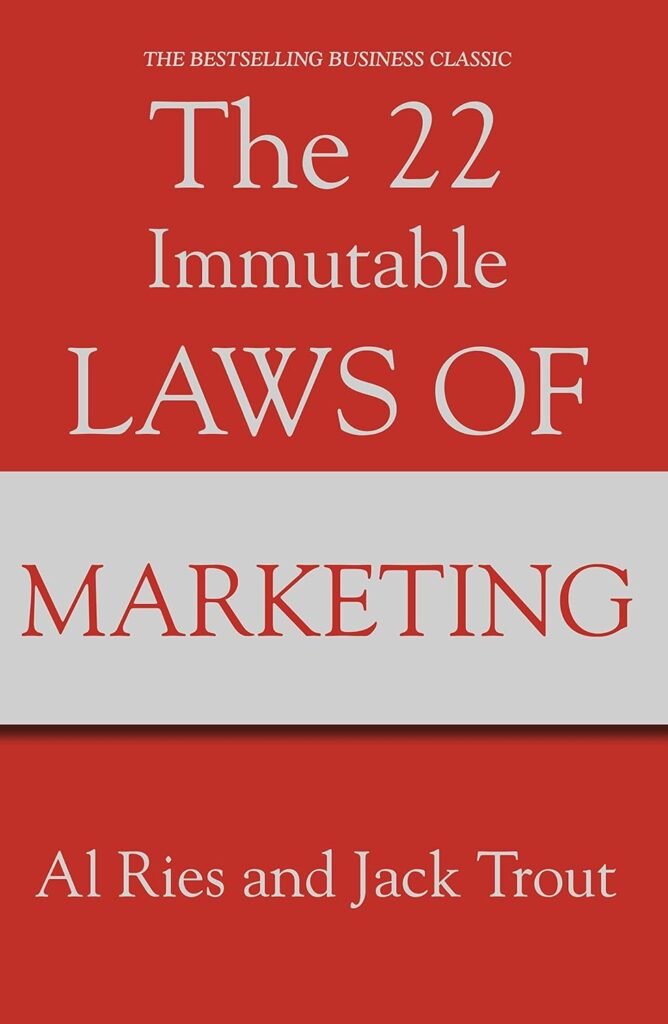
Master the 22 Immutable Laws of Marketing — practical lessons from Ries & Trout to build focus, position your brand, avoid fatal mistakes, and grow profitably.
Why these laws still matter
Marketing is full of fads, buzzwords, and shiny tactics. Ries & Trout cut through the noise: their 22 laws are not clever tricks but patterns observed across industries and decades. Follow them and you massively increase the odds of building a recognisable, profitable brand. Ignore them and you’ll likely repeat mistakes many companies have already paid for.
Below I explain each law, give practical tips, and show real-world examples you can emulate.
The Laws (with explanation, example, and action tip)
1. The Law of Leadership
Principle: It’s better to be first than it is to be better.
Why: Being first gives you the associative lead in people’s minds.
Example: If you think of airline searching, “Google” is top-of-mind for many. The brand that names the space benefits disproportionately.
Action tip: If you can’t be first in a broad market, create and own a narrower category where you can be first.
2. The Law of the Category
Principle: If you can’t be first in a category, create a new category you can be first in.
Example: If you can’t beat Coca-Cola head-on, be the first in “diet cola,” “energy drink,” or a niche subcategory.
Action tip: Define a micro-category (e.g., “vegan meal delivery for shift workers”) and own it in messaging and SEO.
3. The Law of the Mind
Principle: It’s better to be first in the mind than first in the marketplace.
Why: Perception shapes choice.
Example: Xerox was first in copying but “Xerox” became the word for photocopy — dominance in mind matters.
Action tip: Use simple, repeated messaging that links one idea to your brand until it “sticks.”
4. The Law of Perception
Principle: Marketing is not a battle of products, it’s a battle of perceptions.
Why: Reality is filtered through people’s beliefs.
Example: Apple created a perception of elegance and simplicity; that perception drove purchases beyond specs.
Action tip: Map the top three perceptions customers hold about competitors — then craft communications to shift perceptions (not just tout features).
5. The Law of Focus
Principle: The most powerful concept in marketing is owning a single word in the prospect’s mind.
Example: Volvo = safety; FedEx = overnight.
Action tip: Pick one clear attribute you want to own. Repeat it everywhere — product, content, customer experience.
6. The Law of Exclusivity
Principle: Two companies cannot own the same word in the prospect’s mind.
Example: If you try to own “comfort,” you won’t beat a brand already associated with it.
Action tip: Audit your competitors’ words; choose one they don’t have and make it yours.
7. The Law of the Ladder
Principle: The strategy depends on which rung you occupy on the ladder in customers’ minds.
Example: If you’re #2, your best strategy is often to be the opposite of #1 (Avis: “We’re No.2, we try harder”).
Action tip: Identify where you sit on the ladder for your category and pick positioning appropriate to that rank.
8. The Law of Duality
Principle: Over time, every market becomes a two-horse race.
Why: Markets consolidate around two strong narratives or players.
Action tip: Prepare for consolidation: build distinct differentiators and alliances to survive when the field narrows.
9. The Law of the Opposite
Principle: If you’re shooting for second place, your strategy is determined by the leader.
Example: Pepsi positioned itself not as Coca-Cola but as the challenger with youth energy.
Action tip: Study the leader’s weaknesses and craft a complementary positioning that exploits them.
10. The Law of Division
Principle: Over time, a category will divide into multiple categories.
Example: “Personal computers” split into laptops, tablets, phones, etc.
Action tip: Track category splits early and be ready to niche down where you can dominate.
11. The Law of Perspective
Principle: Marketing effects take place over a long time; short-term tactics can ruin long-term positioning.
Example: Frequent discounting may spike Q4 sales but damage perceived value forever.
Action tip: Think in 3–5 year positioning plans rather than quarterly campaigns.
12. The Law of Line Extension
Principle: There’s an irresistible temptation to extend the brand; resist it.
Why: Line extensions dilute focus and confuse customers.
Example: A soda brand launching unrelated products often dilutes its core message.
Action tip: Before launching a new product under your brand, ask: “Does this reinforce our single word?”
13. The Law of Sacrifice
Principle: You must give up something to get something.
Action tip: Choose what you’ll not do — markets reward focus. Sacrifice customers, products, or territories to gain clarity.
14. The Law of Attributes
Principle: For every attribute, there is an opposite, effective attribute.
Example: If the leader is “expensive,” claim “affordable quality.”
Action tip: Define the leader’s attribute and pick a credible opposite to position against.
15. The Law of Candor
Principle: When you admit a negative, the prospect gives you a positive. Honesty builds credibility.
Example: A brand admitting “We’re not the cheapest” can then claim “but we’re the most reliable.”
Action tip: Use candid statements to neutralise objections and then pivot to your strength.
16. The Law of Singularity
Principle: In each situation, only one move will produce substantial results.
Action tip: Identify the single clearest action that would shift perception and focus resources there.
17. The Law of Unpredictability
Principle: You cannot predict the future of a market with full confidence.
Action tip: Build flexible plans and reserve resources to respond to surprises.
18. The Law of Success
Principle: Success often leads to arrogance and complacency, which can destroy you.
Action tip: Regularly test assumptions and invite critical feedback to avoid the arrogance trap.
19. The Law of Failure
Principle: Failure is to be expected and accepted. Punishing it kills innovation.
Action tip: Create “safe-to-fail” experiments and celebrate learning when things go wrong.
20. The Law of Hype
Principle: The more hype, the more likely the eventual disappointment.
Action tip: Under-promise and over-deliver. Build authentic momentum rather than media-driven hype.
21. The Law of Acceleration
Principle: Successful programs are built on trends, not fads.
Action tip: Look for structural trends to ride; avoid betting the business on a short-lived craze.
22. The Law of Resources
Principle: Without adequate funding, an idea won’t gain traction. But resources must be allocated wisely.
Action tip: Fund the category and focus-building activities that produce mental ownership; don’t waste budget on unfocused advertising.
Two Real-World Success Stories
Story 1 — Avis: The Power of the Opposite
Avis couldn’t beat Hertz on scale, so they leaned into being #2 — “We try harder.” The messaging admitted a perceived weakness and turned it into a promise of better service. That’s Laws 7 (Ladder), 9 (Opposite), and 15 (Candor) in action.
Lesson: Honesty + a clear opposite strategy can turn rank into an advantage.
Story 2 — Apple: Focus + Perception
Apple didn’t just sell machines — it sold the perception of simplicity and elegance (Laws 4, 5, and 3). They sacrificed breadth to own the “design/simplicity” word and let that perception justify premium pricing (Laws 13 & 11).
Lesson: A single-minded focus on perception and disciplined sacrifice scales value over decades.
Action Plan: How to Apply the Laws Today
-
Audit your word. What single word do people associate with your brand? If none, pick one and start owning it.
-
Pick your category. If you can’t be #1, invent a micro-category to be first in.
-
Map the ladder. Who’s #1, #2, #3? Choose an opposite or complementary position.
-
Say one thing, do one thing. Align product, experience, and comms around that one thing.
-
Say the honest thing. Use candor to neutralize objections.
-
Protect your focus. Reject line extensions that dilute the single word.
-
Plan long-term. Design marketing with 3–5 year effects, not one-time spikes.
-
Reserve resources. Invest in the activities that build mental ownership (PR, content, category education).
10 Practical Takeaways (At-a-Glance)
-
Be first in the mind or create a new category.
-
Own one clear word in customers’ minds.
-
If you’re not #1, position opposite the leader.
-
Less is more — focus beats breadth every time.
-
Line extensions dilute; sacrifice to gain clarity.
-
Honesty disarms objections; use candor strategically.
-
Build on trends (acceleration), not fads (hype).
-
Expect failure and learn fast; don’t punish it.
-
Plan for the long game; marketing effects compound.
-
Resources matter — but spend them on building mind share.
Call to Action
Inspired by this breakdown? This post is part of the Book to Life series — practical stories and summaries that turn great books into action. Read The 22 Immutable Laws of Marketing by Al Ries & Jack Trout, apply one law this week, and report back what changed. Want my help mapping one word to your brand? Reply with your category and top 3 competitors — I’ll suggest a focus word and a 30-day plan.
Disclaimer: This is a practical summary and interpretation of The 22 Immutable Laws of Marketing intended to show how to apply the book’s concepts in real life.
Common Pitfalls & How to Avoid Them
-
Pitfall: Chasing every “opportunity” (violates Laws 5, 13).
Fix: Use a “yes/no/someday” filter — most new product ideas go to “someday.” -
Pitfall: Overextending the brand into unrelated categories (Law 12).
Fix: Test new offerings with a separate sub-brand or spin-off. -
Pitfall: Buying short-term traffic at the cost of brand positioning (Law 11).
Fix: Balance immediate growth with campaigns that reinforce your single word.
Final Thoughts — The Heart of the Matter
The genius of The 22 Immutable Laws is that it forces discipline. Marketing success is rarely about adding more; it’s about focusing harder. Whether you’re a founder in Bangalore, a CMO in New York, or a solopreneur in Mumbai, these laws are a checklist to keep you honest.
If you take only one thing away, let it be this: decide what single word you want customers to think when they hear your brand — then ruthlessly align everything to that word.