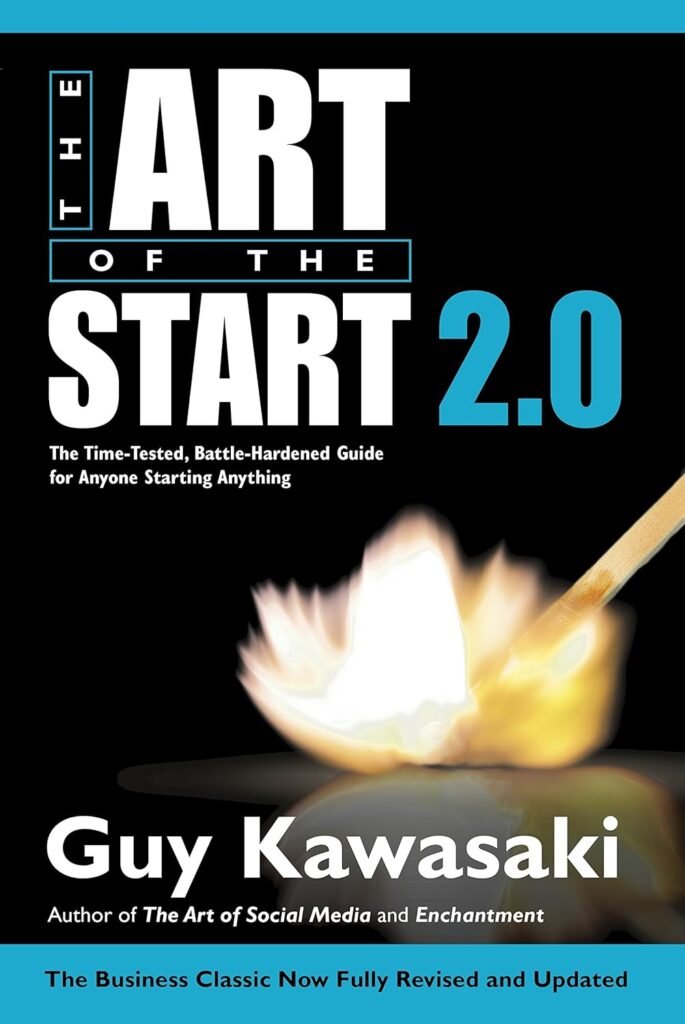
How entrepreneurs, creators, and dreamers can start anything—and actually make it work.
Why The Art of the Start 2.0 Matters (And Who It’s For)
Starting something new—whether it’s a startup business, a personal brand, a YouTube channel, or a social enterprise—often feels overwhelming. Ideas are easy. Execution is hard. Sustainability is harder.
This is where The Art of the Start 2.0 by Guy Kawasaki becomes a rare and powerful guide.
Guy Kawasaki, former Apple evangelist, entrepreneur, investor, and creator of the Business Model Canvas, wrote this book as a battle-hardened manual for anyone starting anything. Not just startups—but careers, movements, side hustles, products, and brands.
This book matters because it strips entrepreneurship down to its essentials:
-
Meaning before money
-
Clarity before complexity
-
Action before perfection
Unlike theory-heavy startup books, The Art of the Start 2.0 is practical, direct, and brutally honest. It teaches you how great businesses actually begin—not how they look in pitch decks after success.
This book is for:
-
Entrepreneurs and startup founders
-
Solopreneurs and creators
-
Professionals planning a career pivot
-
Anyone who wants to build something meaningful and profitable
-
People tired of overthinking and ready to start
The Big Idea of the Book: Start with Meaning, Not Money
One of the strongest ideas Guy Kawasaki emphasizes is simple yet revolutionary:
Great businesses don’t start with a desire to get rich. They start with a desire to make meaning.
Amazon didn’t start to dominate cloud computing. It started by selling books online.
Apple didn’t start to become a trillion-dollar company. It started to make computers friendly for humans.
Facebook didn’t start to become an advertising giant. It started as a college connection tool.
Money followed meaning.
Key Concepts & Principles from The Art of the Start 2.0
Let’s break down the most important lessons and how they apply in real life.
1. Ask the Four Questions Before You Start Anything
Guy Kawasaki insists that before starting, you must ask four brutally honest questions:
1. “What are you here to change?” (The “Therefore What?” Test)
Every meaningful startup answers “Therefore what?”
Example:
-
Smartphones + Internet → Therefore what?
→ People can share moments instantly → Instagram, Facebook, WhatsApp were born.
If your idea doesn’t change something—even a small thing—it won’t matter.
Practical Tip:
If you can’t explain the change your product creates in one sentence, your idea isn’t ready.
2. “Is it interesting?”
Interesting ideas spark curiosity.
A restaurant selling burgers isn’t interesting.
A burger joint selling “raclette-melted burgers inspired by Swiss street food” is.
Real-Life Example:
A small café in Bangalore rebranded from “Coffee Shop” to “Slow Brew Conversations Café.”
Same coffee. New curiosity. Footfall doubled.
3. “Is there a better way?”
Most successful startups didn’t invent something new—they improved something old.
-
Porsche didn’t invent cars; it built better ones.
-
Netflix didn’t invent movies; it made access easier.
-
Google Maps didn’t invent navigation; it removed friction.
Practical Tip:
Study how people currently solve the problem. Your opportunity lies in what frustrates them.
4. “Why hasn’t anyone else done it?”
If no one has done it, ask why:
-
Is it too hard?
-
Too expensive?
-
Too risky?
If the answer is “because technology or behavior just changed,” you might be onto something powerful.
2. Find Your Soulmate (Co-Founder or Partner)
Great companies are rarely built alone.
Guy Kawasaki emphasizes complementary partnerships, not clones.
-
One person handles vision and storytelling
-
The other executes operations and systems
Famous Examples:
-
Steve Jobs & Steve Wozniak (Apple)
-
Bill Gates & Paul Allen (Microsoft)
-
Larry Page & Sergey Brin (Google)
Practical Tip:
Don’t choose a co-founder because they are your friend. Choose them because they balance your weaknesses.
3. Create a Mantra (Not a Mission Statement)
Forget long mission statements nobody remembers.
Guy Kawasaki recommends a 3–4 word mantra that captures your essence.
Examples:
-
Nike → Authentic Athletic Performance
-
Apple → Think Different
-
Starbucks → Rewarding Everyday Moments
A mantra:
-
Is short
-
Is emotional
-
Is memorable
Practical Tip:
If your team can’t remember your mantra, neither will your customers.
4. Pick a Simple, Clear Business Model
Complexity kills startups.
Ask only two questions:
-
Who has the money?
-
How will you get it?
Example:
-
eBay → Listing fee + commission
-
Netflix → Monthly subscription
-
YouTube → Advertising + creators
If you can’t explain your business model in 10 words, you don’t have one.
5. The Art of Launching: Build for the Future Curve
Great products jump curves.
Example of evolution:
-
Ice harvesting → Ice factories → Refrigerators
-
Telegraph → Telephone → Mobile → Smartphone
The question is not:
“Is my product good today?”
But:
“Will it get dramatically better over time?”
Four Product Types:
-
Valuable but not different
-
Different but not valuable
-
Neither valuable nor different (worst)
-
Valuable AND different (winner)
Practical Tip:
Your product must sit in quadrant #4—even if it starts small.
Real-Life Example #1: Instagram’s Early Days
Instagram started as Burbn, a complex check-in app.
The founders noticed:
-
People ignored most features
-
Everyone loved photo sharing
They simplified ruthlessly.
Lesson:
Start small. Observe behavior. Double down on what works.
That mindset reflects The Art of the Start 2.0 perfectly.
Real-Life Example #2: Canva (Guy Kawasaki’s Own Company)
Canva didn’t aim to disrupt Adobe overnight.
It focused on:
-
Non-designers
-
Simple templates
-
Drag-and-drop ease
By making design accessible, Canva built meaning first—profits followed.
Action Plan: How to Apply the Book in Real Life
Step 1: Make Meaning
Ask:
-
Whose life improves because of my work?
-
What frustration disappears?
Step 2: Write Your Mantra
3–4 words that define your purpose.
Step 3: Validate with Action
Don’t wait for perfection.
-
Launch a basic version
-
Talk to real users
-
Improve fast
Step 4: Keep the Business Model Simple
-
One clear customer
-
One clear payment method
Step 5: Tell Powerful Stories
People don’t buy products.
They buy belief in a better future.
Lessons Learned: Biggest Takeaways from the Book
-
Start with meaning, not money
-
Great ideas answer “Therefore what?”
-
Simplicity beats complexity
-
Mantras beat mission statements
-
Complementary partners matter
-
Business models must be crystal clear
-
Launch early, learn fast
-
Products must improve over time
-
Storytelling builds belief
-
Action beats planning—always
Step-by-Step Startup Guide (Practical Implementation)
-
Define the change you create
-
Write a 3-word mantra
-
Identify your paying customer
-
Choose one revenue stream
-
Launch a basic version
-
Observe real behavior
-
Improve relentlessly
-
Tell your story everywhere
-
Build meaning before scale
-
Start now—not later
10 Powerful Takeaways from The Art of the Start 2.0
-
Entrepreneurship is learnable
-
Meaning creates momentum
-
Small starts beat big plans
-
Curiosity fuels growth
-
Partnerships accelerate success
-
Clarity attracts customers
-
Great brands tell simple stories
-
Execution matters more than ideas
-
The future belongs to adaptable builders
-
The best time to start is now