
In a rapidly changing world, where yesterday’s market leaders disappear overnight and unknown startups become billion-dollar giants, one timeless truth stands out—innovation destroys comfort.
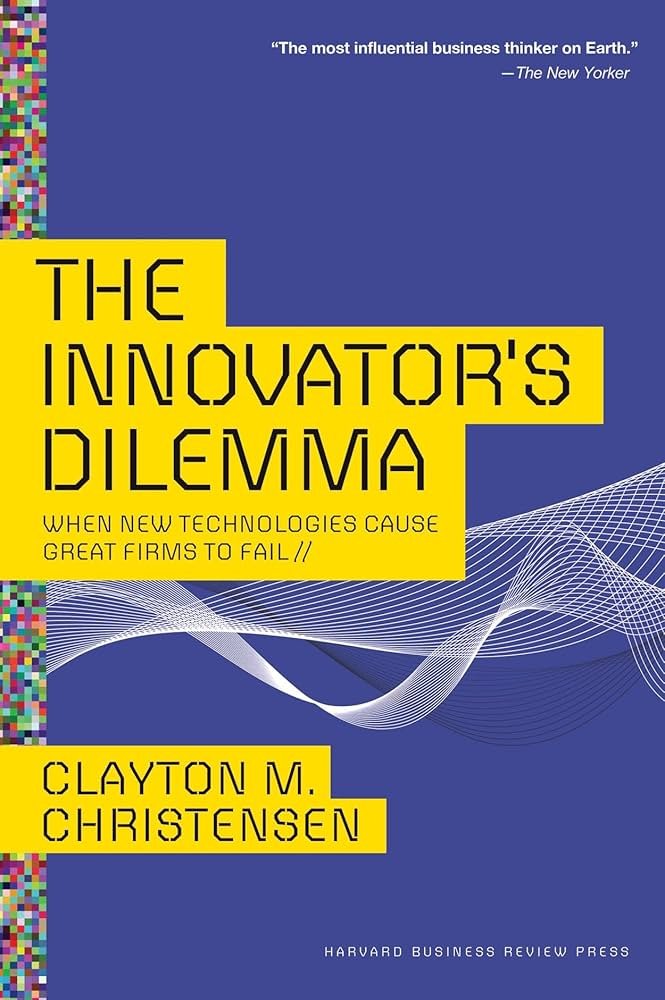
This powerful idea is at the heart of The Innovator’s Dilemma by Clayton M. Christensen—a book that explains why the best-managed companies often fail and how disruptive innovation reshapes industries forever.
From Kodak to Nokia, from Netflix to Uber—this book shows how disruption doesn’t attack from the top. It attacks from the edges, from niches, from products that look weak at first… but later dominate the world.
Let’s dive into this life-changing business bible.
✅ Overview – Why This Book Matters & Who It’s For
The Innovator’s Dilemma explores one of the most important paradoxes in business:
The very practices that make companies successful today often cause their failure tomorrow.
Christensen studied dozens of industries and found that:
-
Great companies listen to customers
-
They invest in better technology
-
They improve quality
-
They manage costs efficiently
Yet… many still collapse.
This Book Is Perfect For:
-
Entrepreneurs & Startup Founders
-
Business Owners
-
Product Managers
-
Investors
-
Sales & Marketing Leaders
-
Anyone in self growth and development
It teaches you how to survive disruption instead of being destroyed by it.
✅ Core Idea of the Book
There are two types of innovation:
1. Sustaining Innovation
Improving existing products for existing customers.
✅ Example:
-
Better camera in smartphones
-
Faster processors in laptops
-
Higher battery life in electric vehicles
These improvements help companies stay competitive in current markets.
2. Disruptive Innovation
Simple, cheaper, lower-performance products that:
-
Start in niche markets
-
Serve new or ignored customers
-
Eventually overtake mainstream markets
✅ Example:
-
Digital cameras vs film cameras
-
Streaming vs cable TV
-
Smartphones vs feature phones
-
Netflix vs DVD rental
-
UPI vs traditional banking payments
Disruptive innovations don’t look dangerous at first—and that’s exactly why giants ignore them.
✅ Key Concept 1: Why Great Companies Fail
Great companies fail not because they are bad, but because they are too good at what they do.
They:
-
Listen to their best customers
-
Focus on high-margin products
-
Invest in predictable growth
-
Avoid risky unknown markets
But disruptive products:
-
Offer lower margins
-
Have smaller markets
-
Serve customers that big companies ignore
So leaders reject them.
By the time disruption becomes “serious,” it’s already too late.
✅ Real-Life Example: Kodak
Kodak invented the digital camera in 1975…
But ignored it to protect its film business.
Result: Digital photography destroyed Kodak.
✅ Key Concept 2: Why Investing in Disruptive Tech Feels “Illogical”
Big companies avoid disruption because:
-
Low profits initially
-
Small market size
-
No clear customer demand
-
High uncertainty
-
Risk to existing business model
Disruption never looks attractive to established firms.
✅ Key Concept 3: The Solution – Independent Organizations
Christensen’s most powerful solution:
Disruptive innovation must be developed in separate, independent organizations.
Why?
Because:
-
Large companies are optimized for high profits
-
Disruption needs low-cost experiments
-
New markets require new cultures
-
Old rules suffocate new ideas
✅ Example:
-
Google created Android separately
-
Amazon created AWS as a separate unit
-
Tata created Tata Motors EV division separately
✅ Key Concept 4: Small Markets Are the Future
Large companies ignore small markets because they don’t move the revenue needle.
But for startups:
-
Small markets = survival
-
Small profits = validation
-
Niche customers = learning labs
✅ Example:
Amazon started with only books
Now it dominates global ecommerce
✅ Key Concept 5: Technology Overshoots Customer Needs
Often companies improve products more than customers actually require.
Film cameras became too advanced.
Digital cameras were initially “bad”… but good enough.
Soon they improved—and replaced film forever.
Disruption works like this:
-
Start inferior
-
Enter ignored market
-
Improve silently
-
Destroy incumbents
✅ Two Real-Life Success Stories Using Disruptive Innovation
✅ 1. Netflix vs Blockbuster
Blockbuster focused on retail rental profits.
Netflix focused on mail-order DVDs, then streaming.
Blockbuster ignored it.
Netflix destroyed it.
✅ 2. UPI vs Traditional Banking
Banks focused on branch expansion.
UPI focused on free instant mobile transfers.
Banks had to adopt it later.
Now UPI dominates payments in India.
✅ Action Plan – How You Can Apply Disruptive Innovation in Your Life & Business
1. Stop Chasing Only Big Customers
Look at:
-
Ignored customers
-
Price-sensitive users
-
First-time buyers
2. Build for Simplicity, Not Perfection
Disruptive products win because they are:
-
Cheaper
-
Easier
-
Faster
-
More accessible
3. Start Small & Experiment Cheap
-
Build MVP
-
Test niche market
-
Improve fast
-
Fail early, cheap, and smart
4. Separate Innovation from Stability
Don’t kill disruptive ideas by forcing them into:
-
Old KPIs
-
Old approval systems
-
Old profit expectations
5. Focus on Learning, Not Forecasting
Disruption cannot be predicted perfectly.
It must be discovered through experiments.
✅ Step-By-Step Practical Guide to Apply the Book
Step 1: Identify a Pain Point That Big Companies Ignore
Ask:
-
Who is underserved?
-
Who is overcharged?
-
Who is frustrated?
Step 2: Build a Simple, Cheaper Alternative
Don’t aim for perfection.
Aim for:
-
Functionality
-
Speed
-
Ease
Step 3: Test in a Niche Market
Start where:
-
Competition is low
-
Expectations are flexible
Step 4: Improve Rapidly
Use customer feedback to upgrade.
Step 5: Expand Toward the Mainstream
Once your product becomes “good enough,” enter big markets.
✅ Lessons Learned from The Innovator’s Dilemma
-
Big companies fail not due to incompetence—but excellence
-
Customers control company priorities
-
Small markets grow into massive ones
-
Innovation must match organizational structure
-
Disruption is invisible until it’s unstoppable
✅ 10 Powerful Takeaways from The Innovator’s Dilemma
-
Disruption always starts small
-
Big companies ignore low-margin products
-
Sustaining innovation protects today
-
Disruptive innovation builds tomorrow
-
Customer focus can be dangerous
-
Technology often overshoots user needs
-
Separate teams must handle disruption
-
Small markets create massive futures
-
Forecasting fails—learning wins
-
Startups beat giants by moving faster
f this blog opened your eyes to how disruption truly works, imagine what happens when you apply even one principle from this book in your life or business.
👉 Read the original book.
👉 Start small.
👉 Think differently.
👉 Build for the future.
Visit: www.mycashflowhub.com
📞 Call: 885-511-869
Your next big idea may look small today—but it could dominate tomorrow.
⚠️ DISCLAIMER
This blog is for educational and motivational purposes only. The concepts shared are based on the book and real-world examples. Business results may vary. This content does not guarantee success and should not be considered financial or business advice.