
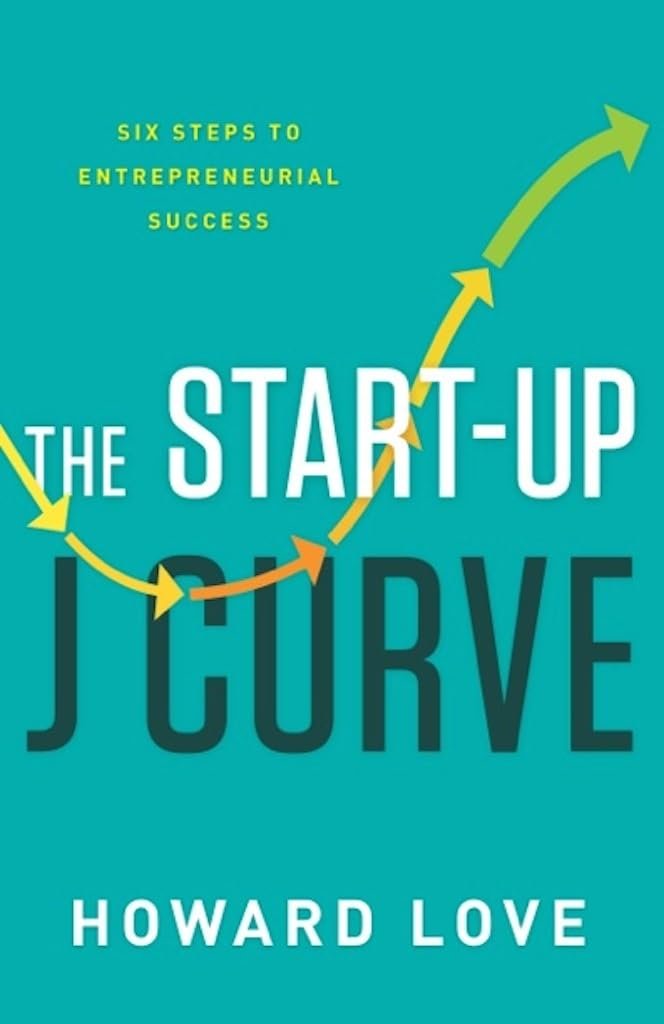
Why The Start-Up J Curve Matters and Who This Book Is For
Every startup journey looks glamorous from the outside. Funding announcements, growth charts, and success stories dominate social media. But what most people never talk about is the painful dip before success — the phase where motivation drops, cash burns faster than expected, and self-doubt peaks.
The Start-Up J Curve by Howard Love exists to explain this hidden
Howard Love introduces the Start-Up J Curve, a visual and psychological model that explains why nearly every startup experiences a sharp decline before eventual growth — and why understanding this curve is critical for survival .
Howard Love, an American entrepreneur and investor, built and scaled companies like LoveToKnow Media. His insights come not from theory but from real operational and leadership experience .
This book is ideal for:
Startup founders and co-founders
Entrepreneurs and solopreneurs
First-time business builders
Investors and startup employees
Anyone focused on self-growth and long-term success
The Big Idea: Understanding the Start-Up J Curve
The Start-Up J Curve explains a simple but uncomfortable truth:
Before a startup grows, it almost always gets worse.
Your notes clearly show a J-shaped curve:
Initial excitement (Concept stage)
A steep dip (Release, Morph, Model stages)
Gradual recovery and growth (Scale and Harvest stages)
Most founders quit during the dip — not because the idea is bad, but because they misunderstand the process.
The Six Stages of the Start-Up J Curve (Deep Dive)
1. Concept – The Excitement Phase
This is where everything begins.
From your handwritten notes:
New idea
High energy
Strong belief
Easy optimism .
Founders brainstorm, pitch, and often raise early money during this stage.
Practical Tip: Stay flexible. Don’t fall in love with the idea — fall in love with solving the problem.
2. Release – Launching the MVP
Release is about getting something real into the market.
Your notes emphasize:
Build MVP
Launch quickly
Avoid perfectionism .
This stage often disappoints founders because customers don’t immediately adopt the product.
Common Mistake: Over-polishing instead of learning.
3. Morph – The Bottom of the J Curve
Morph is the most painful stage.
According to your summary:
Radical changes
Heavy customer feedback
Possible pivots
Emotional exhaustion .
This is where most startups fail.
Key Insight: The dip is not failure — it’s feedback.
4. Model – Finding How to Make Money
In the Model stage, founders revisit their business model.
Your notes highlight:
Pricing experiments
Monetization testing
Subscription vs freemium vs one-time payment .
Many startups survive Morph but die here by scaling too early.
5. Scale – Growing What Works
Scale comes only after validation.
Your notes stress:
Build systems
Hire specialists
Scale cautiously .
Important Rule: Never scale confusion.
6. Harvest – Reaping the Rewards
Harvest is where founders:
Expand
Exit
Pay dividends
Or sell the business
This stage exists only for those who survive the dip.
Two Real-Life Examples of the J Curve in Action
Example 1: SaaS Startup Pivot
A SaaS founder launched a productivity app with strong early interest. After release, usage dropped sharply. Instead of quitting, the team entered Morph, redesigned features based on feedback, changed pricing, and found product-market fit six months later.
Example 2: Offline-to-Online Business
A coaching business moved online during the pandemic. Revenue dipped initially. After restructuring the model and audience targeting, growth accelerated beyond pre-pandemic levels.
Action Plan: Applying the Start-Up J Curve in Real Life
Step 1: Expect the Dip
Mentally prepare for the J Curve.
Step 2: Allocate Resources Wisely
Cash burn peaks during the dip.
Step 3: Learn Fast During Morph
Feedback is fuel.
Step 4: Fix the Model Before Scaling
Revenue clarity first.
Step 5: Scale Systems, Not Chaos
Stability precedes growth.
Lessons Learned from The Start-Up J Curve
The dip is normal
Most startups fail emotionally, not strategically
Feedback matters more than vision
Timing is critical
Scaling too early kills startups
Business models evolve
Persistence must be intelligent
Growth is earned, not promised
Survival precedes success
Understanding the curve saves founders
Step-by-Step Practical Guide for Founders
Validate the problem
Build MVP fast
Launch early
Listen deeply
Iterate ruthlessly
Test monetization
Build repeatable systems
Scale intentionally
10 Key Takeaways from The Start-Up J Curve by Howard Love
All startups follow a J Curve
Expect things to get worse first
Morphing is essential
Feedback drives evolution
Monetization takes time
Scale only after validation
The dip is survivable
Patience is strategic
Focus beats panic
Growth follows clarity
Call to Action
If you are in the dip right now, don’t quit.
Re-read your journey through the lens of the Start-Up J Curve. Learn. Adapt. Persist intelligently.
The curve bends upward — but only for those who understand it and stay the course.