(Why Most Startups Fail—and How Customer Development Can Save Yours)
Why The Startup Owner’s Manual Matters More Than Ever
Every year, millions of startups are launched with passion, funding, and big dreams—yet nearly 90% fail. The most painful truth?
Most startups don’t fail because of bad products.
They fail because they build something nobody wants.
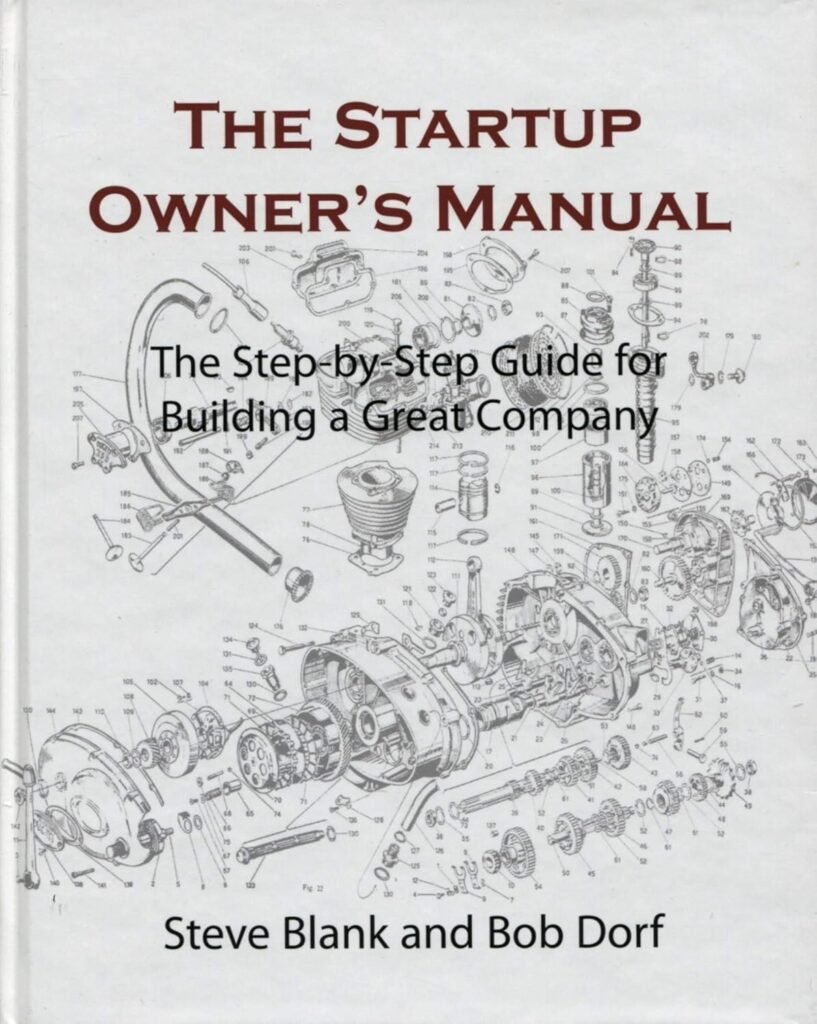
This is where The Startup Owner’s Manual by Steve Blank becomes one of the most important business books ever written.
Steve Blank—American entrepreneur, educator, Silicon Valley veteran, and architect of the Customer Development Methodology—wrote this book as a step-by-step operational manual for entrepreneurs. Unlike motivational startup books, this one is brutally practical.
It answers questions every founder secretly fears:
-
Who are my real customers?
-
Do they care enough to pay?
-
Am I solving a real problem?
-
When should I scale—and when should I stop?
This book is written for:
-
First-time entrepreneurs
-
Startup founders
-
Product managers
-
Innovators & solopreneurs
-
Anyone serious about building a repeatable, scalable business
If you are an entrepreneur, startup business owner, or someone focused on self-growth and development, this book doesn’t just teach—it forces clarity.
What Is a Startup? Steve Blank’s Revolutionary Definition
Steve Blank begins by destroying a dangerous myth:
“A startup is not a smaller version of a large company.”
Instead:
A startup is a temporary organization designed to search for a repeatable and scalable business model.
This single idea changes everything.
Large companies execute known models.
Startups search for unknown ones.
Most founders fail because they:
-
Write detailed business plans
-
Build full products
-
Hire teams
-
Spend money on marketing
👉 Before knowing if customers actually exist
The Traditional Product Launch Model (Why It Fails Startups)
Traditional companies follow a waterfall model:
-
Concept
-
Product Development
-
Testing
-
Launch
-
Sales & Marketing
This works for established firms, not startups.
Why?
Because startups operate on assumptions, not facts.
Steve Blank calls this approach deadly for startups—and outlines Nine Deadly Sins that founders commit.
The Nine Deadly Sins of Startups
-
Assuming you know what customers want
-
Assuming which features to build
-
Focusing on launch dates instead of learning
-
Emphasizing execution over experimentation
-
Writing static business plans instead of flexible models
-
Confusing job titles with startup responsibilities
-
Premature sales & marketing
-
Premature scaling
-
Crisis-driven management
These sins don’t kill companies overnight.
They slowly drain cash, morale, and opportunity.
The Customer Development Manifesto (The Heart of the Book)
Steve Blank replaces guessing with learning through his Customer Development Manifesto—14 rules that guide startups.
Here are the most powerful ones:
Rule 1: There Are No Facts Inside Your Building
Customers don’t live in PowerPoint slides.
Get outside. Talk to real people.
Rule 2: Pair Customer Development with Product Development
Build → Test → Learn → Pivot → Repeat
Rule 3: Failure Is Part of the Search
Failure isn’t weakness—it’s data.
Rule 5: No Business Plan Survives First Contact with Customers
Replace business plans with the Business Model Canvas.
Rule 6: Design Experiments to Test Hypotheses
Every belief must be tested.
Rule 8: Startup Metrics Are Different
Vanity metrics don’t matter. Learning metrics do.
The Four-Step Customer Development Process
This is the core framework of The Startup Owner’s Manual.
Step 1: Customer Discovery – Are You Solving a Real Problem?
This stage tests:
-
Who the customer is
-
What problem they have
-
Whether they care enough to solve it
Founders must ask questions like:
-
“What’s the hardest part of your day?”
-
“How do you currently solve this?”
-
“What frustrates you the most?”
👉 You are not selling. You are listening.
Real-Life Example #1: Dropbox
Before building the full product, Dropbox created a simple explainer video.
If people didn’t sign up, the company wouldn’t exist today.
Customers validated the problem before the product was built.
Step 2: Customer Validation – Can You Sell Repeatedly?
Now you test:
-
Will customers pay?
-
Is the sales process repeatable?
-
Can you acquire customers profitably?
This stage separates interest from commitment.
Steve Blank emphasizes:
“A startup isn’t successful when users say they like it—it’s successful when they pay.”
If customers don’t buy:
👉 Pivot (change customer, problem, solution, or channel)
Step 3: Customer Creation – Creating Demand
Once validation exists, startups move to demand generation.
This depends on market type:
-
Existing Market
-
New Market
-
Re-segmented Market
-
Hybrid Market
Marketing strategies vary for each.
Real-Life Example #2: Airbnb
Airbnb didn’t scale until they:
-
Understood hosts’ motivations
-
Personally visited listings
-
Improved photography
-
Built trust systems
Customer creation only works after validation.
Step 4: Company Building – From Startup to Scalable Company
Only now does a startup:
-
Build departments
-
Hire managers
-
Scale operations
Many startups fail because they jump here too early.
Premature scaling is the #1 reason funded startups collapse.
Lean Startup Meets Customer Development
Steve Blank’s work directly influenced Eric Ries’ Lean Startup movement.
Key shared principles:
-
Build MVPs
-
Test hypotheses
-
Pivot fast
-
Learn continuously
But Blank adds something deeper:
👉 Customer behavior comes before product features
Why Failure Is Not the Enemy
In this book:
-
Failure = learning
-
Pivots = progress
-
Feedback = fuel
A pivot is not quitting.
It’s course correction based on truth.
Action Plan: How to Apply This Book in Real Life
Week 1–2: Hypothesis Mapping
-
Who is your customer?
-
What problem do they have?
-
Why now?
Week 3–4: Customer Discovery Interviews
-
Talk to 30–50 potential customers
-
Don’t pitch—listen
Week 5–6: MVP & Validation
-
Build the simplest version
-
Ask for money, not opinions
Week 7–8: Measure & Pivot
-
What worked?
-
What didn’t?
-
Change fast
Step-by-Step Practical Guide
-
Replace business plan with Business Model Canvas
-
Identify riskiest assumptions
-
Test with customer interviews
-
Build MVP
-
Validate willingness to pay
-
Iterate fast
-
Scale only after validation
Lessons Learned from The Startup Owner’s Manual
-
Startups are experiments, not execution engines
-
Customers—not ideas—define success
-
Speed of learning beats speed of building
-
Premature scaling kills startups
-
Humility wins markets
10 Powerful Takeaways from the Book
-
A startup searches; a company executes
-
There are no facts inside the building
-
Customer discovery precedes product building
-
Failure is essential data
-
MVPs reduce waste
-
Business models evolve—not plan
-
Validation comes from payment, not praise
-
Pivoting is strength
-
Scaling comes last
-
Listening is a competitive advantage
Call to Action
If you are serious about building a startup that actually survives, this book is not optional—it’s essential.
📘 The Startup Owner’s Manual teaches you how to stop guessing, start learning, and build businesses customers truly want.
👉 Read the book. Apply the framework. Talk to customers.
Your startup deserves facts—not assumptions.
Disclaimer
This blog is for educational purposes only.
All examples are illustrative and meant to demonstrate how to apply the concepts of The Startup Owner’s Manual in real life.