A Business That Looked Good—but Felt Stuck
On a freezing January morning in Chicago, David Thompson stood in front of his laptop, staring at his website analytics.
Visitors were coming.
Leads were not.
David was 37, running a small consulting business that helped local service companies improve operations. On paper, everything looked right—experience, credentials, testimonials. But month after month, revenue stayed flat.
His website headline read:
“We Deliver Innovative Operational Solutions for Growing Businesses.”
Even David didn’t know what that meant anymore.
Clients often asked on discovery calls,
“So… what exactly do you do?”
And every time David tried to explain, he spoke faster, added more features, and left people more confused than when the call started.
At night, doubt crept in.
Is my business broken—or is it me?
Turning Point: Discovering Building a StoryBrand
One evening, after a long day of client calls that led nowhere, David attended a small entrepreneurs’ meetup near River North. During casual conversations, one founder shared something simple but striking:
“Once I clarified my message using Building a StoryBrand, my sales doubled in three months.”
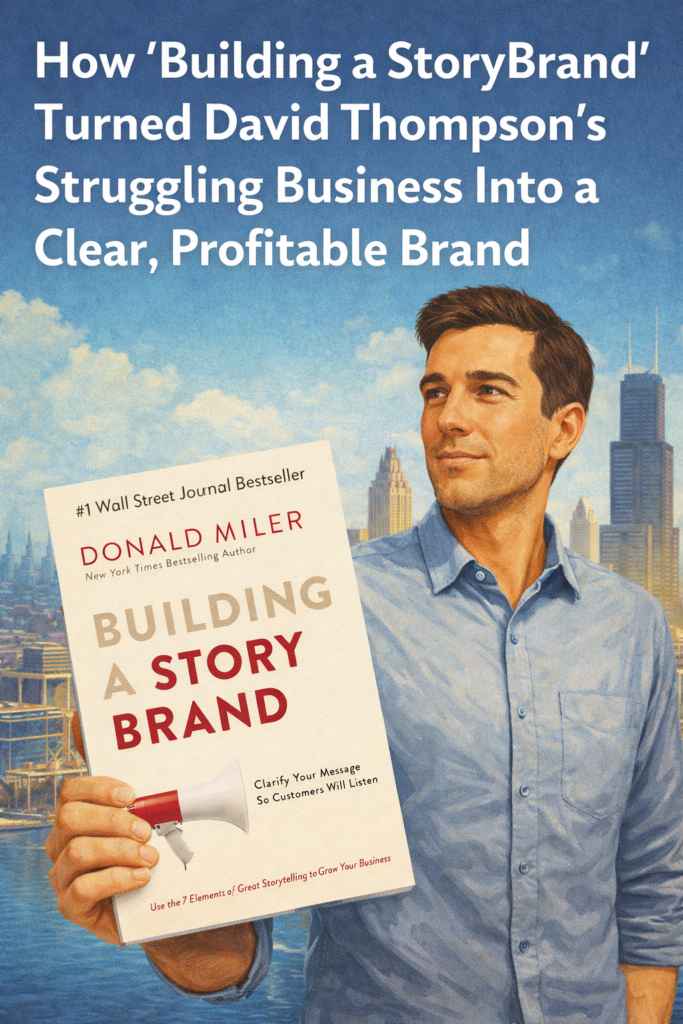
That night, David ordered **Building a StoryBrand by Donald Miller.
He didn’t expect miracles.
But by chapter three, something uncomfortable hit him hard:
“Your customer is the hero of the story. Not you.”
David realized his brand story was entirely about him.
His experience.
His process.
His achievements.
No wonder customers didn’t listen.
Implementation Phase: Applying the StoryBrand Framework Step by Step
David didn’t just read the book—he rebuilt his business messaging around it.
1. Making the Customer the Hero (Not the Business)
Before:
“We provide operational excellence solutions.”
After:
“We help overwhelmed business owners simplify operations so they can grow without burnout.”
David stopped talking about what he did—and focused on what customers wanted:
-
Less stress
-
More clarity
-
Predictable growth
Suddenly, prospects leaned in.
2. Identifying the Real Problem (External, Internal, Philosophical)
Using StoryBrand, David mapped his customer’s problems:
-
External problem: Disorganized systems and inefficiency
-
Internal problem: Feeling overwhelmed and out of control
-
Philosophical problem: “Running a business shouldn’t cost you your sanity”
This reframing changed everything. His marketing wasn’t about processes—it was about relief.
3. Becoming the Guide, Not the Hero
StoryBrand teaches that the guide needs:
-
Empathy: “I understand your struggle.”
-
Authority: “I’ve helped others succeed.”
David added:
-
Short case studies
-
A personal note: “I built this system after nearly burning out myself.”
Trust skyrocketed.
People didn’t want a genius.
They wanted a guide.
4. Creating a Simple Plan
Instead of long proposals, David introduced a 3-step plan:
-
Schedule a clarity call
-
Get a customized operational roadmap
-
Implement systems that free your time
No jargon.
No confusion.
Clients finally understood how to start.
5. Calling Customers to Action (Clearly and Boldly)
Previously, David’s website said:
“Learn More”
Now it said:
“Book Your Free Clarity Call”
He also added transitional CTAs:
-
Download a checklist
-
Watch a 5-minute explainer video
Conversions doubled within weeks.
The Breakthrough: When Everything Changed
Three months later, David received an email from a prospect who wrote:
“Your website felt like it was written for me. I finally understood what problem you solve.”
That month:
-
Revenue increased by 65%
-
Discovery calls became shorter—and more effective
-
Clients closed faster, with less resistance
The turning point wasn’t a new product.
It wasn’t more ads.
It was clarity.
Life After Change: A Business That Finally Made Sense
A year later, David’s life looked different.
-
He worked fewer hours
-
Raised his prices
-
Attracted better clients
-
Built a small team
Most importantly, he felt confident explaining his business—in one sentence.
His new one-liner:
“I help service business owners simplify operations so they can grow without burning out.”
Simple.
Clear.
Memorable.
Reflection: David’s Biggest Lessons from StoryBrand
David often shares these insights with other entrepreneurs:
1. Confused customers never buy
If people don’t understand your message in 5 seconds, they move on.
2. Your customer wants to be the hero
Your brand exists to support their transformation—not showcase your brilliance.
3. Simplicity beats sophistication
Clear beats clever. Always.
4. Storytelling isn’t marketing fluff—it’s survival
The human brain is wired for stories, not features.
5. Clarity creates confidence
When you know what you do and who you serve, selling becomes service.
Practical Takeaways You Can Apply Today
-
Rewrite your homepage headline focusing on customer outcomes
-
Identify your customer’s internal problem
-
Create a simple 3-step plan
-
Add a bold, direct call to action
-
Remove jargon and buzzwords
-
Test your one-liner on a friend—if they can repeat it, it works
Call to Action
Inspired by David’s journey?
This is just one story in our Book to Life series.
Pick up Building a StoryBrand by Donald Miller today—and take the first step toward clarifying your message, growing your business, and transforming your life.
Your story already matters.
It’s time to tell it clearly.
Disclaimer
This story is hypothetical and created solely to demonstrate how the concepts from the book can be applied in real life through a story format.