Why Most Startup Stories Lie — and Why Jason’s Didn’t
Most success stories are told backward.
They begin with headlines:
“Startup Sells for Millions.”
“Founder Becomes Overnight Success.”
But Jason Reed’s journey in New York City didn’t start with success.
It started with doubt, unpaid rent, late-night subway rides, and a constant fear that he might be chasing the wrong dream.
And what changed everything for him wasn’t a motivational quote, a viral reel, or a business guru.
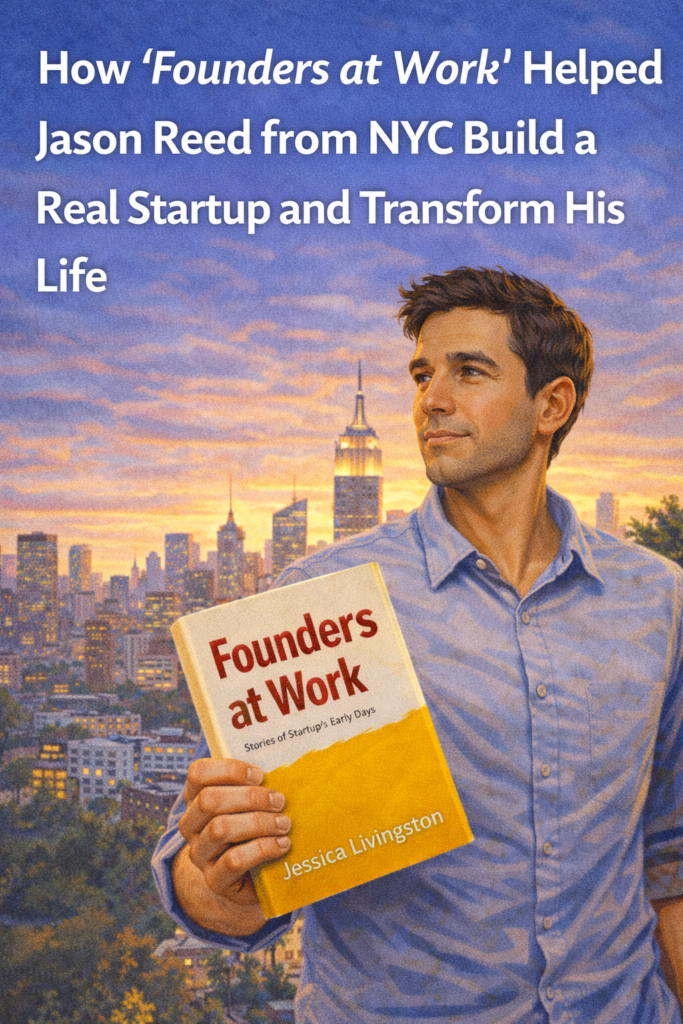
It was a brutally honest book called Founders at Work by Jessica Livingston.
Chapter 1: Jason Before the Breakthrough — Stuck, Smart, and Silent
Jason Reed was 29, living in a cramped apartment in Brooklyn, working as a product analyst at a mid-sized tech company in Manhattan.
On paper, he was doing fine.
But inside?
He felt stuck.
Every day looked the same:
-
Morning subway ride
-
Endless meetings
-
Talking about “innovation” while building nothing new
-
Watching startup success stories online and wondering, “What am I missing?”
Jason had ideas — plenty of them.
But he never acted.
Why?
Because he believed a lie many aspiring entrepreneurs believe:
“If the idea isn’t perfect, I shouldn’t start.”
Fear kept him frozen.
The Real Struggle: Fear of Getting It Wrong
Jason didn’t fear hard work.
He feared:
-
Starting with the wrong idea
-
Failing publicly
-
Looking foolish in front of friends
-
Losing control over his future
In New York City, surrounded by ambition, failure felt louder.
And so Jason stayed safe — until one evening changed everything.
Chapter 2: The Turning Point — Discovering Founders at Work
One rainy Thursday night, Jason wandered into a small bookstore near Union Square.
He wasn’t looking for motivation.
He was looking for truth.
A book with a simple cover caught his eye:
Founders at Work: Stories of Startups’ Early Days — Jessica Livingston
No flashy promises.
No “10X Growth” slogans.
Just stories.
That night, Jason read until 3 a.m.
And something clicked.
What Shocked Jason the Most
The founders in the book:
-
Didn’t start with perfect ideas
-
Didn’t feel confident
-
Didn’t know what would work
Companies like PayPal, Yahoo, Blogger, Hotmail, Flickr all began with:
-
Confusion
-
Wrong assumptions
-
Constant pivots
Jason realized something powerful:
“I’m not behind. I’m just at the beginning.”
Chapter 3: Implementation Phase — Applying the Lessons Step by Step
Jason didn’t quit his job the next day.
Instead, he did something smarter.
He applied the lessons from Founders at Work one by one.
Principle 1: Your First Idea Doesn’t Have to Be the Final One
From the book, Jason learned:
Most startups don’t succeed with their first idea — and that’s normal.
So he stopped searching for the “perfect idea.”
Instead, he asked:
-
What problems do people around me face repeatedly?
-
What frustrates them enough to complain about?
He noticed something simple:
Many small service businesses in NYC struggled to manage customer follow-ups and repeat clients.
So Jason built a basic prototype — not a startup, not a company — just a tool.
No logo.
No pitch deck.
Just usefulness.
Principle 2: Do More With Less (Simplicity Over Sophistication)
One recurring theme in Founders at Work is simplicity.
The founders didn’t overbuild.
They shipped something small and learned fast.
Jason followed suit:
-
No fancy UI
-
No complex features
-
Just one core function done well
Instead of spending months building, he launched in three weekends.
And then — he talked to users.
Principle 3: Talk to Users, Not Your Ego
Another powerful lesson from the book:
Founders who listen survive. Founders who assume disappear.
Jason met business owners:
-
Coffee shop owners
-
Freelancers
-
Small agencies
He asked:
-
“What do you hate doing repeatedly?”
-
“What tool do you already use but dislike?”
Some feedback hurt.
Some ideas failed immediately.
But Jason remembered a line from the book:
Failure early is information, not defeat.
Principle 4: Team Matters More Than the Idea
Jason originally planned to do everything alone.
But Founders at Work made one thing clear:
A strong team can rescue a weak idea. A weak team can kill a great one.
He partnered with:
-
A designer who hated marketing
-
A sales-minded friend who hated coding
Each filled a gap.
No titles.
No ego.
Just shared ownership and trust.
Principle 5: Funding Is Not Success — Control Is
Living in NYC, Jason constantly heard:
“Raise money.”
“Pitch investors.”
“Scale fast.”
But Founders at Work showed him the hidden cost of early funding:
-
Loss of control
-
Forced growth
-
External pressure
Jason chose a different path:
-
Bootstrapped
-
Lean
-
Profitable first, scalable later
That decision changed everything.
Chapter 4: The Breakthrough — When Reality Finally Shifted
Six months in, something unexpected happened.
Customers started referring others.
Not because of ads.
Not because of branding.
But because the product solved a real problem simply.
One day, Jason checked his dashboard:
-
Revenue covered his rent
-
Then his monthly expenses
-
Then his salary
That night, sitting in the same Brooklyn apartment, Jason realized:
“This isn’t a side project anymore. This is my business.”
That was the crossover point.
Chapter 5: Life After Change — A New Definition of Success
Jason didn’t become a billionaire.
He became something better.
He became free.
His new life looked like:
-
Flexible schedule
-
Meaningful work
-
Calm decision-making
-
Growth on his own terms
He eventually left his job — not in panic, but in confidence.
How Jason Maintains Success Today
Jason still follows the lessons from Founders at Work:
-
He listens more than he speaks
-
He ships before he perfects
-
He protects simplicity
-
He values people over hype
His business grows steadily — sustainably.
Chapter 6: Reflection — Jason’s Advice to Aspiring Founders
Jason often shares this advice:
“Stop waiting to feel ready. Founders never feel ready.”
What he learned:
-
Confusion is part of the process
-
Starting small is not thinking small
-
Control beats valuation early on
-
Real users teach faster than mentors
-
The journey is human, not heroic
Key Lessons from Founders at Work (Applied in Jason’s Life)
-
First ideas are rarely final
-
Simplicity beats complexity
-
Teams matter more than ideas
-
Funding is optional, not mandatory
-
Control enables creativity
-
Early failure saves future pain
-
Real stories beat startup myths
-
Listening is a superpower
-
Constraints sharpen thinking
-
Success grows quietly at first
Call to Action
Inspired by Jason’s journey?
This is just one story in our Book to Life series.
📘 Read Founders at Work by Jessica Livingston
🚀 Apply its lessons to your own journey
✍️ Start before you feel ready
Because every great founder once stood exactly where you are now.