When Talent Isn’t Enough
Ethan Miller had what most people would call a dream career.
A senior product designer at a fast-growing tech company in San Francisco, he worked on products used by millions. The pay was good. The office had free coffee, standing desks, and inspirational posters about “innovation.”
Yet on a foggy Tuesday morning, staring at his laptop in a glass-walled meeting room, Ethan felt something he hadn’t felt before:
Fear.
Not the loud kind. The quiet, corrosive kind.
Fear of speaking up.
Fear of suggesting ideas that might sound stupid.
Fear of failing in public.
Once known as “the creative guy,” Ethan had slowly become invisible in meetings. His ideas stayed in his notebook. His confidence eroded, meeting by meeting.
Creativity hadn’t left him.
It had been suffocated.
Before the Book: A Creative Career in Slow Decline
Ethan’s struggle wasn’t about skill. It was about environment.
His company talked about innovation but punished mistakes. Feedback came late and vague. Leadership valued execution speed over exploration. Every review meeting felt like a silent test.
Over time:
-
He stopped experimenting
-
He played safe
-
He optimized instead of imagining
At home, he felt drained. On weekends, he avoided personal projects. Creativity—once his identity—felt like a liability.
One evening, after another meeting where his idea died unspoken, Ethan admitted something painful to himself:
“I’m not failing because I’m not creative. I’m failing because I’m afraid.”
The Turning Point: Discovering Creativity, Inc. by Ed Catmull
The turning point came unexpectedly.
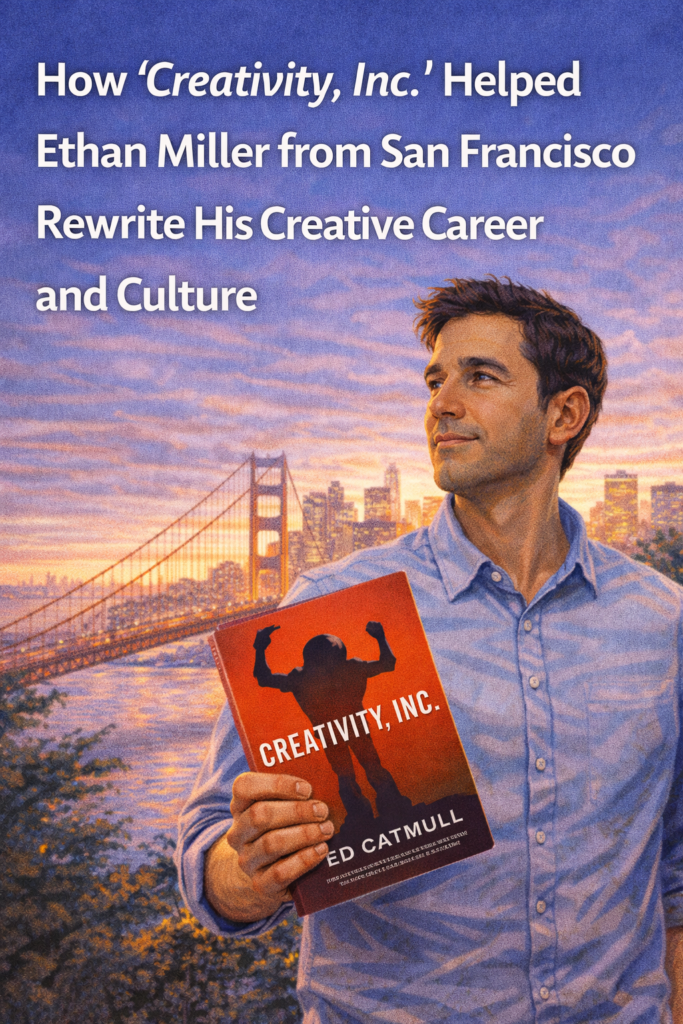
At a small independent bookstore in Mission District, Ethan picked up a book with a simple title:
Creativity, Inc. by Ed Catmull
He knew Pixar. He loved Toy Story, Up, Inside Out. But what caught his eye was the subtitle:
Overcoming the unseen forces that stand in the way of true inspiration
That line felt personal.
Ethan bought the book, telling himself it was “just a weekend read.” But by Sunday night, he had underlined half the pages.
For the first time, he realized something liberating:
Creativity doesn’t fail. Environments do.
Implementation Phase: Applying Pixar’s Lessons to Real Life
Ethan didn’t quit his job. He didn’t start a company.
Instead, he decided to experiment where he was—just like Pixar did.
Lesson 1: People Matter More Than Ideas
One idea from the book hit him hard:
“Give a great idea to a mediocre team and they’ll ruin it. Give a mediocre idea to a great team and they’ll fix it.”
Ethan realized he had been protecting his ideas instead of collaborating.
What he changed:
-
He started sharing half-formed ideas early
-
He invited critique instead of waiting for perfection
-
He focused on building creative trust, not personal credit
Instead of asking, “Is my idea good?”
He asked, “Can we make this better together?”
Lesson 2: Candor Without Cruelty
Pixar’s concept of candor—honest feedback without hierarchy—was a revelation.
Ethan noticed his team avoided real feedback. Praise was vague. Criticism was political.
He started small.
What he did:
-
Asked specific questions: “What’s unclear?” instead of “Thoughts?”
-
Framed feedback around problems, not people
-
Publicly thanked colleagues who challenged his ideas
Slowly, conversations changed.
People spoke more openly. Meetings became energizing instead of tense.
Lesson 3: Removing Fear from the Room
Ed Catmull wrote that fear is creativity’s greatest enemy.
Ethan saw fear everywhere:
-
Fear of being wrong
-
Fear of leadership reaction
-
Fear of looking incompetent
He couldn’t change company culture overnight—but he could change his micro-environment.
What he changed:
-
Shared his own mistakes openly
-
Admitted uncertainty in meetings
-
Encouraged junior designers to speak first
By making vulnerability visible, he made creativity safer.
Lesson 4: Failure Is Data, Not Disaster
Pixar films start out bad. Ethan loved that idea.
Instead of hiding mistakes, Pixar studies them.
So Ethan proposed something radical for his team:
“Let’s review what didn’t work this sprint—and what it taught us.”
At first, silence.
Then stories emerged. Patterns became clear. Solutions followed.
Failure became fuel.
Lesson 5: Leadership Is About Environment, Not Control
Ethan wasn’t a manager—but leadership isn’t a title.
Inspired by Catmull, he focused on:
-
Clearing obstacles
-
Connecting people
-
Protecting creative space
Without realizing it, he became someone others trusted.
The Breakthrough: When Everything Shifted
The breakthrough came during a high-stakes product review.
A feature Ethan’s team had been developing wasn’t working. Metrics were weak. Pressure was high.
Instead of defending the work, Ethan did something different.
He said:
“This version failed—but here’s what we learned. And here’s what we’ll try next.”
The room paused.
Then something unexpected happened.
Leadership leaned in.
Questions followed—not accusations. The project wasn’t killed. It was reimagined.
Two months later, the redesigned feature launched—and outperformed expectations.
Ethan wasn’t just noticed.
He was trusted.
Life After Change: A New Kind of Success
Ethan’s career transformed—but not in the way he expected.
Yes, he earned a promotion.
Yes, he led bigger projects.
But the real change was internal.
-
He enjoyed work again
-
He started mentoring others
-
He revived personal creative projects
-
He became known as a culture-builder, not just a designer
Creativity returned—not as pressure, but as joy.
Reflection: What Ethan Learned from Creativity, Inc.
Looking back, Ethan summarized his transformation in one sentence:
“Creativity isn’t about being brilliant—it’s about being brave in the right environment.”
His advice to others:
-
Don’t wait for permission to create safety
-
Speak honestly, kindly, and early
-
Treat failure as information
-
Build trust before chasing innovation
-
Remember: people create ideas—not the other way around
Actionable Takeaways for Readers
You don’t need to work at Pixar to apply these lessons.
You can start today by:
-
Encouraging honest feedback
-
Admitting what you don’t know
-
Sharing imperfect ideas
-
Protecting creative space
-
Leading through trust, not control
Call to Action
Inspired by Ethan’s journey?
This is just one story in our Book to Life series.
📘 Read Creativity, Inc. by Ed Catmull
🎯 Apply one lesson this week
🚀 Start building an environment where creativity—and confidence—can grow
Because creativity isn’t a talent problem.
It’s an environment problem.
Disclaimer
This story is hypothetical and written only for the purpose of demonstrating how the concepts from the book can be applied in real life, in story form.