
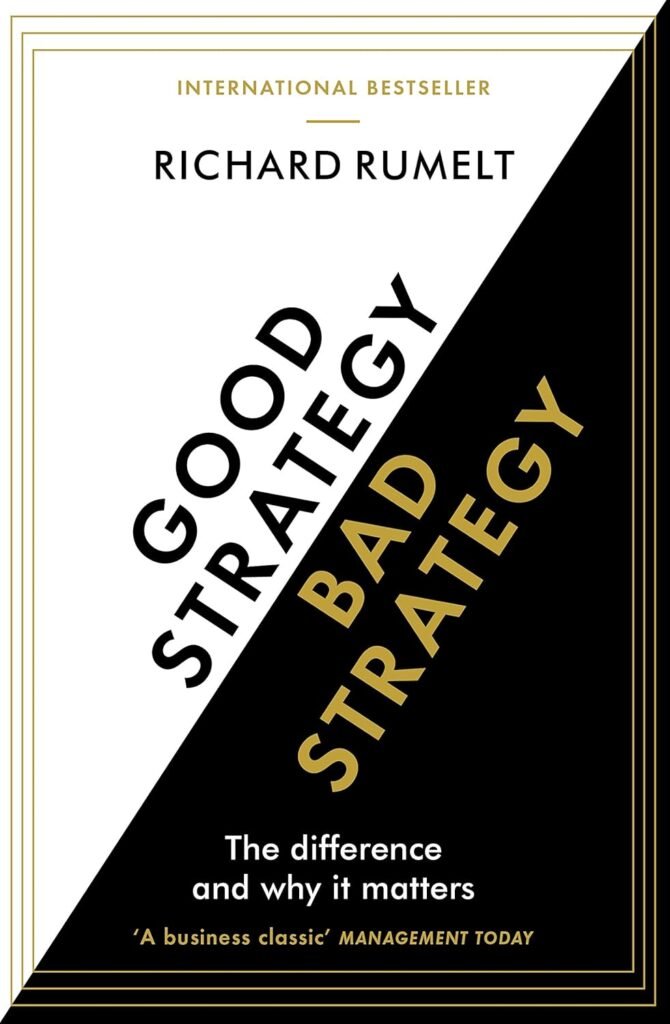
What separates a good strategy from a collection of ambitious goals? Richard Rumelt’s Good Strategy/Bad Strategy offers a powerful answer: good strategy begins by facing reality, identifying the critical challenge, and concentrating effort where it matters most.
Many people believe strategy means setting bigger goals.
“Grow the business.”
“Become number one.”
“Increase sales.”
“Beat the competition.”
“Build a strong brand.”
These sound impressive. But they are not necessarily strategies.
A real strategy tells you what problem you are facing, what approach you will take, and where you will concentrate your resources to overcome it.
That is the central lesson behind Richard Rumelt’s influential book Good Strategy/Bad Strategy.
strategy is presented as a response to critical factors, built around a diagnosis, a guiding policy, and coherent actions.
This blog explores the Good Strategy Bad Strategy by Richard Rumelt summary lessons through practical examples, business thinking, personal development, entrepreneurship, startup business, sales and marketing, and one simple question:
What would change if you stopped confusing goals with strategy?
Why Good Strategy Bad Strategy by Richard Rumelt Matters
Imagine two business owners.
The first says:
“Our goal is to double revenue in three years.”
The second says:
“Our biggest problem is that we are losing customers because our service takes three days to respond. We will focus on serving our highest-value customers within four hours, redesign the support process, and move resources away from low-value activities.”
Who has a strategy?
The second person.
The first has a goal.
The second has identified a challenge and a coordinated response.
This distinction is one of the most important lessons in the book.
Rumelt argues that strategy is not simply a vision statement, motivational slogan, financial target, or list of ambitions. A strong strategy deals with the difficult reality standing between where you are and where you want to go.
strategy as a response to critical factors and emphasize three major components:
- Diagnosis
- Guiding policy
- Coherent action
These elements need to work together rather than exist as disconnected ideas.
That simple framework can transform how an entrepreneur thinks.
The Three Building Blocks of Good Strategy
1. Diagnosis: Understand the Real Problem
The first step is diagnosis.
Before asking, “What should we do?”, ask:
“What is actually going wrong?”
This sounds obvious, but it is surprisingly difficult.
Businesses often treat symptoms instead of causes.
Sales are falling, so they launch discounts.
Customers are leaving, so they increase advertising.
Employees are unproductive, so management adds more meetings.
Profits are declining, so they cut expenses everywhere.
But none of these actions necessarily addresses the real problem.
Describe diagnosis as understanding the complexity of a company’s circumstances and identifying the important challenge.
Practical example
Suppose a startup says:
Problem: “We need more customers.”
That is too broad.
After investigation, the real issue might be:
“Customers are visiting our website but abandoning the purchase because the checkout process is confusing.”
Now the problem is actionable.
The company doesn’t necessarily need more advertising.
It needs a better conversion process.
Practical Tip
Before making a strategy, write down:
- What is happening?
- What is not happening?
- Why is it happening?
- Which factor matters most?
- Which problem, if solved, would create the biggest improvement?
That is diagnosis.
2. Guiding Policy: Decide How You Will Win
Once the problem is diagnosed, the next question is:
What approach will we take?
This is the guiding policy.
Your notes describe the guiding policy as the direction that guides the response to the diagnosis and helps focus resources toward the objective.
A guiding policy creates boundaries.
It tells you what you will focus on—and sometimes, more importantly, what you will not focus on.
For example:
A restaurant could try to serve everyone.
Families.
Students.
Tourists.
Business executives.
Luxury customers.
Budget customers.
But a better strategy might be:
“We will become the fastest, most reliable healthy lunch option for nearby office workers.”
Now decisions become easier.
What menu should we create?
What should our delivery time be?
Where should we advertise?
What social media content should we publish?
Who should we hire?
The guiding policy creates alignment.
3. Coherent Action: Turn Strategy Into Reality
A strategy is incomplete without action.
Coherent actions as the third component of good strategy. They also highlight examples involving specific activities, resources, and objectives working together.
This is where many strategies fail.
A company may have an excellent presentation explaining its strategy, but if its actions don’t support that strategy, nothing changes.
Think about a company that says:
“We are the premium customer-service brand.”
But:
- Customer support is outsourced to the cheapest provider.
- Employees are poorly trained.
- Complaints take seven days to resolve.
- The website is difficult to use.
- Management measures only cost reduction.
The strategy and actions contradict each other.
A coherent strategy would align resources, people, processes, technology, and measurement toward the same objective.
The Story of Alex: When “Work Harder” Stopped Working
Consider a fictional but realistic entrepreneur named Alex.
Alex owned a growing digital marketing company.
For five years, the business had grown steadily.
Then everything changed.
Competition increased.
New agencies appeared every month.
Clients started comparing prices.
Alex responded in the usual way.
More advertising.
More salespeople.
More social media.
More services.
More meetings.
More employees.
And yet profits continued to fall.
One Monday morning, Alex sat alone in the office at 8:30 p.m.
The city outside was glowing through the glass windows.
His laptop showed twelve unfinished tasks.
His phone showed twenty-three unread messages.
Revenue was higher than it had ever been.
But somehow, the business felt weaker.
Alex thought:
“Maybe I just need to work harder.”
Then he encountered Richard Rumelt’s ideas about strategy.
That sentence began to bother him.
Perhaps the problem wasn’t effort.
Perhaps the problem was direction.
Step 1: Alex Diagnoses the Real Problem
Instead of immediately creating another marketing campaign, Alex spent one week studying the business.
He looked at:
- Customer profitability
- Customer retention
- Service delivery
- Employee workload
- Sales conversion
- Pricing
- Competitors
- Client complaints
- Time spent on different services
The results surprised him.
His company had 47 clients.
But nearly 70% of profit came from only 12 clients.
The remaining clients consumed enormous amounts of employee time.
Alex had been treating every customer equally.
That was his first strategic mistake.
His diagnosis became:
“The company is not suffering primarily from a lack of customers. It is suffering from an unfocused customer and service model.”
Everything suddenly looked different.
Step 2: Create a Guiding Policy
Alex decided to stop trying to be everything for everyone.
His agency would focus on one specific segment: established local businesses that needed measurable digital customer acquisition.
He would reduce low-margin services.
He would stop accepting every client.
He would build specialized expertise.
The objective wasn’t simply:
“Increase revenue.”
It became:
“Build a specialized, high-value agency around clients for whom measurable digital growth is strategically important.”
That was a guiding policy.
Step 3: Create Coherent Actions
Alex then changed the business.
He:
- Rebuilt the service packages.
- Reduced low-margin projects.
- Created specialized teams.
- Improved reporting.
- Trained employees in the target industry’s problems.
- Changed the sales process.
- Increased prices for specialized services.
- Created educational content around the company’s expertise.
- Focused marketing on a narrow customer group.
None of these actions was extraordinary individually.
Together, they created coherence.
That is the power of strategy.
Real-Life Example: Walmart and the Power of Advantage
One of the examples highlighted in your handwritten notes is Walmart and its competitive advantage, contrasting its strategy with competitors. The notes emphasize the relationship between strategy, policy, action, and competitive advantage.
Walmart’s success wasn’t simply because someone announced:
“We want to become the world’s biggest retailer.”
The important question was how the company created an advantage.
Its model involved interconnected choices around pricing, purchasing, distribution, inventory, store locations, and operational efficiency.
The lesson for entrepreneurs is powerful:
Competitive advantage rarely comes from one isolated brilliant idea.
It often comes from a system of mutually reinforcing decisions.
A competitor might copy one activity.
But copying the entire system is much harder.
Real-Life Example: NVIDIA and the Power of Strategic Focus
Your notes also refer to NVIDIA and its approach to the 3D graphics market, illustrating diagnosis, guiding policy, and action.
The broader lesson is especially useful for technology entrepreneurs.
When entering a competitive market, you cannot simply say:
“We will build the best technology.”
You need to identify where the opportunity lies, understand what competitors are doing, and concentrate resources where your capabilities can create an advantage.
That is strategic thinking.
The same principle applies to startups today.
Don’t ask:
“How can we compete with everyone?”
Ask:
“Where can our particular capabilities give us an advantage?”
Good Strategy Is Not Just a Goal
This may be the biggest lesson from Good Strategy Bad Strategy by Richard Rumelt.
A goal describes a desired future.
Strategy explains how you will overcome the obstacles between today and that future.
Consider these statements:
Goal
“We want to become the market leader.”
Bad Strategy
“We will provide world-class service, innovate continuously, build our brand, expand globally, and maximize shareholder value.”
Better Strategy
“Our biggest obstacle is that customers see our product as interchangeable with cheaper alternatives. We will concentrate on one high-value customer segment, develop a specialized product for its most expensive problem, and build our sales and service system around that niche.”
The difference is enormous.
What Makes Bad Strategy So Attractive?
Bad strategy often sounds impressive.
It contains:
- Big words
- Ambitious targets
- Corporate language
- Inspirational statements
- Long presentations
- Multiple priorities
- Complicated plans
But it may avoid the uncomfortable truth.
Your notes specifically highlight several warning signs of bad strategy, including failure to face challenges, mistaken goals, and vague strategic objectives.
A bad strategy essentially says:
“We want a better future.”
A good strategy says:
“Here is the obstacle preventing that future, here is how we will approach it, and here are the actions we will take.”
The Kernel of Good Strategy
Rumelt’s framework can be remembered as a simple three-part sequence:
1. Diagnosis
What is really happening?
Identify the critical challenge.
2. Guiding Policy
How will we respond?
Choose an approach that concentrates effort.
3. Coherent Actions
What must we actually do?
Create coordinated actions that reinforce the policy.
The strategy “kernel” around these three parts and repeatedly connect diagnosis, guiding policy, and coherent action.
This framework is useful far beyond corporate strategy.
It can be applied to:
- Entrepreneurship
- Career planning
- Personal development
- Financial goals
- Sales
- Marketing
- Startup business
- Social media brand building
- Leadership
- Productivity
How to Apply Good Strategy to Your Career
Imagine you’re unhappy in your career.
Your goal is:
“I want a better career.”
That’s not enough.
Diagnosis
Maybe the real problem is:
“I have strong analytical skills, but my current role gives me almost no opportunity to use them.”
Guiding Policy
You decide:
“I will move toward roles where analytical and strategic skills are central.”
Coherent Actions
You:
- Identify three target industries.
- Learn the required skills.
- Build two relevant projects.
- Network with people in those industries.
- Update your résumé around measurable analytical achievements.
- Apply selectively.
- Review progress every month.
Now you have a strategy.
How Entrepreneurs Can Use the Framework
For an entrepreneur, strategy should answer five practical questions:
What is our biggest obstacle?
Not ten obstacles.
The critical obstacle.
What advantage can we exploit?
What can you do better, faster, cheaper, differently, or more effectively?
Where should resources be concentrated?
Money, people, time, technology, attention, and relationships are limited.
What should we stop doing?
This is often ignored.
A strategy requires choices.
Do our actions reinforce each other?
If your marketing promises premium quality but your operations prioritize low cost, there is a strategic contradiction.
Strategy Requires Saying “No”
This is one of the hardest lessons for ambitious people.
They want:
- More customers
- More products
- More markets
- More employees
- More social media
- More revenue
- More opportunities
But strategic focus requires saying:
“Not now.”
The importance of focus and concentration of resources, rather than trying to pursue multiple objectives without sufficient concentration.
Imagine sunlight.
Spread across a wide area, it warms.
Concentrated through a magnifying glass, it can ignite.
Strategy works similarly.
Concentration creates power.
The Action Plan: Build Your Own Strategy
Here is a simple exercise you can complete in one hour.
Step 1: Write Your Current Situation
Describe reality without exaggeration.
Where are you now?
What is working?
What isn’t?
Step 2: Identify the Critical Challenge
Complete this sentence:
“The biggest obstacle preventing me from achieving my objective is ______.”
Don’t write:
“I need more success.”
Be specific.
Step 3: Find the Leverage Point
Ask:
“If I could solve only one part of this problem, which part would create the biggest improvement?”
That is your leverage point.
Step 4: Create Your Guiding Policy
Write:
“Therefore, I will focus on ______ by ______.”
This should define your approach.
Step 5: Create Three to Five Coherent Actions
Don’t create twenty actions.
Choose a few actions that reinforce each other.
For example:
- Learn the necessary skill.
- Remove the biggest distraction.
- Concentrate resources on the highest-value customer.
- Improve the core process.
- Measure the result.
Step 6: Review Weekly
The importance of weekly review and adapting strategy as circumstances change.
Ask every week:
Is the diagnosis still correct?
Is the guiding policy working?
Are our actions producing results?
Strategy isn’t something you write once and put in a drawer.
Reality changes.
Good strategists learn to adapt.
10 Biggest Takeaways from Good Strategy Bad Strategy
1. Strategy is not a goal
“Grow 30%” is an objective, not a strategy.
2. Face reality
Don’t build strategy around what you wish were true.
3. Diagnose before acting
Understand the actual challenge before jumping to solutions.
4. Focus creates power
Limited resources become powerful when concentrated.
5. Choose a guiding policy
Decide how you will approach the critical challenge.
6. Actions must be coherent
Individual actions should reinforce one another.
7. Competitive advantage matters
Strategy should help you create or exploit an advantage.
8. Don’t confuse ambition with strategy
Wanting something badly doesn’t explain how you will achieve it.
9. Strategy involves difficult choices
You cannot pursue everything simultaneously.
10. Adapt when reality changes
A good strategy must remain connected to changing circumstances.
These takeaways reflect the central framework and themes captured in your handwritten notes, especially the distinction between good and bad strategy, the strategy kernel, focus, competitive advantage, and adapting to change.
The Moment Everything Changed for Alex
Six months after changing his strategy, Alex’s company looked completely different.
Revenue wasn’t dramatically higher.
Something more important had happened.
Profitability had improved.
The company had fewer clients but better clients.
Employees were less overwhelmed.
Customers understood exactly what the company specialized in.
Sales conversations became easier.
Marketing became clearer.
Alex finally had time to think.
One evening, he closed his laptop at 6:15 p.m.
For the first time in years, there were no urgent messages.
He walked outside.
The city was still moving.
Cars passed.
People hurried home.
But Alex wasn’t rushing.
He realized something.
His business had not been transformed by working harder.
It had been transformed by thinking more clearly about where effort mattered.
That was his strategic breakthrough.
Good Strategy in Sales and Marketing
The same framework works beautifully in marketing.
Suppose a company says:
“We need to increase social media followers.”
That’s a weak objective.
Instead, diagnose the problem.
Maybe the company has thousands of followers but very few customers.
The real challenge isn’t audience size.
It is audience quality and conversion.
The guiding policy could be:
Focus content on a narrow customer problem and build authority around solving it.
Coherent actions could include:
- Educational content
- Customer case studies
- Problem-specific videos
- Email capture
- Targeted advertising
- Sales follow-up
Suddenly social media isn’t just about “posting consistently.”
It becomes part of a larger strategic system.
Good Strategy and Personal Development
Perhaps the most interesting application is personal life.
People often create goals:
“I want to become wealthy.”
“I want to become successful.”
“I want to become healthier.”
“I want to become a better leader.”
But ask yourself:
What is the critical obstacle?
Maybe someone wants financial freedom but spends everything they earn.
Their problem isn’t necessarily income.
It might be spending behavior.
Another person wants to build a business but constantly changes ideas.
Their problem may not be lack of opportunity.
It may be lack of strategic focus.
Someone wants career growth but spends most of their time on low-value activities.
The diagnosis changes the solution.
This is why strategy isn’t only a business concept.
Strategy is a disciplined way of thinking about reality.
A Simple Good Strategy Checklist
Before starting your next major project, ask:
Diagnosis
- What is the real problem?
- What evidence supports my diagnosis?
- What is the most important obstacle?
Guiding Policy
- What approach will I take?
- Where will I concentrate my resources?
- What will I deliberately not pursue?
Coherent Actions
- What three to five actions directly support my policy?
- Do these actions reinforce each other?
- What resources are required?
Review
- What results am I getting?
- What has changed?
- Is my original diagnosis still correct?
- What should I change?
This converts strategy from an abstract management word into a practical daily discipline.
Final Lessons: Think Like a Strategist
The deepest lesson from Good Strategy Bad Strategy by Richard Rumelt is not simply how to run a company.
It is how to think clearly when circumstances are difficult.
When things aren’t working, don’t immediately panic.
Don’t automatically work harder.
Don’t create another motivational goal.
Stop.
Look at reality.
Diagnose the challenge.
Find the critical issue.
Choose a guiding policy.
Concentrate your resources.
Take coherent action.
Then observe what happens and adjust.
The value of strategy comes from dealing with challenges rather than avoiding them, and from coordinating resources and actions toward a meaningful objective.
A great strategy doesn’t promise that the journey will be easy.
It gives you a clearer way to move through difficulty.
And sometimes that is exactly what separates someone who is busy from someone who is actually making progress.
Inspired to Think Differently? Start Your Own Strategy
If there is one question you should take away from this Good Strategy Bad Strategy summary, let it be this:
“What is the real obstacle—and what focused action can I take to overcome it?”
Write the answer down.
Then choose your guiding policy.
Then take the first coherent action.
Don’t wait for perfect certainty.
Start with the best diagnosis you can make, act, learn, and improve.
That is how strategy moves from a page in a book into real life.
And that is the spirit behind the Book to Life approach: don’t just read great books—turn their ideas into decisions, habits, actions, and results.
10 Quick Takeaways for Readers
- Goals tell you where you want to go; strategy explains how you will deal with obstacles.
- Diagnosis comes before action.
- Find the critical challenge instead of trying to solve everything.
- A guiding policy gives direction.
- Coherent actions turn strategy into execution.
- Concentration of resources creates strength.
- Competitive advantage is central to successful strategy.
- Avoid vague statements disguised as strategy.
- Good strategy requires difficult choices and trade-offs.
- Review, learn, and adapt as circumstances change.
Disclaimer
This blog is an educational summary and interpretation of Good Strategy Bad Strategy by Richard Rumelt. The fictional story of Alex is created only to demonstrate how the book’s concepts could be applied in real life. It is not a real-life account of an actual person. The examples and applications are intended for learning and discussion, not as professional business, financial, or investment advice.