Book Summary, Key Lessons, Sales Strategy, Startup Business Growth, Lead Generation & Practical Action Plan
What if sales did not depend on a few talented salespeople, random referrals, or the founder personally chasing every customer?
What if a business could build a repeatable and scalable sales system that continuously creates qualified leads, develops opportunities, closes customers, and produces predictable revenue?
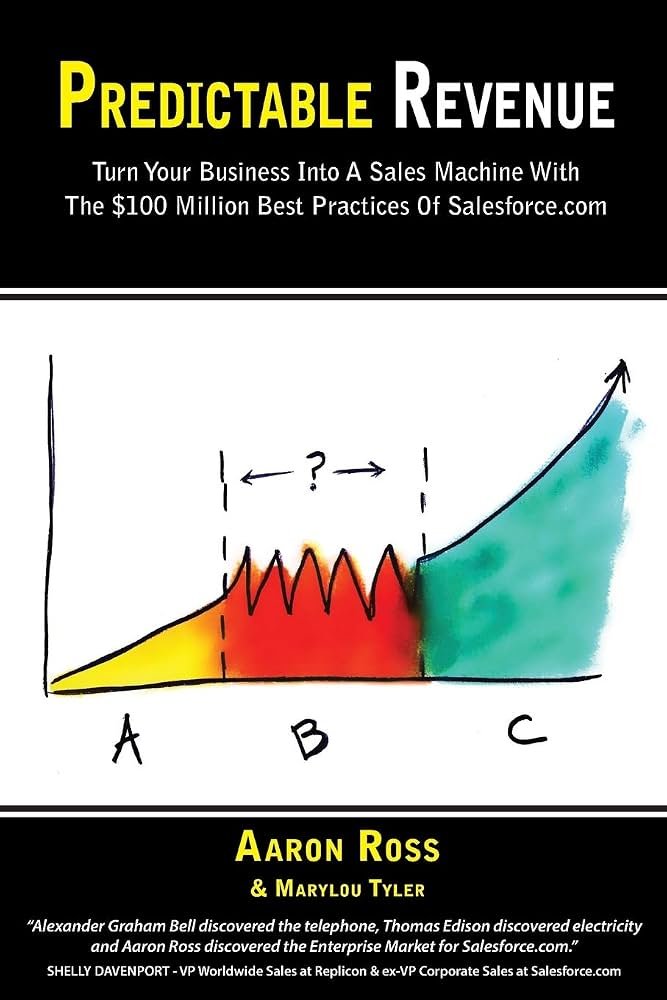
That is the central idea behind Predictable Revenue by Aaron Ross.
The handwritten notes provided for this book describe it as a guide to turning a business into a sales machine, with particular attention to predictable, repeatable, and scalable sales growth. The notes also emphasize three important areas: predictable lead generation, a sales development process, and a consistent sales system.
But the deeper lesson is bigger than sales.
It is about moving from hope to process.
From:
“I hope customers come this month.”
to:
“I know what activities create opportunities, how many prospects we need, and what process converts them into customers.”
That shift can completely change an entrepreneur’s relationship with business growth.
The Story Behind Predictable Revenue
Imagine two business owners.
The first starts every month with uncertainty.
He checks his bank account.
He looks at the sales pipeline.
He asks his team:
“Any new customers?”
Sometimes there are five.
Sometimes there are none.
When sales fall, everyone becomes anxious. The founder starts making calls personally. Marketing changes its strategy. Discounts are offered. Employees work longer hours.
Then, unexpectedly, a big customer arrives.
Everyone celebrates.
But the following month, the same uncertainty returns.
The second business owner operates differently.
At the beginning of every month, she knows approximately:
- how many leads are required,
- how many qualified opportunities are needed,
- how many sales conversations must happen,
- how many proposals should be generated,
- how many deals are expected to close,
- and which activities create those opportunities.
Her business is not guaranteed to succeed.
But it has a system.
That is the difference Aaron Ross explores in Predictable Revenue.
The book’s core philosophy is particularly valuable for entrepreneurs, startup businesses, sales leaders, founders, and anyone trying to create sustainable business growth.
Why Predictable Revenue Matters
Many entrepreneurs believe that increasing revenue simply means:
“Sell more.”
But that statement hides a much bigger question:
How do you consistently create more opportunities to sell?
The handwritten notes highlight the goal of developing a system that is predictable, repeatable, and scalable.
These three words are powerful.
Predictable
You should be able to estimate future sales based on measurable activities.
Repeatable
The process should work repeatedly instead of depending on one exceptional salesperson.
Scalable
The process should be capable of handling more customers without requiring the founder to personally do everything.
This is one of the most important lessons for a growing entrepreneur.
A business cannot become truly scalable if its sales process exists only inside the founder’s head.
Alex’s Problem — When Sales Depend on Luck
Consider a fictional but realistic entrepreneur named Alex.
Alex runs a growing technology services company.
The business has good customers.
The service is strong.
Customers are happy.
Yet Alex has one major problem:
Sales are unpredictable.
One month brings $80,000 in revenue.
The next brings $35,000.
Then $100,000.
Alex begins to notice something uncomfortable.
The company does not really have a sales system.
It has talented people making sales.
Those are not the same thing.
When one salesperson leaves, relationships disappear.
When marketing slows down, leads disappear.
When Alex gets busy, prospecting stops.
The entire business becomes vulnerable.
Alex decides that the problem is not simply “we need more sales.”
The problem is:
“We need a system that continuously creates sales opportunities.”
That is when Alex discovers Predictable Revenue.
Lesson 1 — Build a Sales Machine, Not Just a Sales Team
One of the strongest ideas from the handwritten notes is:
Salesperson → Activity → Result.
The goal is to understand which activities consistently produce results.
This changes how a business thinks about sales.
Instead of asking:
“Who is our best salesperson?”
Ask:
“What process does our best salesperson follow that we can replicate?”
This is a fundamental difference.
A salesperson can produce $1 million in revenue.
But if nobody understands how they did it, the business has learned very little.
A sales machine asks:
- Where did the leads come from?
- Which leads were qualified?
- How quickly were they contacted?
- How many conversations happened?
- What messaging worked?
- What objections appeared?
- What percentage moved forward?
- What activities produced customers?
The answers become part of the system.
Practical tip
Create a simple sales activity dashboard.
Track:
Leads → Qualified Leads → Sales Conversations → Opportunities → Proposals → Customers → Revenue
Once you measure the entire journey, you can identify where the real problem exists.
Lesson 2 — Predictable Lead Generation Comes First
The notes identify predictable lead generation as one of the three major components of predictable revenue.
This is extremely important.
A company cannot close customers if there are no prospects.
Many businesses make the mistake of focusing almost entirely on closing.
They train salespeople to negotiate better.
They improve presentations.
They create discounts.
But they do not create enough qualified opportunities.
Alex realizes that his team is spending too much time waiting for inbound leads.
So he asks:
“Can we deliberately create conversations with our ideal customers?”
That question changes everything.
The Three Types of Leads
The handwritten notes describe three lead types:
- Seed
- Net
- Spears
This provides a useful way to think about lead generation.
Seed Leads
These grow organically.
They may come from:
- referrals,
- existing customers,
- word of mouth,
- relationships,
- organic reputation.
They are valuable, but they can be difficult to control.
Net Leads
These are generated through broader marketing activities.
Examples include:
- content,
- SEO,
- social media,
- advertising,
- webinars,
- email marketing.
The business casts a wider “net.”
Spear Leads
These are highly targeted.
Instead of saying:
“We want more customers.”
the business says:
“We want to speak with these specific types of companies.”
The notes emphasize targeting specific prospects rather than simply generating a huge number of leads.
Practical lesson
Do not measure marketing only by the number of leads.
Measure qualified opportunities.
A thousand irrelevant leads can be less valuable than fifty highly relevant prospects.
Lesson 3 — Separate Prospecting From Closing
One of the most powerful concepts in the book is specialization.
The notes discuss sales development and a process where prospecting and closing become distinct responsibilities.
This solves a common problem.
Imagine a salesperson has five hours available.
Should they:
- find new prospects,
- send prospecting emails,
- make cold calls,
- qualify leads,
- conduct discovery meetings,
- prepare proposals,
- negotiate,
- close existing opportunities,
- or follow up with customers?
Trying to do everything creates inefficiency.
A better model is to create specialized roles.
Sales Development Representative
Focuses on:
- outbound prospecting,
- identifying potential customers,
- initial conversations,
- qualifying opportunities,
- setting meetings.
Account Executive
Focuses on:
- discovery,
- presenting solutions,
- managing opportunities,
- negotiation,
- closing.
Account Manager / Customer Success
Focuses on:
- existing customers,
- retention,
- expansion,
- relationships.
This type of sales structure, including sales development, account executive, and customer/account management roles.
A Real-World Example — Salesforce and the Sales Development Model
The predictable revenue approach with Salesforce.com and its growth-oriented sales process.
The important lesson is not simply the success of one company.
It is the principle behind the system:
Don’t force every salesperson to perform every sales activity.
Specialization allows people to become exceptionally good at a particular stage of the customer journey.
This is especially useful as a startup grows.
In the beginning, the founder may handle everything.
But eventually:
Founder → salesperson → sales team → sales organization → sales machine.
The founder’s role must evolve.
Lesson 4 — Target the Right Customer
Alex initially believes that more prospects automatically mean more revenue.
Then he learns a painful lesson.
His salespeople are talking to too many people who will never buy.
The notes repeatedly emphasize defining an ideal customer profile and identifying the right target companies and people.
An ideal customer profile should answer questions such as:
- What industry are they in?
- How large is the company?
- What problem do they have?
- Who makes the buying decision?
- What triggers them to search for a solution?
- Can they afford the product?
- Are they likely to need the product repeatedly?
The more clearly you define your target customer, the easier sales becomes.
Practical exercise
Complete this sentence:
“Our best customers are companies that ________, because they struggle with ________, and our solution helps them ________.”
This simple statement can improve marketing, prospecting, sales messaging, and customer qualification.
Lesson 5 — Create a Repeatable Sales Process
The notes describe documenting rules and processes, following the same process, and repeating it again and again.
This is where many small businesses struggle.
The founder knows what to do.
But the team doesn’t.
A customer asks a question.
The founder answers it.
A salesperson encounters an objection.
The founder explains what to say.
A new employee joins.
The founder trains them personally.
This does not scale.
Alex begins documenting:
- Ideal customer profile
- Prospecting script
- Email templates
- Qualification questions
- Discovery process
- Follow-up sequence
- Proposal process
- Closing process
- CRM stages
- Customer handoff
Now the business is building an asset.
The process is no longer dependent on memory.
Lesson 6 — Cold Calling Should Become a Process
The cold calling 2.0 and describe a five-step approach.
The broader lesson is that outbound prospecting should not be random.
Step 1: Define Your Ideal Customer
Know exactly who you want to reach.
Step 2: Build Your Target List
Create a list of relevant companies and contacts.
Step 3: Find the Right Person
Do not waste time contacting people who cannot influence the purchase.
Step 4: Start the Conversation
The notes describe using discovery calls with the target prospects.
Step 5: Pass Qualified Opportunities Forward
Once the opportunity is properly qualified, the closing salesperson takes over.
The key is not simply “make more cold calls.”
It is:
Make better-targeted calls using a defined system.
Lesson 7 — Stop Measuring the Wrong Things
One of Alex’s biggest discoveries is that his company has been celebrating activity without measuring outcomes.
For example:
“Salespeople made 500 calls!”
Sounds impressive.
But how many qualified conversations happened?
How many opportunities were created?
How many eventually became customers?
The notes emphasize focusing on higher-quality prospects and higher-quality conversations, rather than simply generating huge volumes of activity.
This creates a powerful principle:
Activity matters only when it contributes to the desired outcome.
A useful dashboard might track:
| Sales Stage | Metric |
|---|---|
| Target Accounts | 500 |
| Qualified Prospects | 100 |
| Conversations | 50 |
| Opportunities | 20 |
| Proposals | 10 |
| Customers | 4 |
| Revenue | $X |
Now the business can identify bottlenecks.
Lesson 8 — Don’t Waste Time on the Wrong Prospects
Identify wasting time with wrong prospects as a major mistake.
This sounds obvious.
But entrepreneurs frequently make this mistake.
They think:
“Any customer is a good customer.”
Not necessarily.
A bad-fit customer can consume:
- sales time,
- support time,
- management attention,
- operational resources,
- emotional energy.
And sometimes they produce little profit.
Alex changes his philosophy.
Instead of asking:
“Can we sell to them?”
he asks:
“Should we sell to them?”
That small change improves the entire business.
Lesson 9 — Build a Sales Funnel With Clear Stages
Detailed sales funnel showing progression from targeting and prospecting toward discovery calls, qualification, closing, and account management.
This is one of the most practical applications of the book.
A funnel creates visibility.
Instead of saying:
“We should get more sales.”
Alex can now ask:
“Where exactly is the funnel breaking?”
If there are many leads but few meetings, the prospecting process may be weak.
If there are many meetings but few opportunities, qualification may be weak.
If there are many opportunities but few closes, the sales presentation, offer, pricing, or negotiation may need improvement.
If customers close but leave quickly, customer success may be the problem.
The funnel turns a vague problem into a measurable problem.
Lesson 10 — The Goal Is Predictability, Not Perfection
After months of implementation, Alex finally experiences the moment that proves the system is working.
Previously, every month began with anxiety.
Now the company can estimate its pipeline.
The team knows:
- how many prospects are being targeted,
- how many conversations are expected,
- how many opportunities should emerge,
- and approximately how many deals can be closed.
Not every month is perfect.
Some deals are delayed.
Some prospects disappear.
Some customers say no.
But the business is no longer completely surprised.
That is the real meaning of predictable revenue.
Predictability does not mean certainty.
It means having enough understanding of the system to make better forecasts and decisions.
Two Real-Life Applications of the Book’s Principles
Example 1 — Salesforce’s Specialized Sales Approach
Salesforce is associated with the sales development model discussed in the notes.
The broader lesson for entrepreneurs is specialization.
Instead of asking one salesperson to prospect, qualify, close, and manage every customer, different roles can focus on different stages.
This allows the organization to build expertise at each stage of the funnel.
Example 2 — The Entrepreneur Who Stops Being the Only Salesperson
Consider a realistic startup founder who initially closes every customer personally.
At first, this works.
But once the company reaches dozens of customers, the founder becomes the bottleneck.
Applying the principles of Predictable Revenue, the founder defines an ideal customer profile, creates a target list, documents the sales process, introduces specialized prospecting, and measures the funnel.
The founder gradually stops being the only person capable of generating revenue.
That is the real transition from:
Founder-led sales → system-led sales.
Action Plan — How to Apply Predictable Revenue to Your Business
You don’t need a 50-person sales department to begin.
Start small.
Step 1: Define Your Ideal Customer
Write down exactly who your best customer is.
Step 2: Identify Your Revenue Target
Decide what revenue you want to achieve.
Step 3: Work Backward
Estimate:
Revenue → Customers → Opportunities → Qualified Prospects → Leads.
Step 4: Create a Target List
Build a list of companies or individuals who match your ideal customer profile.
Step 5: Create a Prospecting Process
Develop email, calling, social media, referral, and other outreach processes appropriate to your market.
Step 6: Separate Prospecting and Closing
As the business grows, consider specialized responsibilities.
Step 7: Document Everything
Create SOPs for:
- prospecting,
- qualification,
- discovery,
- proposal,
- closing,
- follow-up.
Step 8: Measure the Funnel
Track conversion rates between every stage.
Step 9: Improve One Bottleneck
Do not change everything simultaneously.
Find the weakest stage.
Fix it.
Measure again.
Step 10: Repeat
The system becomes stronger through continuous improvement.
10 Biggest Lessons From Predictable Revenue
1. Sales should be a system, not an accident.
2. Predictable lead generation is the foundation of predictable revenue.
3. Define your ideal customer before chasing customers.
4. Specialized sales roles can improve efficiency.
5. Prospecting and closing are different activities.
6. Document your sales process.
7. Measure quality, not just quantity.
8. Avoid wasting time on poor-fit prospects.
9. Build a measurable sales funnel.
10. Scale processes instead of simply adding more people.
These lessons are consistent with the themes emphasized throughout the uploaded notes, including lead generation, specialization, target accounts, sales processes, measurable funnels, and avoiding low-quality prospects.
Final Reflection — From Selling to Building a Sales Engine
The biggest transformation in Alex’s journey is not that he becomes a better salesperson.
It is that he stops thinking like a salesperson.
He begins thinking like a system builder.
That distinction matters.
A salesperson asks:
“How can I close this customer?”
A sales leader asks:
“How can we create more qualified opportunities?”
A business builder asks:
“How can we create a repeatable system that produces qualified opportunities without depending entirely on me?”
That final question is where scalability begins.
This idea beautifully through their emphasis on predictable, repeatable, and scalable revenue and the development of a structured sales system.
For entrepreneurs, startup founders, sales professionals, and business owners, this is perhaps the most important takeaway from Predictable Revenue:
Don’t just work harder to generate revenue. Build a system that makes revenue generation more predictable.
Book to Life — Turning the Lesson Into Action
The real value of a business book is not finishing the last page.
It is what happens after you close the book.
If you run a business, ask yourself today:
- Do I know exactly who my ideal customer is?
- Where do my best leads come from?
- How many leads become qualified prospects?
- How many prospects become opportunities?
- How many opportunities become customers?
- Which sales activity produces the best results?
- Is my sales process documented?
- Could another person follow it?
- Am I personally the bottleneck?
- Can my sales process scale?
If you cannot answer these questions, you may not have a revenue problem.
You may have a sales-system problem.
And that is precisely why the ideas in Predictable Revenue by Aaron Ross are so valuable.
Start Building Your Predictable Revenue Machine
Your business does not need to become enormous overnight.
Start with one customer profile.
One target market.
One prospecting process.
One sales funnel.
One measurable system.
Then improve it.
Because sustainable business growth rarely comes from one magical sales call.
It comes from doing the right activities, for the right customers, through the right process, consistently.
And when those activities become measurable, repeatable, and scalable, revenue becomes much easier to understand—and ultimately much easier to grow.
Don’t wait for your next customer to arrive by chance. Start building the system that creates the next customer deliberately.
That is the real Book to Life lesson from Predictable Revenue.
Disclaimer: This blog post is created for educational and informational purposes only. The ideas discussed are based on Predictable Revenue by Aaron Ross and the handwritten notes provided for this book. The article is intended to simplify and explain the book’s concepts in a practical way and should not be considered professional business, sales, financial, or investment advice.
The examples and stories used in this article are illustrative and fictionalized to demonstrate how the concepts might be applied in real-life situations. Individual business results may vary depending on the industry, market conditions, execution, resources, and other factors.
Readers are encouraged to read the original book, conduct their own research, and adapt the ideas according to their own circumstances. The views expressed in this article are for learning and discussion as part of the Book to Life series.