
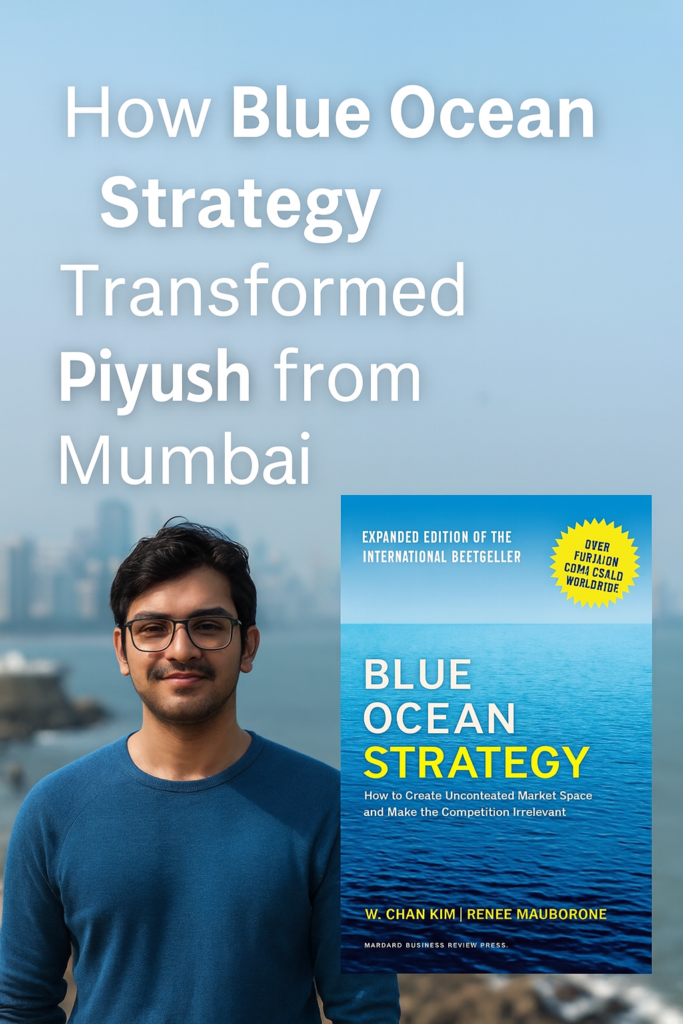
Opening Scene: Fighting in a Red Ocean
At 6:30 AM, the local train rattled into Andheri station, already overflowing. Piyush stood gripping the steel handle, laptop bag slung over his shoulder, eyes half-closed from another sleepless night.
By day, he ran a small digital marketing agency in Mumbai.
By night, he worried about losing clients, undercut competitors, and shrinking margins.
Every week felt the same:
-
A new agency launched with cheaper pricing
-
Old clients demanded discounts
-
Ads grew costlier
-
Results became harder to guarantee
He was drowning in what he didn’t yet know was a Red Ocean—a crowded market soaked with competition.
On the outside, he looked like a hustling entrepreneur.
On the inside, he carried a quiet fear:
“What if I’m doing everything right… and still failing?”
Rent was due. Two employees depended on him. Family expectations pressed heavily. At night, he scrolled LinkedIn and saw story after story of founders raising funding, scaling teams, celebrating exits. He congratulated them with a forced smile and an aching chest.
He wasn’t losing because he lacked effort.
He was losing because he was fighting the wrong battle.
Turning Point: A Book at a Railway Bookstall
One rainy evening in Dadar, delayed and exhausted, Piyush ducked into a tiny bookstall near the platform. His eyes landed on a simple title with a powerful promise:
The Blue Ocean Strategy
The subtitle felt like it spoke directly to him:
“How to Create Uncontested Market Space and Make the Competition Irrelevant.”
He bought it impulsively.
That night, as rain streaked the window of his modest apartment, he read and underlined furiously. For the first time in years, a business book didn’t talk about beating competitors. It spoke about escaping them altogether.
One line changed his worldview:
“The only way to beat the competition is to stop trying to beat the competition.”
For the first time, his exhaustion gave way to excitement.
He decided:
“I will not compete anymore. I will create.”
Implementation Phase: Applying The Blue Ocean Strategy Step-by-Step
Piyush didn’t just read the book—he rebuilt his thinking using its core principles. Here’s how five major concepts reshaped his mindset and actions.
🔹 Concept 1: Red Ocean vs Blue Ocean Thinking
Piyush finally understood the trap he was in:
-
Competing on price
-
Copying competitors’ services
-
Fighting for the same clients
This was Red Ocean behavior.
Blue Ocean thinking meant:
✅ Stop fighting for existing demand
✅ Create new demand
✅ Serve non-customers
✅ Make competition irrelevant
So he asked a bold question:
“Who am I not serving right now?”
That question led him to an overlooked group:
Local home-based retailers and solopreneurs—tailors, home bakers, tutors, yoga trainers—who wanted customers but felt overwhelmed by digital marketing.
Big agencies ignored them.
Piyush decided to build for them.
🔹 Concept 2: Value Innovation (High Value + Low Cost)
Instead of selling complex, expensive marketing packages, Piyush rebuilt his offering around value innovation:
-
Eliminate: Long-term contracts, complicated reports
-
Reduce: Ad budgets, jargon-heavy strategies
-
Raise: Personal attention, education, transparency
-
Create: A simple, affordable “Growth-in-30-Days” program for local entrepreneurs
He didn’t reduce quality—he reduced confusion.
Clients didn’t feel intimidated anymore.
They felt empowered.
🔹 Concept 3: The Four Actions Framework
Using the book’s famous grid, he redesigned his entire service:
| Action | What He Changed |
|---|---|
| Eliminate | Pushy sales calls, long proposals |
| Reduce | Operating costs, agency overhead |
| Raise | Speed of execution, clarity in results |
| Create | Community workshops, DIY learning kits |
This created a brand-new value curve—nothing like traditional agencies.
🔹 Concept 4: Targeting Non-Customers
Instead of competing for clients already served by big agencies, he targeted three layers of non-customers:
-
Soon-to-be non-customers: Small businesses frustrated with agencies
-
Refusing non-customers: Those who never tried marketing due to fear
-
Unexplored non-customers: Women homepreneurs, retired professionals
Within 90 days, his lead flow doubled—without ads.
🔹 Concept 5: Aligning the Whole System Around the Strategy
Piyush didn’t just change his product—he changed everything:
-
Pricing
-
Marketing message
-
Sales conversations
-
Training modules
-
Support delivery
Everything aligned around simplicity, speed, and accessibility.
This alignment created trust at scale.
The Breakthrough: When the Blue Ocean Took Shape
The real breakthrough came when a local women’s entrepreneurship group invited Piyush to conduct a free workshop.
He almost declined—free events reminded him of wasted time. But this was a Blue Ocean move: creating demand, not chasing it.
That Saturday, 80 women filled a community hall. He didn’t sell. He taught:
-
How to get customers using WhatsApp
-
How to build reels without fear
-
How to get first 10 online leads
By the end of the session:
✅ 34 people enrolled in his paid 30-day program
✅ ₹3.8 lakh collected within a week
✅ Zero ad spend
✅ Massive word-of-mouth referrals
For the first time in years, his business wasn’t fighting—it was flowing.
Life After Change: From Survival to Significance
Two years later:
-
Piyush runs a thriving growth education company
-
He has trained 3,000+ small business owners
-
His programs run in four Indian cities
-
His monthly revenue crossed what his entire year once made
But the most powerful change wasn’t financial.
He slept peacefully.
He worked creatively.
He stopped comparing himself to others.
He had found his Blue Ocean.
Reflection: What Piyush Learned About Business—and Life
One evening, during a student Q&A session, someone asked:
“What was your biggest mistake before success?”
Piyush smiled and answered:
“I thought winning meant defeating others. Now I know winning means creating something others don’t even imagine.”
His advice to aspiring entrepreneurs:
-
Don’t chase crowded markets
-
Don’t race to the bottom on pricing
-
Don’t copy competitors
-
Do solve overlooked problems
-
Do design for non-customers
-
Do simplify instead of complicating
✅ 10 Powerful Takeaways from The Blue Ocean Strategy
-
Stop competing—start creating
-
New markets are built, not found
-
Value innovation beats price wars
-
Non-customers hold the biggest opportunities
-
Eliminate, reduce, raise, and create strategically
-
Simplicity attracts mass adoption
-
Strategy needs execution support
-
Differentiation and low cost can coexist
-
Alignment across systems is essential
-
Blue oceans provide long-term profitable growth
✅ Call to Action
Inspired by Piyush’s journey?
This is just one story in our Book to Life series—where powerful books turn into real-life transformations.
If you feel stuck in competition, overwhelmed by pricing pressure, or invisible in a crowded market, it’s time to think differently.
👉 Pick up The Blue Ocean Strategy today and take the first step toward your own transformation.
For guidance on business strategy, personal finance, and growth:
🌐 www.mycashflowhub.com
📞 885-511869
✅ Disclaimer
This story is hypothetical and created only to demonstrate how the concepts of The Blue Ocean Strategy can be applied in real life using a storytelling format. Results vary based on individual effort, market conditions, and execution.