
There is a moment in almost every person’s financial life when a simple question becomes surprisingly difficult:
“What should I do with my money?”
Should you save more? Invest now or wait for the market to fall? Buy a house or continue renting? Pay off debt? Invest in stocks? Build an emergency fund? Spend money today or sacrifice today for a better tomorrow?
These questions can become overwhelming because personal finance is often presented as a collection of complicated rules.
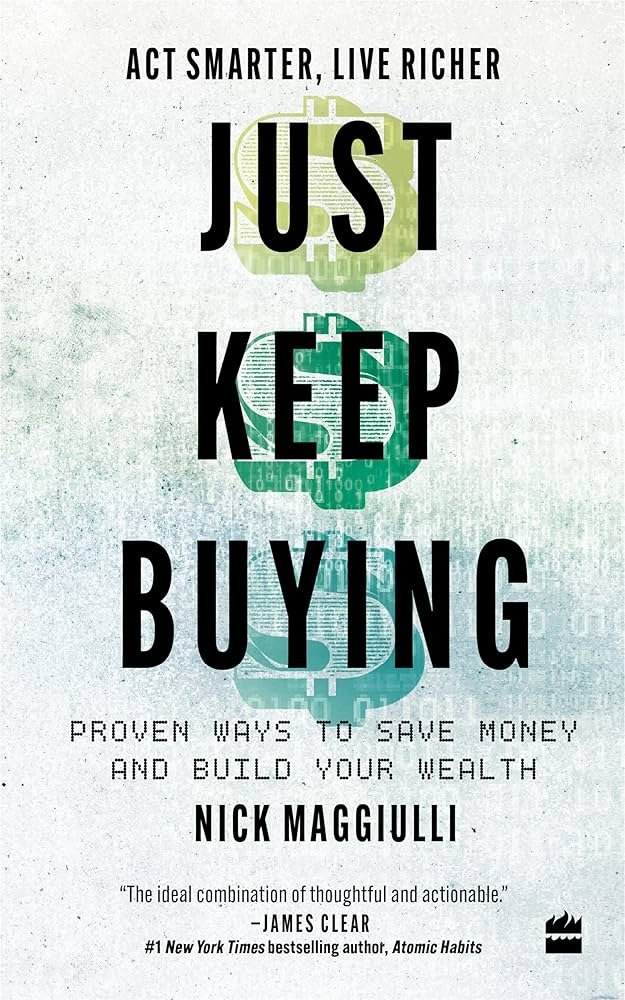
But the central message captured in the handwritten notes for Just Keep Buying is much simpler:
Build good financial habits, keep investing consistently, and stop trying to predict the perfect moment.
The notes repeatedly return to the idea that wealth is not created by one brilliant financial decision. It is created by consistent saving, increasing income, investing patiently, controlling spending, and giving your money enough time to grow.
This article explores those ideas through the Book to Life approach: not simply understanding what the book teaches, but asking how those lessons can actually change the way an ordinary person handles money.
Why “Just Keep Buying” Is an Important Personal Finance Book
One of the biggest problems with personal finance is that people often wait for certainty.
They wait for the stock market to fall.
They wait for the “right” investment.
They wait until they earn more.
They wait until they have a bigger salary.
They wait until their expenses become lower.
And sometimes, they wait so long that years pass without meaningful financial progress.
The handwritten notes emphasize this directly: do not wait for the perfect market condition to invest; instead, continue buying consistently. The notes also connect this philosophy with increasing income, saving a portion of income, controlling lifestyle spending and investing for the long term.
That is why this book matters.
It shifts the question from:
“What will the market do next?”
to:
“What can I control today?”
You can control how much you save.
You can control how much you spend.
You can control whether you invest.
You can control whether you increase your income.
You can control whether you keep learning.
And most importantly, you can control whether you remain consistent.
The Core Philosophy: Just Keep Buying
Imagine two investors.
Investor A spends every week watching financial news.
When the market rises, they become excited.
When the market falls, they become frightened.
They constantly ask:
“Should I buy now?”
Investor B follows a simple plan.
Every month, money automatically moves into investments.
The market rises.
They buy.
The market falls.
They buy.
The market becomes uncertain.
They continue buying according to their plan.
The second investor may not look as intelligent on social media.
But over decades, consistency can become a powerful financial advantage.
The notes describe this philosophy repeatedly: don’t wait for market crashes or the “perfect” opportunity; continue investing and allow time and compounding to work.
This does not mean buying blindly or ignoring valuation, diversification, risk or personal circumstances. Rather, the lesson is to avoid allowing the search for perfect timing to become an excuse for doing nothing.
Lesson 1: Saving Is the Foundation of Wealth
Before Ryan, stocks, real estate or sophisticated investment strategies can build wealth, there needs to be something available to invest.
That something is savings.
The notes describe saving as one of the most important habits in personal finance and suggest saving a meaningful percentage of income, while also recognizing that the right percentage depends on individual circumstances.
The important point is not simply:
“Save 10%.”
The deeper lesson is:
Create a gap between what you earn and what you spend.
That gap becomes your financial fuel.
Practical example
Suppose someone earns ₹80,000 per month and spends ₹75,000.
They have only ₹5,000 available for future wealth.
Now imagine the same person gradually increases their savings to ₹15,000 per month.
The difference is not merely ₹10,000.
That money can become:
- an emergency fund
- investment capital
- a house down payment
- retirement savings
- business capital
- financial security
The notes emphasize the idea of saving what you can, rather than becoming paralyzed because you cannot save an ideal percentage.
Book to Life Action
Start with a percentage you can realistically maintain.
Then increase it when your income increases.
The goal is to make saving automatic rather than emotional.
Lesson 2: Increase Your Income, Not Just Your Savings
There is a limit to how much you can cut.
You cannot reduce your expenses to zero.
But your income can potentially continue increasing.
This is one of the most powerful ideas in the notes.
The notes describe several ways to increase income, including:
- Selling your time or expertise
- Selling skills or services
- Teaching other people
- Selling products
- Creating content and building an audience
This is particularly relevant in today’s economy.
Imagine someone earning ₹50,000 per month.
They try to save more by reducing expenses.
They manage to save an additional ₹5,000.
That is useful.
But suppose they develop a valuable skill and increase their income to ₹75,000.
Suddenly, the financial equation changes dramatically.
This is why personal development and financial development are connected.
Your five income questions
Ask yourself:
1. Can I become better at my current job?
2. Can I develop a high-value skill?
3. Can I sell that skill independently?
4. Can I teach what I know?
5. Can I build something that produces income without requiring every hour of my time?
The notes specifically connect income growth with selling time, skills, products and building an audience.
That makes this lesson highly relevant for entrepreneurs, startup founders, freelancers, creators and professionals.
Lesson 3: Keep Your Lifestyle Inflation Under Control
One of the quietest enemies of wealth is lifestyle inflation.
You receive a raise.
Instead of saving more, you upgrade everything.
A better car.
A larger house.
More expensive restaurants.
More shopping.
More subscriptions.
More travel.
Soon, the higher income disappears into a higher lifestyle.
The notes repeatedly distinguish between earning, spending and saving, and emphasize focusing on what you actually need rather than automatically spending every additional dollar you earn.
The goal is not to live miserably.
The goal is to ensure that your lifestyle does not consume every improvement in your income.
A simple rule
Whenever your income rises, divide the increase.
For example:
- 50% toward improving your lifestyle
- 50% toward saving/investing
The exact ratio can be different for everyone.
The principle is what matters:
Let your wealth grow faster than your lifestyle.
Lesson 4: Time Is One of Your Greatest Financial Assets
People often think wealth comes primarily from money.
But the notes highlight another important asset:
time.
A small investment held for a few months does not have enough time to demonstrate the power of compounding.
A portfolio held for decades is different.
The notes discuss long-term saving and investing, including examples showing how starting earlier can dramatically affect wealth accumulation.
This produces one of the most important lessons in personal finance:
Starting early can matter more than starting perfectly.
Consider two people.
Person A starts investing ₹5,000 per month at age 25.
Person B waits until age 35 because they want to “get their finances perfectly organized.”
Person B may eventually invest more aggressively, but Person A has something Person B cannot buy back:
ten additional years.
That is why the notes repeatedly emphasize long-term thinking.
Lesson 5: The Power of Compounding
Compounding is where patience begins to become powerful.
Your money earns returns.
Those returns remain invested.
Then those returns can themselves generate returns.
It becomes a snowball.
At first, the snowball looks tiny.
Later, it can become enormous.
The handwritten notes include examples illustrating how long-term investing and compounding can dramatically increase wealth over several decades.
This leads to an important psychological lesson:
Do not judge a long-term investment strategy by what happens in the first few years.
A tree does not become large immediately after planting.
Financial wealth works similarly.
Lesson 6: “Just Keep Buying” Means Don’t Try to Predict Every Market Move
One of the most practical lessons in the notes is the idea of continuing to invest rather than waiting for the market to become perfectly predictable.
Why?
Because markets are unpredictable.
Suppose an investor says:
“I will invest after the next crash.”
What happens if the market continues rising?
They wait.
Then prices rise further.
Eventually they become uncomfortable and buy at a higher price.
Or suppose they invest, the market falls 20%, and they panic.
They sell.
Now they have converted temporary volatility into a permanent loss.
The notes emphasize continuing to buy and not waiting for market crashes.
Practical takeaway
Create a repeatable investment system.
For example:
Income → Save → Invest → Repeat
Instead of:
Income → Watch market → Predict market → Debate → Wait → Panic → Invest
Automation can reduce emotional decision-making.
Lesson 7: Diversification Matters
The notes also discuss keeping fees low and diversifying investments for the long term.
Diversification means avoiding the belief that one asset will always outperform.
Imagine putting your entire financial future into one company.
If that company performs brilliantly, you may become wealthy.
But if something goes wrong, your financial future becomes dangerously dependent on one outcome.
A diversified portfolio spreads risk.
The notes discuss different investment categories, including stocks, bonds, real estate and other assets.
The lesson is not:
“Buy everything.”
It is:
Understand the role each asset plays in your financial plan.
Lesson 8: Keep Investment Costs Low
An investment return is not the only thing that matters.
Fees matter too.
A seemingly small annual fee can become meaningful over decades because you are not only losing the fee itself—you are potentially losing the future growth that money could have generated.
The notes explicitly emphasize keeping fees low and discuss low-cost investing approaches.
This creates a simple question every investor should ask:
“What am I paying for this investment?”
If two similar investments provide similar exposure, costs deserve serious consideration.
Lesson 9: Real Estate Is Not Automatically Better Than Investing
One of the most interesting sections of the handwritten notes deals with housing.
Many people grow up believing:
“Buying a house is always the best investment.”
But the notes encourage a more careful evaluation.
They discuss factors such as:
- mortgage costs
- maintenance
- property taxes
- transaction costs
- opportunity cost
- time spent owning the property
- housing market movements
This is important because buying a home is not merely an emotional decision.
It is also a financial decision.
Before buying a house, ask:
Will I live here long enough?
Can I comfortably afford the debt?
What other costs will I have?
What happens if I need to move?
What alternative could I do with the money?
The notes suggest that buying can make sense under the right conditions, but it should not be treated as automatically superior to renting or other investments.
Lesson 10: Save for Big Purchases Before You Make Them
A major purchase can destroy years of financial progress if it is made without planning.
The notes discuss saving for large purchases and highlight the importance of having the cash ready rather than allowing a major purchase to create unnecessary financial pressure.
Imagine you want to buy a ₹10 lakh car.
Instead of immediately taking the largest possible loan, create a dedicated purchase fund.
Every month, money goes into that account.
Now the purchase becomes a planned decision rather than an emotional decision.
Book to Life principle:
Save first. Buy later.
This is particularly useful for:
- cars
- holidays
- electronics
- weddings
- home improvements
- business equipment
An Illustrative Example: Annie and Bob
The handwritten notes use an Annie and Bob example to demonstrate how different saving behaviors can influence long-term wealth.
Imagine Annie and Bob both earn good incomes.
Annie decides that financial security is important, so she saves consistently from an early stage.
Bob earns a similar income but repeatedly tells himself:
“I’ll start investing when I earn more.”
Years pass.
Annie’s money has had time to compound.
Bob finally starts investing—but he has lost valuable time.
This example illustrates a critical truth:
The best financial strategy is often the one you can follow consistently for a very long time.
It is not about being perfect.
It is about beginning.
A Second Practical Example: Buying During Difficult Markets
The notes discuss the behavior of investors during market declines and emphasize the importance of continuing to invest rather than allowing fear to dictate every decision.
Imagine someone invests every month.
Then the market crashes.
Their portfolio falls.
They feel uncomfortable.
But their monthly investment continues.
Because prices have fallen, the same amount of money purchases more investment units.
Eventually, when markets recover, those purchases made during difficult periods can become valuable.
The lesson is not that every market decline immediately produces profit.
The lesson is:
Volatility is part of investing, and a long-term investor needs a plan for surviving it.
How to Apply “Just Keep Buying” in Real Life
Understanding financial concepts is easy.
Living them is harder.
So let’s turn the ideas into a simple action plan.
Step 1: Know Your Numbers
Write down:
- monthly income
- essential expenses
- discretionary expenses
- debt payments
- current savings
- investments
- major financial goals
You cannot improve what you refuse to measure.
Step 2: Build Your Saving Habit
Choose a realistic savings percentage.
Start there.
Then increase it gradually.
The handwritten notes emphasize that saving should become a regular habit rather than an occasional event.
Step 3: Build Emergency Reserves
Before taking excessive investment risk, create financial breathing room.
An emergency fund can prevent you from selling long-term investments at an unfortunate time when an unexpected expense arrives.
Step 4: Attack Expensive Debt
Debt is not automatically good or bad.
The notes explicitly emphasize that the usefulness of debt depends on how it is used.
Debt used irresponsibly can destroy financial flexibility.
Debt used strategically for an appropriate purpose may be different.
The key is understanding:
Why are you borrowing, how much does it cost, and can you comfortably repay it?
Step 5: Invest Consistently
Once your financial foundation is strong, create an investment process suitable for your goals, risk tolerance and circumstances.
Do not make every investment decision based on headlines.
Step 6: Increase Your Income
Learn.
Sell.
Teach.
Build.
Create.
Develop expertise.
The notes identify multiple pathways to increasing income.
Your greatest financial asset may not be your current bank balance.
It may be your ability to become more valuable.
Step-by-Step “Just Keep Buying” Financial System
Here is a simple version of the philosophy:
Every month:
1. Earn
Increase your income where possible.
↓
2. Save
Pay yourself first.
↓
3. Protect
Maintain an emergency reserve and appropriate protection.
↓
4. Invest
Put money into a diversified long-term strategy.
↓
5. Avoid unnecessary financial leakage
Control fees, excessive debt and lifestyle inflation.
↓
6. Keep learning
Improve your financial knowledge.
↓
7. Repeat
Do it again next month.
And again next year.
And again for decades.
That final step is where the magic happens.
10 Biggest Takeaways From Just Keep Buying
1. Start investing rather than endlessly waiting
Perfect market timing is extremely difficult.
2. Save consistently
Small repeated actions can become significant over time.
3. Increase your income
There is only so much you can cut from expenses.
4. Control lifestyle inflation
Do not allow every raise to disappear into higher spending.
5. Give compounding time
Time can be one of your greatest financial advantages.
6. Keep investment costs low
Fees can reduce long-term returns.
7. Diversify
Do not allow one investment to determine your entire financial future.
8. Think carefully before buying a house
A home can be valuable, but it is not automatically the best investment for everyone.
9. Save before making major purchases
Planning creates financial freedom.
10. Stay disciplined during market volatility
A long-term plan is most valuable when emotions are strongest.
These themes are reflected throughout the uploaded handwritten notes, particularly the repeated focus on saving, investing consistently, long-term compounding, diversification, costs, housing decisions and maintaining discipline.
The Deeper Lesson: Wealth Is a Habit, Not an Event
Perhaps the most powerful lesson from Just Keep Buying is not actually about stocks.
It is about behavior.
Many people think becoming wealthy requires one big opportunity.
One successful business.
One perfect investment.
One property.
One lucky stock.
But sustainable financial progress usually looks much less dramatic.
It looks like:
Saving this month.
Investing this month.
Avoiding unnecessary debt.
Learning a new skill.
Increasing income.
Saving part of the raise.
Investing again.
Staying calm during a market decline.
Repeating.
Years later, what looked like ordinary decisions can become extraordinary results.
The handwritten notes capture this idea beautifully through the repeated theme of “just keep buying” and the emphasis on long-term investing rather than constantly trying to predict the market.
Book to Life: Turn Financial Knowledge Into Financial Behavior
Reading a personal finance book can make you feel productive.
But reading alone does not build wealth.
Action does.
You can read ten books about saving and still spend everything you earn.
You can read about investing and never invest.
You can understand compounding and still delay for another five years.
The purpose of the Book to Life series is therefore simple:
Take an idea from a book and put it into everyday life.
So don’t ask:
“Did I understand the book?”
Ask:
“What will I do differently because I read it?”
Maybe you will automate your monthly investment.
Maybe you will increase your savings rate.
Maybe you will start building an additional income stream.
Maybe you will reconsider an expensive purchase.
Maybe you will stop trying to predict every market movement.
Maybe you will finally begin.
Final Reflection: Keep Buying Your Future
Imagine yourself ten years from now.
You look back at your bank accounts, investments, skills and financial decisions.
What would you wish you had started today?
More importantly, what would happen if you started today and simply continued?
That is the spirit behind Just Keep Buying.
Not:
“Get rich quickly.”
Not:
“Predict the market perfectly.”
Not:
“Never spend money.”
Instead:
Save what you can. Increase what you earn. Invest consistently. Control unnecessary spending. Diversify. Give your money time. And keep moving forward.
Wealth is often built quietly.
One month at a time.
One investment at a time.
One good financial decision at a time.
And eventually, you may look back and realize that the small actions you almost ignored were the actions that changed everything.
Inspired by Just Keep Buying? Start Your Own Financial Transformation
This is the heart of the Book to Life philosophy: read a powerful idea, understand it, and then turn it into action.
If the lessons from Just Keep Buying by Nick Maggiulli inspire you, don’t stop at the final page.
Read the original book.
Review your own financial situation.
Choose one action.
Start saving.
Start investing according to a suitable long-term plan.
Work on increasing your income.
And most importantly—
keep going.
Because your financial future is not built in one day.
It is built by what you repeatedly do.
Just keep learning.
Just keep improving.
Just keep investing.
Just keep building.
And one day, you may discover that those small decisions became the foundation of your financial freedom.
Disclaimer
Disclaimer: This blog is an educational and informational summary inspired by the uploaded handwritten notes and the ideas discussed in Just Keep Buying. Investment examples are for educational purposes only and should not be considered personalized financial advice. Investing involves risk, and readers should consider their own financial situation and consult a qualified financial professional where appropriate.