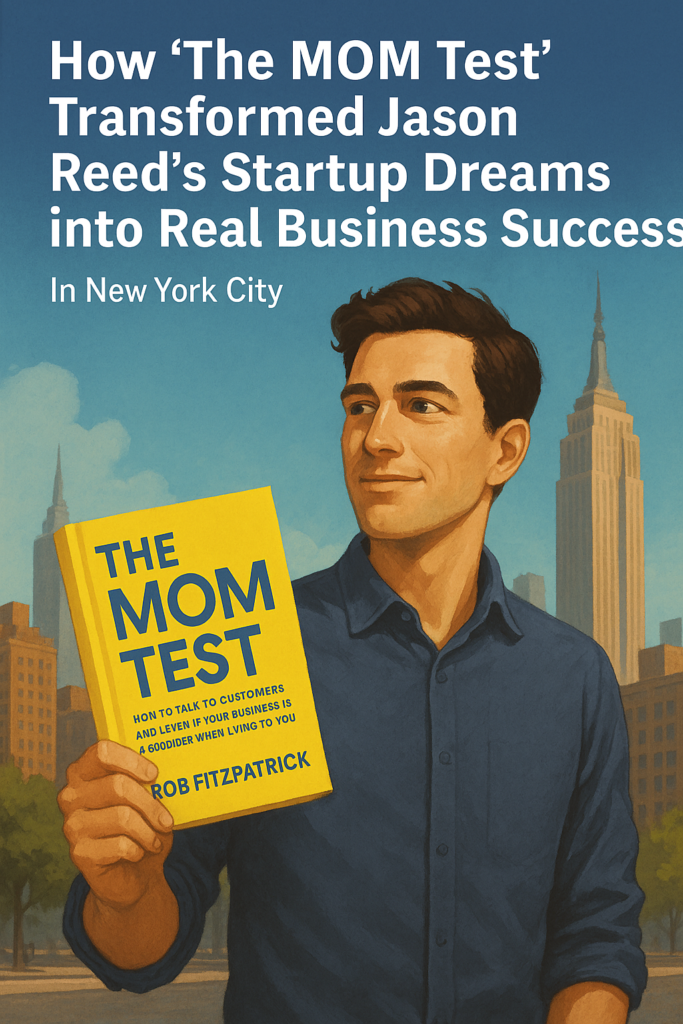
From polite lies to profitable truth — a New York entrepreneur’s wake-up call
How “The MOM Test” Transformed Jason Reed’s Startup Dreams into Real Business Success
A Dream Drowning in Polite Lies (New York City)
At 2:17 a.m., in a cramped Brooklyn apartment lit only by the glow of a laptop screen, Jason Reed refreshed his email inbox for the tenth time that night.
Still nothing.
No sign-ups.
No pre-orders.
No customers.
Just six weeks earlier, Jason had been floating on clouds. His startup idea—an AI-powered productivity planner for freelancers—had received nothing but praise.
“Bro, that’s genius.”
“You’re going to kill it.”
“I’d totally use that.”
His friends, former colleagues, even his parents had showered him with encouragement. He had quit his marketing job in Manhattan with confidence. He had burned through most of his savings building the app.
And now?
Silence.
Jason leaned back against the peeling wall, staring at the ceiling fan as it spun lazily above him. The city outside still buzzed, but inside his chest, everything felt heavy.
For the first time, a terrifying question surfaced:
What if everyone was wrong… including me?
Turning Point – Discovering The MOM Test
Two days later, Jason met Evan, an old college friend turned startup advisor, at a noisy café near Union Square.
After listening patiently to Jason’s emotional outburst, Evan leaned forward and asked one simple question:
“Did you actually validate this idea… or did you just ask people if they liked it?”
Jason blinked. “What do you mean? Everyone said it was great.”
Evan smirked and slid a book across the table.
The MOM Test by Rob Fitzpatrick
“Read this. It will hurt your ego. But it’ll save your business—or whatever’s left of it.”
That night, Jason read the entire book in one sitting. With every chapter, his stomach tightened.
The book’s core message hit him like a sledgehammer:
If your business idea depends on compliments, it’s already dead.
Jason realized he had done everything wrong:
-
He pitched instead of listening
-
He chased encouragement instead of truth
-
He asked about future intentions instead of past behavior
For the first time, he understood why his startup felt like it had hit a wall.
And for the first time in weeks, he felt something new:
Clarity.
Implementation Phase – Applying The MOM Test in Real Life
Jason decided to start over—this time, the right way.
Lesson 1 – Talk About Their Life, Not Your Idea
Instead of saying:
“Would you use my productivity app?”
Jason started asking:
-
“Tell me about the last time you felt overwhelmed with work.”
-
“What tools are you using right now?”
-
“What frustrated you the most last week?”
What he discovered shocked him.
Freelancers weren’t struggling with planning.
They were struggling with:
-
Client payment delays
-
Scope creep
-
Burnout
-
Switching between too many tools
His “big breakthrough idea” wasn’t even addressing their main pain.
That realization alone saved him from building the wrong product.
Lesson 2 – Compliments, Fluff & Ideas Are Dangerous
Jason noticed a pattern:
Whenever someone said:
-
“That sounds amazing!”
-
“You should also add XYZ feature!”
-
“This could be huge!”
They never paid.
They never committed.
They never followed up.
But when someone said:
-
“I lost $800 last month due to late payments.”
-
“I spend two hours every day chasing clients.”
Those conversations were painful, messy—and real.
Jason began tracking:
✅ Money lost
✅ Time wasted
✅ Emotional frustration
That’s where the real business lived.
Lesson 3 – Ask About the Past, Not the Future
Instead of:
“Would you pay for a client management tool?”
Jason asked:
-
“When was the last time a client paid late?”
-
“How did you handle it?”
-
“Did you try any solution?”
He learned that freelancers were hacking Excel sheets, WhatsApp messages, and reminder apps just to manage payments.
That wasn’t a “maybe” problem.
That was a now problem.
Lesson 4 – Talk Less, Listen More
At first, staying quiet was torture.
Jason loved explaining ideas.
But soon, he noticed something powerful:
The less he talked,
The more people revealed.
Frustrations spilled out.
Stories unfolded.
Patterns emerged.
And Jason realized:
Listening is not passive. It’s the most aggressive form of market research.
Lesson 5 – Never Ask for Startup Opinions
Jason stopped asking:
-
“Is this a good idea?”
-
“Would you buy this?”
He only asked:
-
“What happened last time?”
-
“What did you try?”
-
“What failed?”
Slowly, painfully, but surely—the fog lifted.
The Breakthrough – From Zero Users to Paying Customers
Three months later, the app Jason had originally built was gone.
In its place:
A simple tool focused on automated client payment tracking for freelancers.
No fancy features.
No AI hype.
Just:
-
Invoice follow-ups
-
Late payment alerts
-
Simple client dashboard
Before building the full product, Jason did something radical:
He pre-sold it manually.
He emailed 25 freelancers he had interviewed and said:
“I’m building this specifically for the problem you described. Would you like early access for $29/month?”
Eight people paid within 48 hours.
Jason stared at the Stripe notification in disbelief.
That $232 wasn’t just money.
It was proof.
Proof that:
-
The pain was real
-
The solution mattered
-
The MOM Test worked
That night, in the same Brooklyn apartment where he once felt crushed, Jason danced alone like a madman.
Life After Change – The New Jason Reed
Two years later…
Jason no longer checked emails at 2 a.m. in panic.
He now ran:
-
A profitable SaaS tool with 1,200+ users
-
A remote team of 6
-
A predictable monthly recurring revenue
But more importantly, his mindset had changed forever.
He no longer fell in love with:
-
Ideas
-
Hype
-
Features
He fell in love with:
-
Customer behavior
-
Real problems
-
Pain-driven demand
Even when launching new features, he went back to the same principles:
Talk less.
Listen more.
Follow the truth—even when it hurts.
Reflection – Jason’s Lessons for Every Dreamer
Sitting on a park bench overlooking the Hudson River, Jason once reflected:
“The MOM Test didn’t just fix my startup. It fixed how I think.”
Here’s what he learned:
-
Encouragement is emotional, not financial
-
Truth hurts—but it pays
-
Opinions don’t build businesses—behavior does
-
Real validation feels uncomfortable
-
Talking is easy; listening is hard
-
Ego is the enemy of learning
-
Questions are more powerful than pitches
Step-by-Step Actionable Guide Inspired by Jason’s Journey
If you want to apply The MOM Test today:
-
Identify a customer group
-
Write 5 questions about past struggles
-
Avoid pitching completely
-
Focus on time, money, frustration
-
Look for repeated behavior patterns
-
Build only after proof appears
-
Pre-sell before fully building
-
Kill ideas that lack pain
-
Track real commitments, not words
-
Let learning guide building
Call to Action – Your Book to Life Moment Starts Now
Inspired by Jason Reed’s journey?
This is just one story in our Book to Life Series.
👉 Pick up The MOM Test by Rob Fitzpatrick today and take the first step toward your own transformation—from guessing to knowing, from hoping to building, from fake validation to real success.
Your next breakthrough doesn’t start with building.
It starts with listening.
✅ Disclaimer
This story is hypothetical and created solely to demonstrate how the concepts from The MOM Test by Rob Fitzpatrick can be applied in real life through storytelling. Any resemblance to real persons or businesses is purely coincidental.