Book to Life Series | Inspired by The Art of the Start 2.0 by Guy Kawasaki
When “Someday” Starts Feeling Like a Trap
Ryan Anderson used to stare at the Los Angeles skyline every night from his small apartment in Echo Park and wonder a dangerous question:
“Is this it?”
At 32, Ryan had what most people would call a “decent life.” A stable marketing job. A steady paycheck. Weekends filled with Netflix, traffic, and the quiet anxiety of knowing he was capable of more—but doing nothing about it.
He had ideas. Plenty of them.
A sustainable clothing brand.
A digital course for creators.
A community platform for freelancers.
But ideas stayed where they were safest—in his head.
What stopped him wasn’t lack of intelligence or ambition. It was fear:
-
Fear of failure
-
Fear of starting too late
-
Fear of quitting a “secure” job
-
Fear that he wasn’t “entrepreneur material”
Like many people in Los Angeles chasing dreams, Ryan was busy preparing, but never starting.
That changed the day he picked up a book that didn’t promise overnight success—but demanded something far more uncomfortable:
Action.
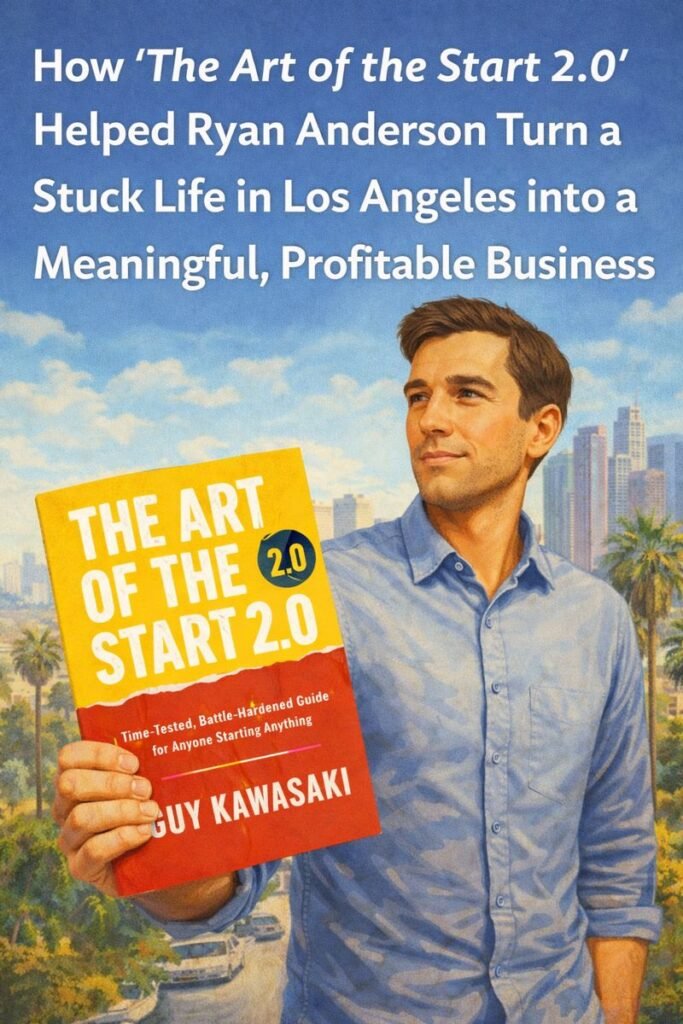
That book was The Art of the Start 2.0 by Guy Kawasaki.
And it didn’t just help Ryan start a business.
It helped him start a new life.
The Turning Point: One Book, One Sentence, One Decision
Ryan discovered The Art of the Start 2.0 during a random Saturday visit to a bookstore in Santa Monica. He wasn’t searching for a startup book. He was killing time.
One line stopped him cold:
“Great companies are built on meaning, not money.”
Ryan realized something uncomfortable:
Every idea he’d considered was about escaping his job, not creating value.
That night, instead of binge-watching another show, he read the first three chapters.
By Sunday evening, he made a quiet but life-altering decision:
“I won’t wait until I’m ready. I’ll start now.”
Implementation Phase: Applying The Art of the Start 2.0 in Real Life
Ryan didn’t quit his job. He didn’t raise funding. He didn’t announce anything on social media.
He followed Guy Kawasaki’s philosophy step by step.
Principle 1: Start with Meaning, Not Money
The first exercise Ryan did was brutally simple:
“What change do I want to create in the world?”
Not:
-
“How can I make money?”
-
“What’s trending?”
-
“What would impress people?”
After honest reflection, Ryan wrote:
“I want to help overwhelmed freelancers build consistent income without burning out.”
That was his meaning.
Suddenly, his ideas stopped being scattered. Everything aligned around one mission.
Mindset Shift:
Ryan stopped chasing opportunities and started solving a real problem.
Principle 2: Answer the “Therefore What?” Question
Guy Kawasaki emphasizes asking:
“Therefore what?”
Ryan asked himself:
-
Freelancers struggle → Therefore what?
-
They lack systems → Therefore what?
-
They burn out → Therefore what?
The answer became clear:
Freelancers don’t need more hustle—they need clarity and simple systems.
That insight shaped Ryan’s first product idea:
A simple digital system to help freelancers plan income, projects, and time—without complex tools.
Principle 3: Create a Mantra (Not a Mission Statement)
Ryan resisted the urge to write a long mission statement.
Instead, he created a three-word mantra, inspired by Guy Kawasaki:
“Calm, Clear, Consistent.”
That mantra became his filter:
-
Does this idea create calm?
-
Does it bring clarity?
-
Does it help consistency?
If not, he dropped it.
Actionable Lesson:
A mantra keeps you focused when motivation fades.
Principle 4: Pick a Simple Business Model
Ryan avoided complexity.
He asked two questions Guy Kawasaki insists on:
-
Who has the money? → Freelancers earning online
-
How will I get it? → Affordable digital products
His business model:
-
Low-cost digital toolkit
-
One-time payment
-
No subscriptions
-
No complicated funnels
He launched with one product, not five.
Principle 5: Launch Before You Feel Ready
Ryan built his first version in three weeks.
Not perfect.
Not polished.
Not “Instagram-worthy.”
But real.
He shared it quietly with 20 freelancers from online communities.
Their feedback wasn’t gentle—but it was gold.
They didn’t care about branding.
They cared about results.
Ryan improved the product weekly.
The Breakthrough: The Moment Everything Shifted
Three months later, something unexpected happened.
One freelancer shared Ryan’s toolkit in a Slack community.
Then another did.
Then another.
Without ads.
Without influencers.
Without hype.
Ryan woke up one morning to 47 sales overnight.
That wasn’t life-changing money—but it was life-changing proof.
Proof that:
-
People needed this
-
His idea mattered
-
Starting imperfectly worked
Six months later:
-
His side income matched his salary
-
He negotiated remote work
-
Stress decreased
-
Confidence skyrocketed
Ryan hadn’t just started a business.
He had started becoming who he wanted to be.
Life After Change: A Business Built on Meaning
One year later, Ryan’s life looked very different.
-
He worked remotely from Los Angeles cafés
-
He ran a small but profitable digital business
-
He served thousands of freelancers worldwide
-
He reinvested profits slowly and wisely
Most importantly, he no longer asked:
“What if I fail?”
He asked:
“What should I build next?”
Ryan didn’t chase unicorn status.
He built a sustainable, meaningful business—exactly what The Art of the Start 2.0 teaches.
Reflection: Ryan’s Biggest Lessons from the Journey
Ryan often shares these lessons with aspiring founders:
1. You don’t need permission to start
2. Meaning attracts momentum
3. Simplicity scales better than complexity
4. A small launch beats a perfect plan
5. Real feedback beats opinions
6. You don’t need funding to validate
7. Focus creates confidence
8. Action builds clarity
9. Fear shrinks when you move
10. Starting changes everything
What The Art of the Start 2.0 Teaches All of Us
Guy Kawasaki’s book is not about startups alone.
It’s about:
-
Starting careers
-
Starting businesses
-
Starting creative projects
-
Starting a better version of yourself
Its message is clear:
You don’t become confident and then start.
You start—and confidence follows.
Call to Action: Start Your Own Book to Life Journey
Inspired by Ryan Anderson’s journey?
This is just one story from our Book to Life series, where powerful books turn into real-world transformations.
📘 Read The Art of the Start 2.0 by Guy Kawasaki
✍️ Define your meaning
🚀 Start before you feel ready
Because the biggest risk isn’t failure.
It’s never starting.
Disclaimer:
This story is hypothetical and created for educational purposes only. It is meant to demonstrate how the concepts from The Art of the Start 2.0 by Guy Kawasaki can be applied in real life through a storytelling format.