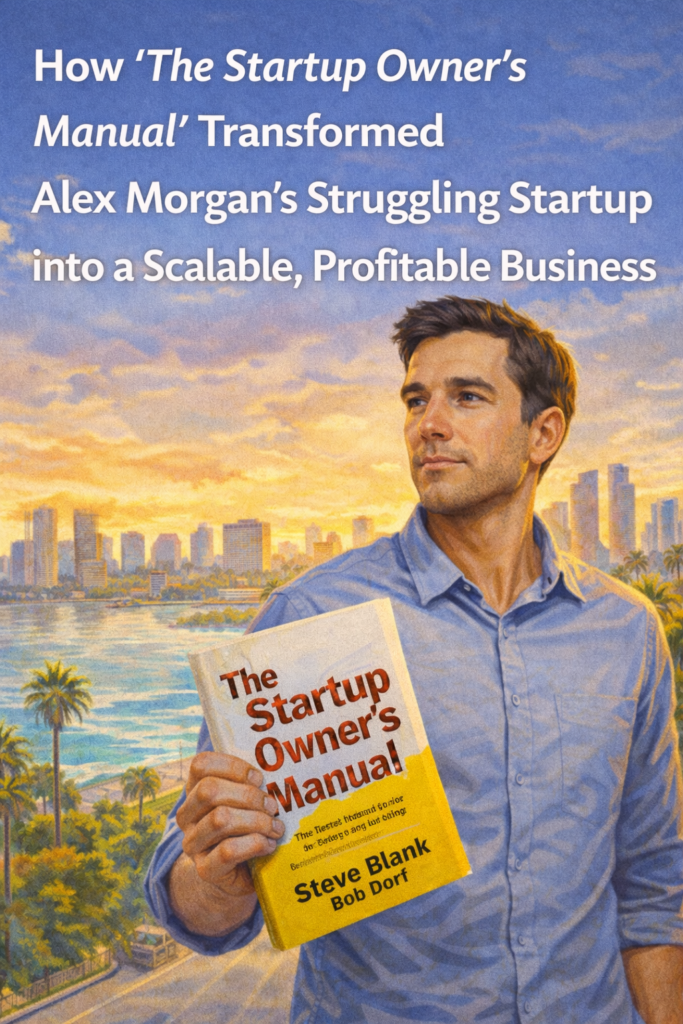
(A Book to Life Story Inspired by Steve Blank’s Customer Development Framework)
The Startup That Looked Perfect—On Paper
Alex Morgan stared at his laptop from a small coffee shop in San Diego, California, watching the waves roll in outside the glass window. The setting was beautiful. His life, on the surface, looked enviable.
But inside, Alex felt stuck.
At 32, he had done everything “right.”
Top-tier university.
A solid product management job at a mid-sized tech firm.
Even a startup idea he had been quietly building on weekends.
And yet—nothing was moving.
His startup idea, a productivity tool for remote teams, looked brilliant in pitch decks. Friends loved it. Mentors said, “This could be big.” Alex had already spent six months designing features, writing specs, and building a near-perfect MVP.
But users weren’t signing up.
The few who did… didn’t stay.
No one was paying.
Every rejection felt personal.
Every unanswered email felt like failure.
Alex wasn’t afraid of hard work.
He was afraid that he might be working on the wrong thing.
That fear would change everything.
The Struggle Before the Breakthrough
Alex’s days followed a painful loop.
Morning: tweak features.
Afternoon: read startup blogs.
Evening: convince himself he was “almost there.”
He blamed marketing. Then pricing. Then UX.
But deep down, a question haunted him:
“What if nobody actually wants this?”
Like many first-time founders, Alex had fallen into a silent trap—assuming instead of knowing.
He had built before listening.
Planned before validating.
Executed before learning.
The emotional toll was heavy:
-
Self-doubt crept in
-
Savings slowly drained
-
Confidence eroded
The dream of entrepreneurship—once exciting—now felt reckless.
The Turning Point: A Book That Changed the Question
One evening, while attending a small startup meetup in La Jolla, Alex struck up a conversation with a seasoned founder. After listening quietly, the founder asked a simple question:
“How many customers have you spoken to?”
Alex hesitated.
“Spoken to?”
“I mean… we did surveys.”
The founder smiled and handed him a book recommendation:
The Startup Owner’s Manual by Steve Blank.
“Read this,” he said.
“Then stop building—and start listening.”
That night, Alex ordered the book.
By chapter three, his stomach sank.
Because the book wasn’t criticizing startups—
It was describing him.
Implementation Phase: Applying Steve Blank’s Framework in Real Life
Mindset Shift #1: A Startup Is Not a Small Company
Steve Blank’s definition hit Alex hard:
“A startup is a temporary organization designed to search for a repeatable and scalable business model.”
Alex realized his biggest mistake.
He had been executing as if his model was known—
When in reality, everything was a hypothesis.
This changed how he saw his role:
-
Not a builder
-
Not a manager
-
But a searcher
Concept #1: There Are No Facts Inside the Building
The book’s first rule felt almost insulting:
“There are no facts inside your building. Get outside.”
So Alex did something uncomfortable.
He stopped coding.
Instead, he emailed 40 remote professionals and asked for 15-minute conversations—not to pitch, but to listen.
The first few calls were awkward.
He caught himself wanting to explain his product.
But slowly, something shifted.
People talked about:
-
Communication breakdowns
-
Burnout
-
Tool overload
-
Frustration—not productivity
And here was the shock:
His product didn’t solve their real problem.
Concept #2: Customer Discovery Before Product Perfection
Steve Blank’s Customer Discovery phase forced Alex to ask:
-
Who is the customer?
-
What problem hurts enough to change behavior?
-
How do they solve it today?
Alex learned that:
-
His assumed target market was wrong
-
His core feature wasn’t important
-
The real pain point was manager visibility, not task tracking
This was painful—but freeing.
For the first time, Alex wasn’t guessing.
Concept #3: Hypotheses, Not Business Plans
Alex threw away his 30-page business plan.
In its place, he used a Business Model Canvas:
-
Customer segments
-
Value propositions
-
Channels
-
Revenue streams
Each box became a test, not a truth.
Instead of asking, “Is my idea good?”
He asked, “What must be true for this to work?”
This changed everything.
Concept #4: MVP as a Learning Tool, Not a Launch Product
Alex rebuilt his MVP—but this time:
-
Fewer features
-
Faster deployment
-
Clear learning goals
He tested one thing only:
👉 Would managers pay to see team workload in real time?
Some said no.
Some ignored him.
But three said yes—and paid.
That was the first money Alex had ever earned from his own product.
Concept #5: Pivoting Is Progress, Not Failure
Steve Blank writes:
“Failure is an integral part of the search.”
Alex finally understood:
-
Pivoting wasn’t quitting
-
It was learning faster
He pivoted:
-
From productivity tool → manager visibility tool
-
From general teams → remote agencies
-
From freemium → paid pilot
Each pivot felt lighter.
Smarter.
Grounded.
The Breakthrough: When Assumptions Became Revenue
The crossover moment came quietly.
Alex launched a paid pilot with five remote agencies.
No big launch.
No press.
Just real users, real problems, real payments.
Within three months:
-
Retention crossed 70%
-
Customers asked for expansions
-
Referrals started coming in
For the first time, Alex wasn’t chasing validation.
Validation was chasing him.
The startup wasn’t a dream anymore.
It was a business.
Life After Change: A Founder With Clarity
A year later, Alex’s life looked different.
Not flashy—but stable.
-
Predictable revenue
-
Clear customer profile
-
Confident decisions
-
Sustainable growth
He quit his job—not out of desperation, but certainty.
His days were now spent:
-
Talking to customers
-
Running experiments
-
Improving outcomes
No guesswork.
No blind optimism.
Just learning.
Reflection: Alex’s Lessons for Every Entrepreneur
Looking back, Alex realized the startup didn’t fail him.
His assumptions did.
Here’s what he learned:
-
Startups are about discovery, not perfection
-
Customers don’t care about your idea—only their problem
-
Talking beats planning
-
Data beats opinions
-
Pivoting early saves years
He now mentors founders—and always asks the same question:
“What did your customers tell you this week?”
Actionable Takeaways from Alex’s Journey
If you’re building a startup, start here:
-
Replace your business plan with hypotheses
-
Talk to customers weekly
-
Test before scaling
-
Measure learning, not vanity metrics
-
Embrace pivots
Call to Action
Inspired by Alex’s journey?
This is just one story in our Book to Life series.
📘 The Startup Owner’s Manual by Steve Blank is not just a book—it’s a field guide for entrepreneurs who want truth over ego, learning over guessing, and businesses that actually survive.
👉 Read the book.
👉 Talk to customers.
👉 Start your own transformation.
Disclaimer
This story is hypothetical and created only to demonstrate how the concepts from The Startup Owner’s Manual by Steve Blank can be applied in real life through a story format. Any resemblance to real individuals or businesses is purely coincidental.