(A Book to Life Story inspired by Never Split the Difference by Chris Voss & Tahl Raz)
A Life of Silent Compromises
Chicago winters have a way of making everything feel heavier.
The cold, the grey skies, the long commute—it all seemed to reflect David Thompson’s inner state as he stood on the crowded L train heading downtown. At 34, David had done everything “right” according to society. A decent education. A stable job in operations at a mid-sized logistics company. A paycheck that paid the bills.
But inside, he felt stuck.
David was good at his job—sometimes too good. He worked late, fixed problems others avoided, and kept clients happy. Yet year after year, his salary barely moved. Promotions went to louder voices. Raises were “not possible right now.”
David never negotiated.
He avoided conflict. He hated uncomfortable conversations. Whenever push came to shove, he compromised.
At work.
In salary discussions.
Even in his personal life.
He believed that meeting halfway was maturity. That keeping peace mattered more than standing firm.
What David didn’t realize was that he wasn’t keeping peace—he was slowly giving away his value.
Turning Point: Discovering Never Split the Difference
One evening, after yet another disappointing performance review, David sat alone in his apartment scrolling through podcasts. A title caught his attention:
“Negotiating As If Your Life Depended On It – Chris Voss”
That phrase stopped him.
Life depended on it?
As he listened, David heard something that challenged everything he believed:
“Compromise is often a bad deal.”
Chris Voss, a former FBI hostage negotiator, spoke about negotiations not as battles of logic—but as emotional conversations.
David bought the book that night:
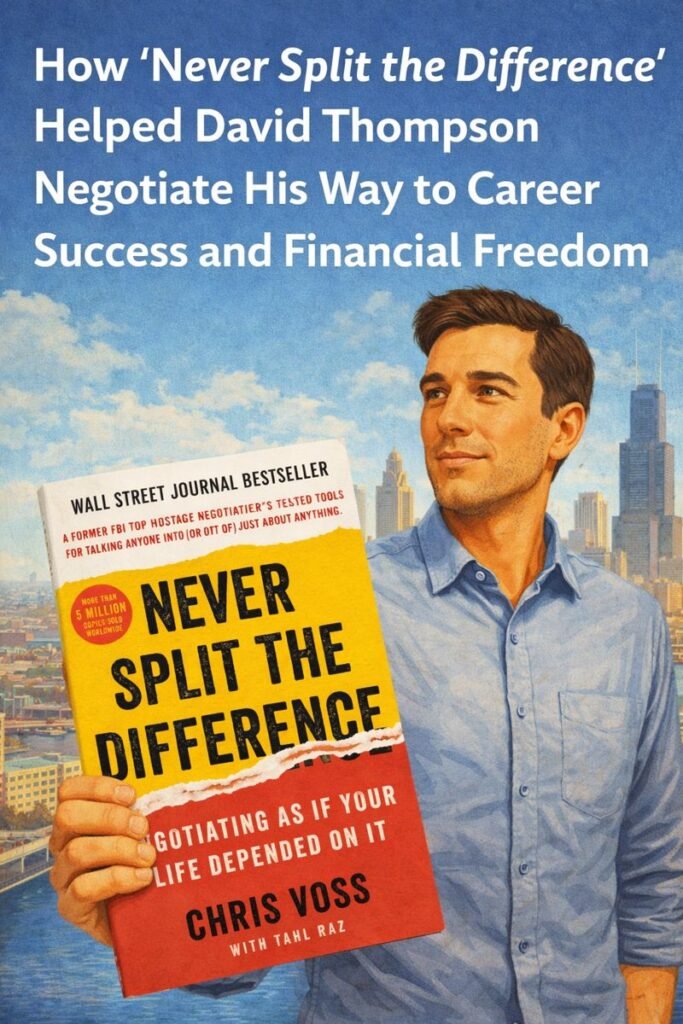
Never Split the Difference by Chris Voss and Tahl Raz
At first, he was skeptical.
“What does an FBI negotiator have to do with my salary or career?” he thought.
But by Chapter 2, David realized something uncomfortable and liberating:
👉 Every important conversation in his life had been a negotiation—and he had been losing quietly.
Implementation Phase: Applying FBI Negotiation Skills to Real Life
David made a decision.
He wouldn’t just read the book.
He would live it.
Concept 1: Tactical Empathy – Understanding Before Being Understood
The first major shift came with tactical empathy.
David learned that empathy wasn’t weakness. It wasn’t agreeing. It was acknowledging emotions without judgment.
Instead of thinking:
-
“They’re unfair.”
-
“They don’t value me.”
He started asking:
-
What pressure are they under?
-
What are they afraid of?
-
What problem are they trying to solve?
At work, David noticed his manager was constantly stressed about budgets and deadlines. Earlier, David would silently resent this.
Now, he labeled it.
In meetings, he calmly said:
“It seems like the team is under a lot of pressure to deliver results with limited resources.”
Something surprising happened.
His manager nodded.
That simple sentence changed the tone of the conversation. David wasn’t pushing—he was understanding.
Concept 2: Mirroring – The Art of Making People Feel Heard
Next, David practiced mirroring—repeating the last few key words someone said, calmly and curiously.
When his manager said:
“We just don’t have room in the budget.”
David responded:
“Not enough room in the budget?”
His manager continued explaining.
David learned a powerful truth:
👉 People love talking to those who listen.
Mirroring:
-
Bought him time
-
Reduced defensiveness
-
Revealed hidden concerns
He stopped interrupting.
He stopped overexplaining.
He started listening.
Concept 3: Labeling Emotions – Defusing Tension Without Arguments
One of the most powerful tools David adopted was labeling.
Instead of reacting emotionally, he named emotions:
-
“It sounds like you’re concerned about risk.”
-
“It seems like you’ve been burned before.”
-
“It looks like this situation is frustrating.”
These labels worked like magic.
During a tense vendor discussion, instead of arguing over pricing, David said:
“It seems like you’re worried about committing resources without certainty.”
The vendor relaxed.
Negotiation shifted from confrontation to collaboration.
Concept 4: “No” Is Not Rejection – It’s Safety
David had always feared “no.”
The book reframed it completely.
Chris Voss taught:
“No” makes people feel safe.”
So David began asking questions that invited “no.”
Instead of:
“Can you approve this raise?”
He asked:
“Would it be unreasonable to revisit my compensation given the results this year?”
His manager said:
“No, that’s not unreasonable.”
That “no” opened the door.
Concept 5: Calibrated Questions – Creating the Illusion of Control
David learned to replace demands with calibrated questions:
-
“How am I supposed to handle this workload without additional support?”
-
“What would make this a win for both of us?”
-
“How can we structure this so it works long-term?”
These questions:
-
Shifted problem-solving to the other person
-
Reduced resistance
-
Made others feel in control
The Breakthrough: The Salary Negotiation That Changed Everything
After months of preparation, David scheduled a formal compensation discussion.
But this time, he didn’t walk in with:
-
Complaints
-
Emotional arguments
-
Ultimatums
He walked in with:
-
Empathy
-
Data
-
Calm confidence
He started with labeling:
“It seems like balancing performance and budgets has been challenging this year.”
Then mirroring.
Then calibrated questions:
“How can my contributions be reflected more accurately in my compensation?”
When numbers came up, David didn’t rush.
He used odd, precise numbers—a technique from the book:
“Based on market data and my role expansion, I was thinking $87,450.”
The specificity made it feel researched, not emotional.
After several rounds, David secured:
-
A significant salary increase
-
Expanded responsibilities
-
A clear growth path
For the first time in his career, he didn’t compromise.
He negotiated.
Life After Change: Confidence, Growth, and Financial Stability
That negotiation changed more than David’s paycheck.
It changed:
-
How he spoke
-
How he listened
-
How he valued himself
David began negotiating:
-
Vendor contracts
-
Project timelines
-
Freelance consulting rates
Within a year:
-
His income increased substantially
-
He built a side consulting practice
-
He felt calm in difficult conversations
He stopped splitting the difference in life.
Reflection: David’s Lessons for Anyone Afraid to Negotiate
Looking back, David realized something profound:
“I wasn’t bad at negotiation. I was just never taught how humans actually work.”
His advice:
-
Don’t argue—listen
-
Don’t convince—understand
-
Don’t rush—slow down
-
Don’t fear “no”
-
Don’t compromise your value
Negotiation, he learned, is not about power.
It’s about connection and clarity.
Call to Action
Inspired by David Thompson’s journey?
This is just one story in our Book to Life series, where powerful books are transformed into real, relatable life journeys.
📘 Read Never Split the Difference by Chris Voss and Tahl Raz
🎯 Practice these skills in your next conversation
🚀 Start negotiating your worth—in career, business, and life
Because the moment you stop splitting the difference,
you start owning your future.
Disclaimer
This story is hypothetical and created for educational and inspirational purposes only. It demonstrates how the concepts from Never Split the Difference by Chris Voss and Tahl Raz can be applied in real life through storytelling