
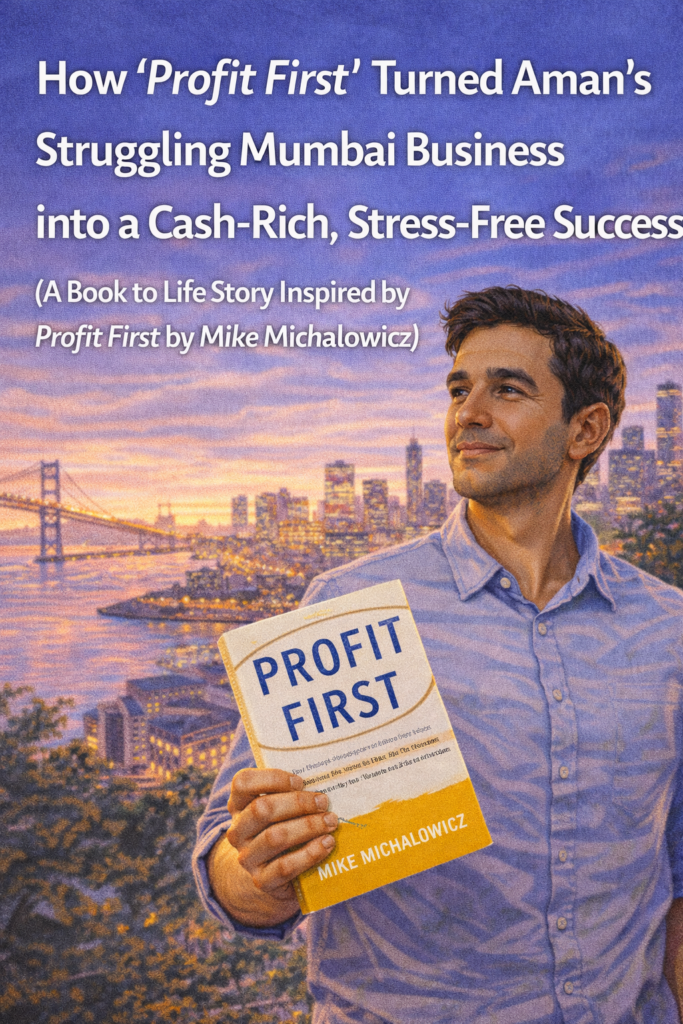
(A Book to Life Story Inspired by Profit First by Mike Michalowicz)
How Profit First by Mike Michalowicz helped Aman from Mumbai escape cash stress, fix money leaks, and build a profitable, peaceful business.
The Illusion of Success
Mumbai never sleeps—and neither did Aman.
At 2:17 a.m., Aman sat alone in his small Andheri office, staring at his laptop screen. The numbers didn’t make sense. His digital services firm had clients. His revenue was growing. People called him “successful.”
Yet his bank account told a different story.
Invoices were pending. GST payments loomed. Salaries were due in five days. His personal savings were gone—again—used to “temporarily” support the business.
Aman rubbed his eyes and whispered the question he had avoided for years:
“How can a business that earns so much always be broke?”
He wasn’t lazy. He wasn’t careless. He worked harder than anyone he knew. But money slipped through his fingers like water.
That night, something inside him cracked—not in despair, but in honesty.
The Problem: Revenue Without Relief
Aman’s story is painfully common among entrepreneurs.
He followed the traditional business formula everyone teaches:
Sales − Expenses = Profit
So Aman focused on:
-
Getting more clients
-
Increasing revenue
-
Expanding services
-
Hiring more people
But profit?
Profit was whatever remained—usually nothing.
Some months looked good on paper. Most months ended with stress. He told himself:
-
“Once revenue crosses ₹50 lakh, things will stabilize.”
-
“Once I hire a finance manager, money issues will go away.”
-
“Once the next big client comes in, I’ll finally relax.”
That “once” never arrived.
Turning Point: A Book That Questioned Everything
One Sunday morning, Aman visited a bookstore at Phoenix Marketcity Mall. He wasn’t searching for business wisdom—just distraction.
A bright yellow book caught his eye.
Profit First – Mike Michalowicz
The subtitle felt like a punch to the chest:
“Transform Your Business from a Cash-Eating Monster to a Money-Making Machine.”
Aman flipped through a few pages and froze at one line:
“Your business is not profitable because profit is an afterthought.”
He bought the book without hesitation.
That night, he read until dawn.
And for the first time, someone explained his problem without blaming him.
The Big Idea That Changed Everything
The book proposed a radical idea:
Flip the formula
Instead of
Sales − Expenses = Profit
Use:
Sales − Profit = Expenses
Profit is not the result.
Profit is the starting point.
Aman felt both excited and terrified.
“What if this actually works?”
“What if I’ve been doing it wrong all along?”
Implementation Phase: Small Steps, Big Resistance
Step 1: Creating Multiple Bank Accounts
The first action felt strangely simple.
Aman opened five separate bank accounts:
-
Income Account
-
Profit Account
-
Owner’s Pay Account
-
Tax Account
-
Operating Expenses (OPEX) Account
Until now, everything flowed into one chaotic account.
Now, money had structure.
Step 2: Starting with Tiny Profit (1%)
Aman didn’t start big.
He allocated:
-
1% to Profit
-
15% to Tax
-
30% to Owner’s Pay
-
The rest to OPEX
He thought:
“1% won’t hurt. But it will test the system.”
The first week felt uncomfortable.
The business suddenly had less money to spend.
And that discomfort revealed something powerful.
Lesson 1: Parkinson’s Law in Action
Mike Michalowicz explains that expenses always rise to match available money.
When Aman reduced available cash:
-
Unnecessary subscriptions stood out
-
Fancy tools lost their importance
-
Costly freelancers were renegotiated
The business didn’t suffer.
It became smarter.
Lesson 2: The Power of Small Plates
Aman remembered the book’s metaphor:
“When you serve food on a smaller plate, you eat less without feeling deprived.”
Smaller operating budgets forced discipline.
Creativity replaced waste.
Facing Resistance: Emotional Money Truths
The hardest part wasn’t math.
It was emotion.
Aman struggled with:
-
Guilt about taking owner’s pay
-
Fear of not having “enough buffer”
-
Anxiety during the first tax allocation
But something strange happened.
For the first time:
-
He paid himself regularly
-
Taxes no longer scared him
-
Financial clarity reduced mental load
Lesson 3: Profit Is a Habit, Not an Event
Aman realized a powerful truth:
Profit doesn’t come from big wins.
It comes from consistent behavior.
Each allocation day became a ritual.
Money stopped being emotional.
It became intentional.
The Breakthrough: The First Profit Distribution
Three months later, Aman reached the book’s milestone:
Quarterly Profit Distribution
He opened his Profit Account.
₹1,86,000.
It wasn’t millions—but it was real.
Money that didn’t belong to clients.
Money that didn’t belong to taxes.
Money that didn’t vanish into expenses.
For the first time in his life:
His business paid him a bonus.
Aman transferred 50% to his personal account.
He didn’t buy gadgets.
He didn’t upgrade his lifestyle.
He slept peacefully.
Life After Change: From Stress to Stability
Within 12 months:
-
Profit allocation increased from 1% to 8%
-
Owner’s pay became predictable
-
Emergency borrowing stopped
-
Decision-making improved
-
Growth became intentional, not desperate
Aman no longer chased every client.
He chose the right clients.
His confidence wasn’t loud—it was grounded.
Lesson 4: Cash Flow Is Oxygen
Revenue is vanity.
Profit is sanity.
Cash flow is oxygen.
Aman learned that businesses don’t die from lack of ideas.
They die from poor cash flow discipline.
Reflection: Aman’s Advice to Entrepreneurs
“I thought I needed more money.
I actually needed better behavior.”
He now tells founders:
-
Start small—1% is enough
-
Don’t wait to be “successful” to take profit
-
Separate money to gain clarity
-
Let structure do the hard work
Key Profit First Concepts Applied in the Story
1. Profit First Formula
Profit before expenses, not after.
2. Multiple Bank Accounts
Remove temptation, increase clarity.
3. Small Plate Principle
Limit spending by design.
4. Quarterly Profit Distribution
Reward discipline and reinforce behavior.
5. Gradual Optimization
Increase profit slowly, sustainably.
What You Can Do Today (Action Plan)
-
Open at least two accounts today: Income + Profit
-
Allocate 1% profit immediately
-
Schedule two allocation days per month
-
Review expenses honestly
-
Read Profit First with action—not theory
10 Takeaways from Profit First
-
Profit is a habit
-
Revenue doesn’t equal success
-
Small changes beat big plans
-
Separate accounts change behavior
-
Cash flow clarity reduces stress
-
Constraints create innovation
-
Profit must be protected
-
Taxes should never surprise you
-
Owner pay is not selfish
-
Simplicity scales better than complexity
Call to Action
Inspired by Aman’s journey?
This is just one story in our Book to Life series.
Read Profit First by Mike Michalowicz, apply just one small change, and take the first step toward your own financial transformation.
Because your business should serve your life, not consume it.
Disclaimer
This story is hypothetical and created solely to demonstrate how the concepts from Profit First by Mike Michalowicz can be applied in real life through a storytelling format. It is intended for educational and inspirational purposes only.