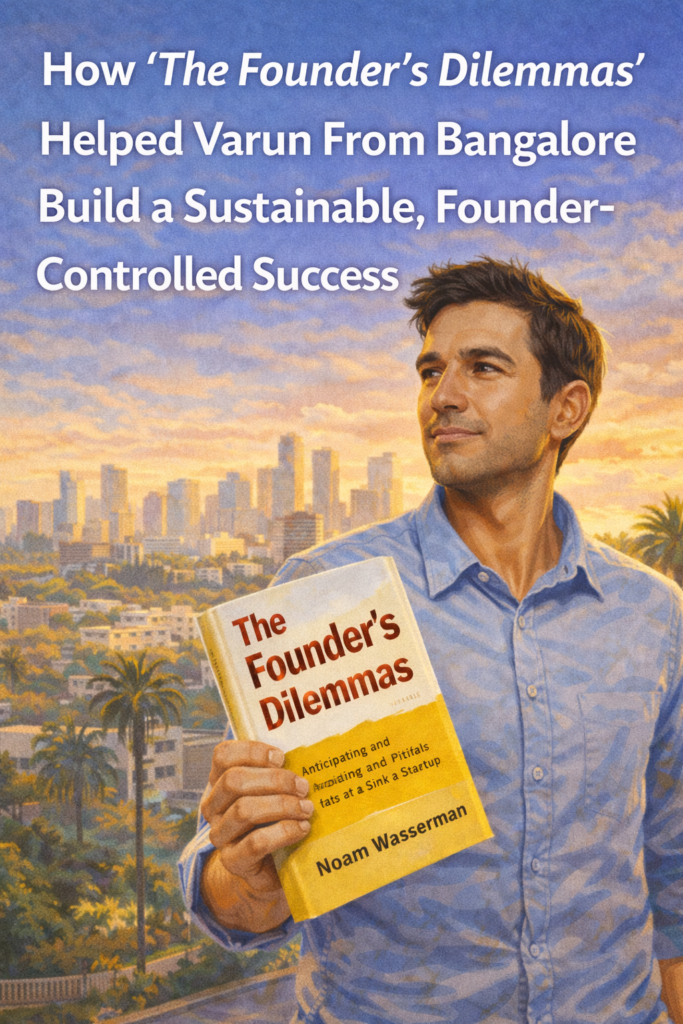
Inspired by The Founder’s Dilemmas by Noam Wasserman
One Founder, One Decision, One Life-Changing Trade-Off
At 11:47 p.m. in a co-living apartment in Koramangala, Bangalore, Varun stared at an Excel sheet glowing on his laptop.
Three columns.
-
Equity Split
-
Investor Terms
-
CEO Role
His WhatsApp buzzed nonstop—co-founders arguing, a potential angel investor pushing for faster scaling, and his parents asking the same question they had asked for six months:
“Is this startup really worth leaving your job?”
Varun was 29.
A senior product manager at a mid-size SaaS company.
Good salary. Stable career. Respectable future.
And yet, he felt trapped.
That night, Varun didn’t know it yet—but he was standing at the exact crossroads described in The Founder’s Dilemmas by Noam Wasserman.
A crossroads between:
-
Wealth vs Control
-
Speed vs Sustainability
-
Emotion vs Strategy
Before the Book: Ambition Without Awareness
Varun’s startup idea was solid.
A B2B SaaS platform for MSMEs to manage compliance, invoicing, and cash flow—built specifically for Indian businesses tired of juggling Excel, CA calls, and GST portals.
The early signs were promising:
-
15 pilot customers
-
One angel investor interested
-
Two co-founders from college onboard
But beneath the surface, cracks were forming.
The Hidden Problems
-
Equity was split equally just to “keep things simple”
-
One co-founder wanted VC funding immediately
-
Another wanted to remain a side project
-
No clarity on who would be CEO long term
Varun felt uneasy but ignored the discomfort.
“We’ll figure it out later,” they kept saying.
That, Noam Wasserman would argue, is exactly how founders lose control before they even realize it’s happening.
The Turning Point: Discovering The Founder’s Dilemmas
One Sunday afternoon, while browsing startup podcasts, Varun heard a guest mention:
“Most startup failures aren’t product failures. They’re founder failures.”
The guest referenced The Founder’s Dilemmas by Noam Wasserman, a Harvard Business School professor who studied thousands of founders.
Curious—and slightly uncomfortable—Varun ordered the book.
By Chapter 3, he felt personally attacked.
By Chapter 6, he felt exposed.
By the end, he felt empowered.
This wasn’t another “hustle harder” book.
This was a mirror.
Key Insight #1: Solo Founder vs Co-Founders – The Bangalore Reality
One of the first dilemmas Wasserman explains is:
Should you be a solo founder or have co-founders?
Varun had co-founders—but for the wrong reasons.
They were:
-
Friends from engineering college
-
Emotionally close
-
Convenient choices
But the book made one thing painfully clear:
Friendship is not a startup qualification.
What Varun Learned
-
Co-founders should fill skill gaps, not emotional gaps
-
Relationship risk increases when business pressure increases
-
If the startup fails, personal relationships often fail too
After honest conversations, Varun made a tough decision:
-
One co-founder exited with a fair settlement
-
Another moved to an advisory role
For the first time, the team structure felt aligned, not awkward.
Key Insight #2: Wealth vs Control – The Decision That Changes Everything
This was the chapter that changed Varun’s life.
Wasserman presents a brutal truth:
If you raise aggressive venture capital early, you maximize valuation—but sacrifice control.
The Data That Shocked Varun
-
By Series A, most founders lose board control
-
By Year 3, 50% of founders are no longer CEOs
-
Entrepreneurs often earn less than salaried professionals over 10 years
Varun realized something uncomfortable:
He didn’t want to be rich on paper while losing:
-
Decision-making power
-
Vision
-
Mental peace
Varun’s Choice
He chose:
-
Bootstrapping
-
Revenue-led growth
-
Control over speed
Not because VC is bad—but because it didn’t match his life goals.
Key Insight #3: The R-System – Relationships, Roles, Rewards
Wasserman’s R-System became Varun’s operating framework.
1. Relationships
Varun stopped assuming alignment and started documenting expectations.
2. Roles
-
Varun: CEO & Product
-
CTO: Engineering & Architecture
-
Advisors: Strategy only
No overlap. No ambiguity.
3. Rewards
-
Equity tied to vesting
-
Clear performance milestones
-
No “equal split for peace”
Conflict reduced. Focus increased.
Implementation Phase: Applying the Book Step by Step
Varun didn’t just read the book.
He executed it.
Step 1: Redefined Success
Success wasn’t unicorn valuation.
It was:
-
Profitability
-
Freedom
-
Long-term sustainability
Step 2: Slowed Down Fundraising
Instead of pitching 50 VCs, Varun focused on:
-
Paying customers
-
Reducing burn
-
Improving retention
Step 3: Built a Control-Friendly Board
-
No aggressive investors
-
One independent advisor
-
Founder majority voting power
The Breakthrough: When the Trade-Off Paid Off
Eighteen months later, something remarkable happened.
The startup crossed:
-
₹1.2 crore ARR
-
95% customer retention
-
Zero external VC funding
An acquisition offer came—from a large fintech firm.
This time, Varun negotiated from strength.
He didn’t have to accept.
He chose a strategic partnership instead.
That moment was his crossover point.
The moment he realized:
Choosing control earlier gave him leverage later.
Life After the Transformation
Today, Varun:
-
Runs a profitable SaaS business
-
Works 8–9 focused hours instead of 16 chaotic ones
-
Mentors first-time founders in Bangalore
-
Speaks openly about founder psychology—not just growth hacks
He didn’t become a media-famous founder.
He became a free one.
Reflection: Varun’s Advice to Future Founders
“Don’t ask how big your startup can become.
Ask what kind of life you want while building it.”
He learned that:
-
Not all money is good money
-
Control is underrated
-
Clarity beats speed
-
Conscious trade-offs beat blind ambition
Actionable Lessons from The Founder’s Dilemmas
3 Questions Every Founder Must Answer Early
-
Do I want control or maximum valuation?
-
Are my co-founders chosen for skills or comfort?
-
Am I building for exit or endurance?
Call to Action
Inspired by Varun’s journey?
This is just one story in our Book to Life series.
📘 Read The Founder’s Dilemmas by Noam Wasserman
✍️ Reflect on your own founder choices
🚀 Build a business that serves your life, not consumes it
Because the biggest startup risk isn’t failure—
it’s succeeding in a life you didn’t want.
SEO Meta Description (~150 characters)
How Varun from Bangalore transformed his startup journey by applying lessons from The Founder’s Dilemmas by Noam Wasserman.
Blog Excerpt (50–60 words)
Varun, a startup founder from Bangalore, was building fast—but losing control. This Book to Life story shows how applying lessons from The Founder’s Dilemmas helped him choose clarity, control, and sustainable success over chaos and burnout.
SEO-Friendly Permalink
/founders-dilemmas-varun-bangalore-startup-journey
SEO Keywords & Tags
The Founder’s Dilemmas, Noam Wasserman, startup founder journey, Bangalore startup story, entrepreneur mindset, wealth vs control, cofounder mistakes, startup decision making, personal growth entrepreneurship
Disclaimer
This story is hypothetical and created purely to demonstrate how concepts from The Founder’s Dilemmas by Noam Wasserman can be applied in real life through storytelling.