A Dream That Slowly Started Dying
San Francisco never sleeps—but that night, Ethan Miller did not either.
At 2:17 a.m., the glow of his laptop filled his small apartment in the SoMa district. Outside, fog rolled over the Bay Bridge like a slow-moving warning. Inside, Ethan stared at declining revenue charts from the startup he had spent six years building.
Once a promising SaaS platform for enterprise data security, his company was now being crushed by faster, cheaper cloud-native tools built by younger startups.
Ethan was doing everything “right.”
He followed customer feedback.
He improved existing features.
He optimized enterprise sales.
He protected high-paying legacy customers.
And yet—something was going terribly, silently wrong.
“We’re improving… but we’re also becoming irrelevant,” he whispered.
The scariest part? He didn’t know how to fix it.
Six months earlier, three of his biggest clients had left for a new AI-based competitor that offered a simpler product at one-third the price. Ethan dismissed it at first.
“They’re not our real customers,” he had told his board.
That night, staring at the numbers, he finally admitted the truth:
“What if the real danger isn’t competition… but disruption?”
The Turning Point – A Book That Felt Like a Mirror
Two weeks later, while attending a low-attendance startup networking event in Palo Alto, Ethan met a retired venture capitalist named Richard.
They spoke about failing startups, missed innovations, and ego.
Before leaving, Richard handed Ethan a book and said:
“This book won’t help you grow… until it helps you unlearn.”
The title hit Ethan like lightning:
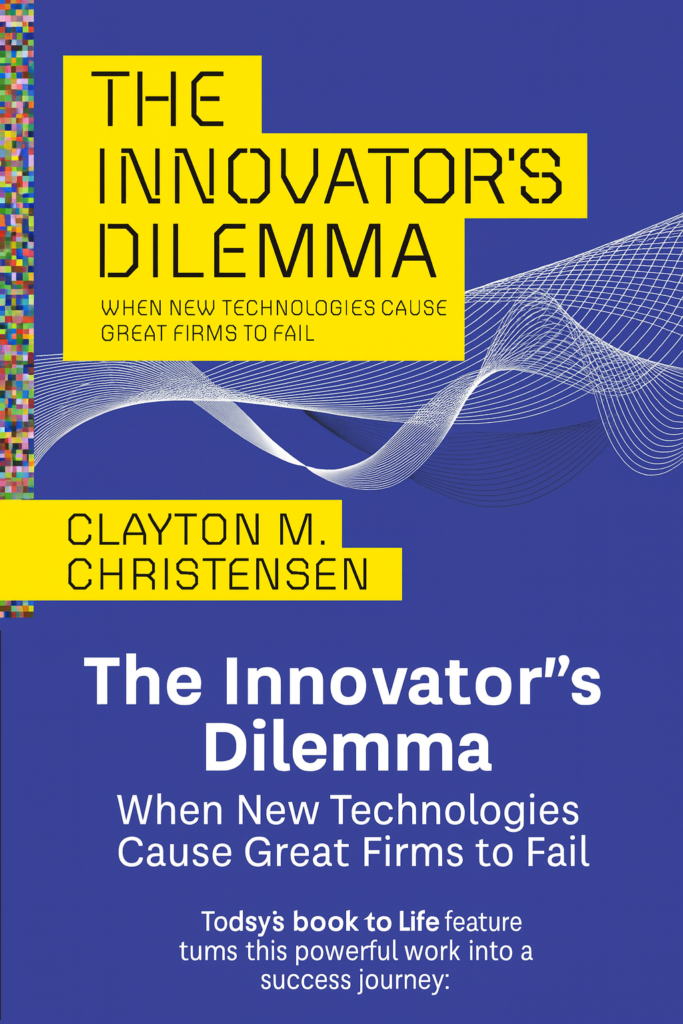
The Innovator’s Dilemma – Clayton M. Christensen
That night, Ethan began reading.
By Page 30, his hands were trembling.
By Page 120, he was uncomfortable.
By Page 200, he was exposed.
The book explained something terrifying:
“Great companies fail not because they are badly managed—but because they are too good at listening to their best customers.”
That sentence pierced through him.
Ethan finally understood why doing everything right was still leading him in the wrong direction.
This wasn’t a business book.
It was an X-ray.
Implementation Phase – Applying Disruptive Innovation to Real Life
Ethan decided to stop reading like a student—and start reading like a survivor.
Below are the 5 transformational principles from The Innovator’s Dilemma that Ethan used to rebuild his life and business.
1. Sustaining Innovation vs Disruptive Innovation
Ethan realized his company was stuck in sustaining innovation:
-
Improving features for existing customers
-
Adding performance upgrades
-
Increasing pricing tiers
-
Serving only enterprise clients
Meanwhile, competitors were using disruptive innovation:
-
Cheaper
-
Simpler
-
Cloud-native
-
Targeting small businesses first
At first, disruptive products always look inferior.
But over time, they become “good enough”—and then dominant.
🎯 Ethan’s Mindset Shift:
Instead of improving for elite customers, he began designing for beginners.
He launched a new low-cost, AI-driven security tool for freelancers and small startups—a market he had always ignored before.
2. Why Big Companies Don’t Invest in Disruption
Christensen explained why established firms fail at disruption:
-
Disruptive products start with low margins
-
They have small, uncertain markets
-
Legacy customers don’t want them
-
They don’t fit traditional financial forecasts
Ethan saw his own board meetings reflected here.
Every time he proposed a risky new product, the answer was always:
“The ROI isn’t clear.”
So Ethan made a bold move.
🎯 Ethan’s Strategic Decision:
He created a separate subsidiary—a lean, independent startup with:
-
A new team
-
A new cost structure
-
A new business model
-
Full freedom to fail fast
This protected disruption from corporate pressure.
3. Small Markets Are the Playground of Giants-in-the-Making
Big companies ignore small markets.
Startups survive in them.
Ethan chose a niche that no enterprise company cared about:
➡️ Remote cybersecurity for solo founders & digital nomads
This market was:
-
Small
-
Cash-light
-
Growing rapidly
-
Completely underserved
🎯 Instead of chasing unicorn valuations, Ethan chased relevance.
Within 7 months:
-
1,300 users onboarded organically
-
87% monthly retention
-
No paid advertising
-
100% referrals
4. Plan to Fail Early and Cheaply
In his old company, failure was punished.
In his new venture, failure became data.
Ethan used:
-
MVP testing
-
Rapid iteration
-
Weekly user interviews
-
Feature experiments
Three early features failed completely.
Instead of mourning them, he measured them.
🎯 Ethan’s Breakthrough Insight:
Failure stopped being emotional—
It became informational.
5. Value Networks Decide What Survives
Christensen explained that every business operates inside a value network—the ecosystem that decides:
-
Which customers matter
-
Which margins are acceptable
-
Which innovations are “allowed”
Ethan left the enterprise value network completely.
He built inside:
-
Creator economy
-
Freelance developers
-
Remote startup founders
-
Indie SaaS builders
A new ecosystem.
A new economy.
A new future.
The Breakthrough – The Day Everything Shifted
Fourteen months after launching his disruptive product, Ethan received an unexpected email:
Subject: “Strategic Acquisition Interest – Urgent”
A global cybersecurity firm had noticed his startup’s explosive organic adoption among independent professionals.
What shocked Ethan wasn’t the offer.
It was the reason:
“We don’t understand this market—but you own it.”
That sentence changed everything.
Within 90 days:
-
Ethan exited with a multi-million-dollar acquisition
-
Retained full autonomy as product head
-
Shifted from “feature improver” to market creator
For the first time in his life—
He was no longer competing.
He had created his own ocean.
Life After Transformation – From Fear to Freedom
Three years later…
Ethan’s mornings look very different.
No panic emails.
No boardroom pressure.
No feature wars.
Instead:
-
Angel investing in deep-tech startups
-
Mentoring founders on disruption
-
Speaking at global innovation summits
-
Publishing case studies on disruptive strategy
Most importantly—
He now builds businesses for the future, not for comfort.
He no longer asks:
❓ “What do my best customers want today?”
Instead he asks:
✅ “What will tomorrow’s non-customers need first?”
Reflection – Ethan’s 7-Life Lessons from The Innovator’s Dilemma
“This book didn’t teach me how to compete.
It taught me how to escape competition.”
Here’s what Ethan learned:
-
Being excellent at today’s game can destroy tomorrow’s survival
-
Disruption always feels unimportant—until it becomes unstoppable
-
Small markets hold giant futures
-
New ideas need new organizations
-
You can’t forecast innovation, only experiment with it
-
Legacy customers don’t build the future—new users do
-
Comfort is more dangerous than failure
Call to Action – Your Turn to Disrupt
Inspired by Ethan’s journey?
This is just one story from our powerful Book to Life Series.
📘 Pick up The Innovator’s Dilemma by Clayton M. Christensen today
and take the first bold step toward building your own disruptive future.
If you are:
-
Stuck in career stagnation
-
Running a slow-growing business
-
Scared to pivot
-
Afraid of starting small
➡️ This book—and this story—are your wake-up call.
📢 DISCLAIMER
This story is hypothetical and created purely to demonstrate how book concepts can be applied in real life through storytelling. Any resemblance to real persons is coincidental.
For business, investing, and personal finance guidance, connect with us:
✅ 10 Quick Takeaways from The Innovator’s Dilemma
-
Disruption starts in small ignored markets
-
Great companies fail by doing everything “right”
-
Low-end products become high-end threats
-
Innovation cannot survive inside rigid systems
-
Customers shape resources—not vision
-
Mountains of data can still hide future risk
-
Start small to think big
-
Spin-offs protect radical ideas
-
Fail fast, learn faster
-
Disrupt yourself before someone else does