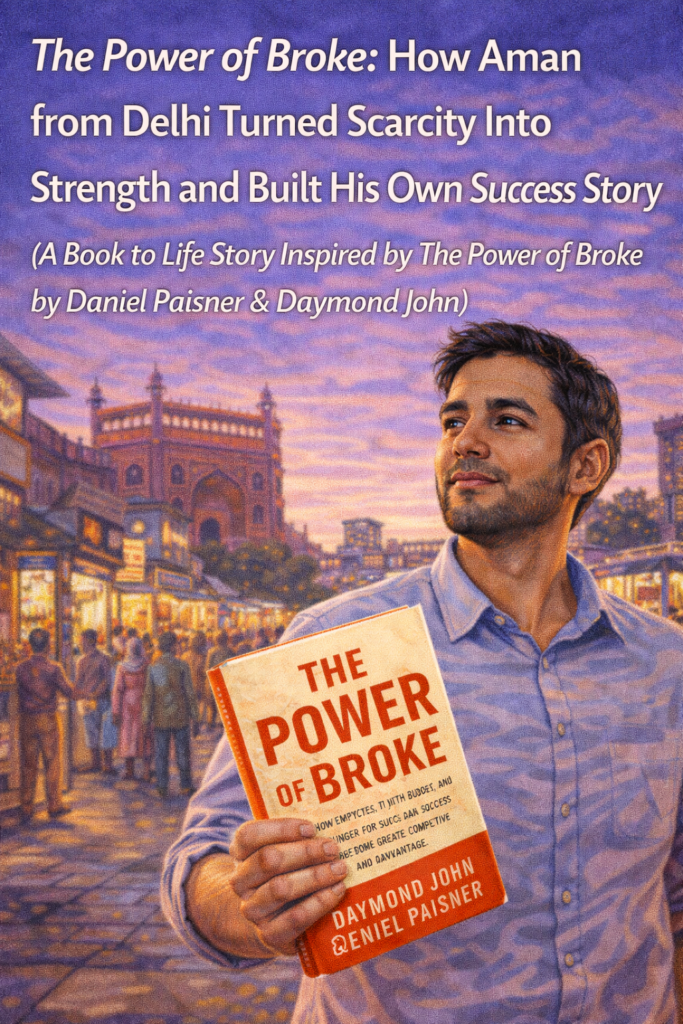
(A Book to Life Story Inspired by The Power of Broke by Daniel Paisner & Daymond John)
When Having Nothing Becomes Everything
What if the very thing you fear most—being broke—is actually your biggest advantage?
Aman didn’t know that yet.
At 27, standing on the terrace of a cramped rented flat in West Delhi, staring at a skyline full of glowing offices he didn’t belong to, Aman felt defeated. His phone buzzed with another bank notification: low balance alert. His startup idea had failed. His job felt suffocating. His confidence was crumbling.
That night, Aman believed he was stuck.
A year later, he would look back at that same moment and call it the turning point of his life.
This is the story of how The Power of Broke changed Aman’s mindset, rebuilt his confidence, and helped him create business success and financial freedom—starting with nothing but hunger.
Life Before the Book — Struggling, Stuck, and Silent
Aman was not lazy. He was not careless. He was not unintelligent.
He was afraid.
Raised in a middle-class Delhi household, Aman did everything “right.” Good marks. Engineering degree. Decent corporate job. But somewhere between deadlines and EMIs, he felt his life shrinking.
He had ideas—plenty of them:
-
A local food brand
-
An online coaching concept
-
A service business for small retailers
But every idea died the same way:
“I don’t have enough money.”
He watched Instagram entrepreneurs flaunt offices, funding rounds, and luxury cars. Meanwhile, Aman calculated how many days his savings would last if he quit his job.
Fear became his constant companion.
Turning Point: Discovering The Power of Broke
One weekend, while visiting a small bookstore near Connaught Place, Aman noticed a bold title:
The Power of Broke
The subtitle caught him off guard:
“How Empty Pockets, a Tight Budget, and a Hunger for Success Can Become Your Greatest Competitive Advantage.”
That night, he read the book in one sitting.
And something shifted.
Daymond John’s story—starting FUBU from his mother’s house, sewing hats with no money, no connections, no guarantees—felt uncomfortably familiar.
But this time, Aman didn’t feel small.
He felt seen.
The Core Realization: Being Broke Is Not a Weakness
The book shattered one dangerous belief Aman carried for years:
“I need money to start.”
Daymond John taught him the opposite:
You start to get money because you start.
Being broke wasn’t a disadvantage—it was a filter:
-
It forced clarity
-
It demanded discipline
-
It required creativity
-
It eliminated ego
Aman realized that money often hides bad ideas, while scarcity exposes truth.
Implementation Phase: Applying The Power of Broke in Real Life
Aman didn’t quit his job overnight. Instead, he applied the book’s principles step by step.
Principle 1: Set a Clear Goal (Not a Dream, a Direction)
From the book, Aman learned:
A goal gives hunger a direction.
He stopped saying:
-
“I want to be rich”
-
“I want a startup”
Instead, he defined:
-
A profitable service business
-
₹1 lakh monthly income
-
No external funding
-
Full control
This clarity changed everything.
Principle 2: Homework Beats Capital
Daymond emphasized that broke entrepreneurs must replace money with research.
Aman spent weeks:
-
Talking to small Delhi shop owners
-
Understanding their daily pain points
-
Observing how they marketed (or didn’t)
He noticed a pattern:
Local retailers struggled with basic digital presence—Google listings, WhatsApp catalogs, simple promotions.
No fancy tech. Just neglected basics.
Principle 3: Start Small, Start Scrappy
Instead of building an app or website, Aman did something radical:
He offered manual digital setup services:
-
Google Business Profile
-
WhatsApp catalog
-
Simple Instagram pages
No ads. No office. No team.
Just:
-
A phone
-
Free tools
-
Relentless hustle
This was The Power of Broke in action.
Principle 4: Sell Before You Scale
Another key lesson:
Sales validate ideas. Funding does not.
Aman went door to door after work.
-
He pitched.
-
He listened.
-
He refined.
His first client paid ₹3,000.
That money didn’t make him rich—but it made him real.
Principle 5: Keep Swimming (Relentless Persistence)
There were rejections.
There were awkward pitches.
There were days he questioned everything.
But the book echoed in his mind:
Keep swimming. Don’t stop. Momentum beats perfection.
Within 3 months:
-
10 clients
-
₹30,000 side income
-
Growing confidence
The Breakthrough: The Day Everything Changed
One evening, a client referred Aman to three more shop owners.
That single referral led to:
-
₹25,000 in new work
-
Repeat business
-
Monthly retainers
Aman realized something powerful:
He didn’t need money to grow. He needed trust.
That month, his side income crossed his salary.
Two months later, he resigned.
Not impulsively—but confidently.
Life After Change: A New Identity, Not Just Income
Today, Aman runs a lean digital services business:
-
No investors
-
No loans
-
No pressure to scale blindly
He works with:
-
Local brands
-
Family-owned businesses
-
Small entrepreneurs
His income is stable.
His stress is lower.
His confidence is unshakeable.
Most importantly, he knows:
Even if everything disappears tomorrow, he can rebuild.
That is the true power of broke.
Reflection: What Aman Learned from The Power of Broke
Aman often says:
-
Money is fuel, not the engine
-
Scarcity sharpens focus
-
Discipline beats funding
-
Hustle builds resilience
-
Control is underrated
-
Starting small is starting smart
Lessons from the Book Applied to Life
3–5 Major Concepts Aman Used
-
Scarcity breeds creativity
-
Homework beats capital
-
Start small and validate
-
Sales before scale
-
Relentless persistence
These ideas didn’t just build a business—they rebuilt Aman’s identity.
Call to Action
Inspired by Aman’s journey?
This is just one story in our Book to Life series. Read The Power of Broke by Daniel Paisner and Daymond John, apply one lesson today, and take the first step toward your own transformation.
Disclaimer
This story is hypothetical and created solely to demonstrate how the concepts from The Power of Broke by Daniel Paisner and Daymond John can be applied in real life through a storytelling format.